
How to Build a Family Financial Plan (Complete 2026 Guide)
Step-by-step framework for building a complete family financial plan in one weekend.
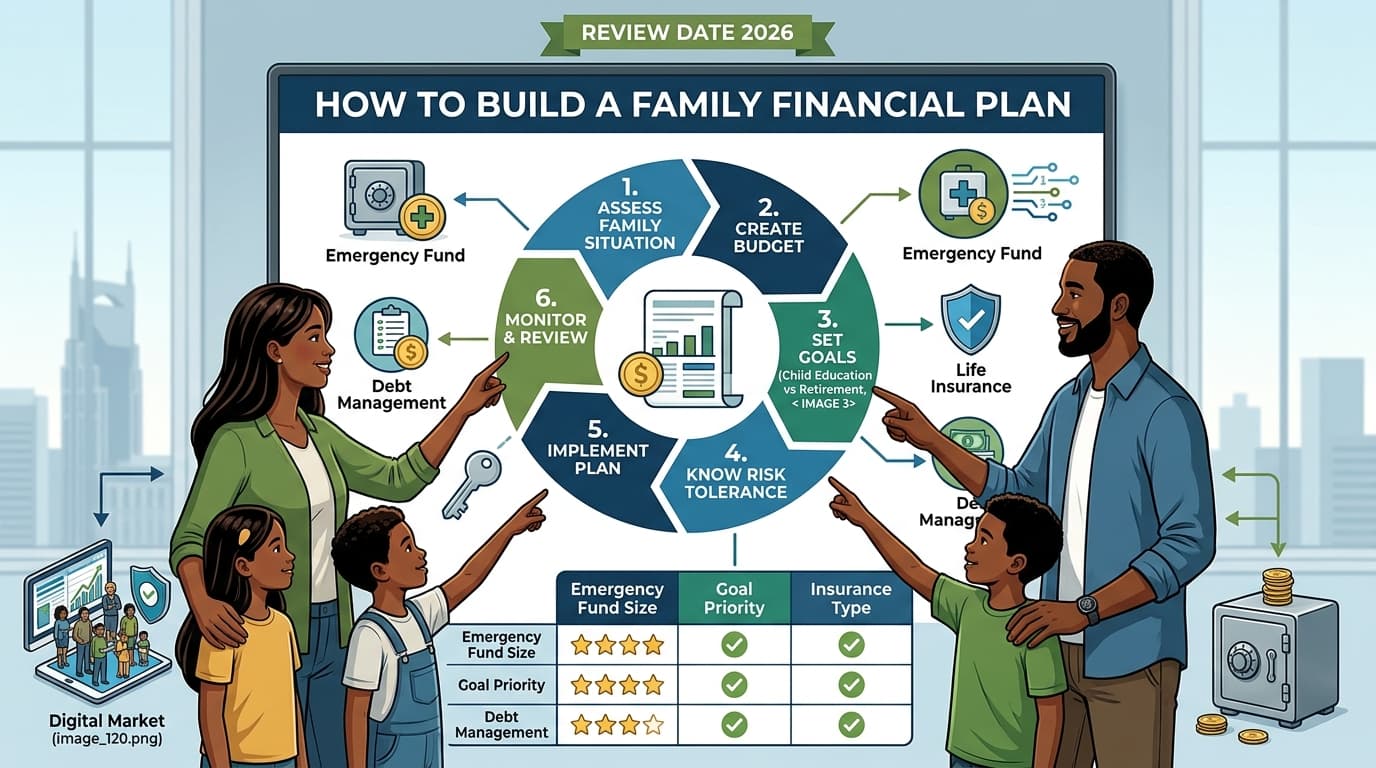
The Short Answer
Build a family financial plan in one weekend by listing all income and expenses, setting 3 specific goals, establishing a 3-month emergency fund target, automating savings, and scheduling quarterly family money reviews.
How to Build a Family Financial Plan (Complete 2026 Guide)
By DadAlt Investments | Category: Personal Finance | Last Updated: March 2026
Most families don't have a written financial plan — not because the task is beyond them, but because nobody ever showed them where to start. The difference between a budget and a financial plan is the difference between managing this month and building the next thirty years: a budget tells you where your money went; a plan tells your money where to go, from today through retirement, college, and the legacy you leave behind. Building a complete family financial plan takes roughly 4–6 focused hours — the equivalent of one Saturday morning — and those hours pay dividends in clarity, reduced financial anxiety, and compounding wealth for decades. This guide walks through every step: calculating your true starting point (net worth), defining goals, building a household budget, prioritizing investments in the correct order, protecting your family with the right insurance, opening a 529 college savings account, creating basic estate documents, and maintaining the whole system with a 15-minute weekly habit. You don't need an MBA, a financial advisor, or a large income to do this. You need a framework — and here it is.
Why Most Families Don't Have a Plan — and Why That's Completely Fixable
The Real Barrier Is Time, Not Intelligence or Income
The families who lack a financial plan are not financially ignorant. They are busy. Between work, kids, household management, and life, the idea of sitting down to build a multi-decade financial strategy feels like a luxury that can wait until things calm down. Things do not calm down. Waiting to have "more time" for financial planning is one of the most expensive habits a family can have — because every month without a plan is a month where money defaults to whatever pattern it has always followed, rather than flowing intentionally toward specific goals.
The good news: the barrier is entirely conquerable. A financial plan is not a 50-page document written by a CFP. It is a set of written decisions: what your family's goals are, in what order you'll pursue them, what you'll do to protect against the unexpected, and how you'll check progress regularly. It can live in a Google Doc, a spreadsheet, or a notes app. What matters is that it exists and gets reviewed.
Budget vs. Plan: A Critical Distinction
A budget manages month-to-month cash flow — income, expenses, and whether you're overspending in any category. That is valuable and necessary. But a budget, by itself, answers only one question: where did the money go?
A financial plan answers a different and more important set of questions:
- Where will we be financially in 5, 10, and 20 years?
- Do we have enough life insurance if something happens to me or my partner?
- Are we on track for retirement, or are we falling behind?
- Do we have a will that protects our kids?
- Is our college savings strategy right for our family?
Families who only budget are managing tactically. Families with a financial plan are building strategically — and the difference in outcomes, compounded over decades, is transformational.
Step 1: Calculate Your Starting Point — Net Worth
You cannot build a plan without knowing where you are today. Net worth is the single most important number in your family's financial life: the sum of everything you own minus everything you owe.
What to Include
Assets (what you own):
- Home equity (current market value minus remaining mortgage balance)
- All retirement accounts: 401(k), 403(b), IRA, Roth IRA, SEP-IRA
- Taxable open a brokerage accounts
- High-yield savings accounts and cash
- HSA (Health Savings Account) balance
- Vehicles (current market value, not what you paid)
- Business equity (if applicable, at a conservative estimate)
Liabilities (what you owe):
- Mortgage balance outstanding
- Student loan balances
- Car loan balances
- Credit card balances (all cards)
- Personal loans, medical debt, any other outstanding obligations
Net Worth = Total Assets − Total Liabilities
Why This Matters More Than Income
Income tells you how fast money flows in. Net worth tells you how much has accumulated — and whether your financial decisions over the last decade have been working. Two families with identical incomes can have radically different net worths depending on spending patterns, debt management, and investment behavior. Net worth is the scorecard that actually measures financial progress.1
Fidelity, Vanguard, and Schwab Investments describes it this way: "It all really starts with understanding your assets and liabilities so you know what your total net worth is. This allows someone to understand the value of their cash positions, taxable investments and retirement assets, as well as real estate, life insurance surrender value, and any business interests."1
Tools to Calculate and Track Net Worth
- Empower (formerly Personal Capital): Free. Connects all accounts — bank, brokerage, 401(k), mortgage, credit cards — in one real-time dashboard. The easiest way to calculate net worth automatically.
- Monarch Money: $14.99/month. Combines net worth tracking, budgeting, and investment monitoring in one platform. Best for couples who want a shared view.
- Simple spreadsheet: Google Sheets or Excel; free; fully private. List every account and its current balance quarterly. Less automated but total privacy — no account linking required.
Related: Best Tools for Tracking Net Worth — our full comparison of Empower, Monarch, YNAB, and spreadsheet approaches.
How often to update: Quarterly is ideal. Once per year at minimum. Do not obsess over daily or weekly fluctuations driven by market movements — focus on the long-term trend over 12–24 months.
Step 2: Define Your Family's Financial Goals
A financial plan without specific goals is just a collection of good intentions. Every goal in a family financial plan needs three things: a description, a specific dollar amount, and a target date.
Short-Term Goals (1–3 Years)
Short-term goals are the foundation. Without these, longer-term goals are structurally unstable:
- Full emergency fund versus investing: 3–6 months of essential expenses in a high-yield savings account. If you don't have this, it is Goal #1 above everything else.
- Pay off high-interest debt: Any debt above 7% interest is a guaranteed return equal to the interest rate when paid off. This beats most investment returns.
- Replace a deteriorating vehicle: A planned purchase is funded in advance; an emergency replacement is a financial crisis.
- Other near-term one-time expenses: Home repair, medical procedure, family travel
Medium-Term Goals (3–10 Years)
- Home purchase — if you rent and plan to buy, define the target down payment and timeline
- Home renovation or addition — quantify the project and timeline
- Start college savings — every year you wait is a year of tax-free compounding lost
- Pay off non-mortgage debt — student loans, auto loans
- Major life event funding — a child's wedding, a sabbatical, a career transition
Long-Term Goals (10+ Years)
- Retirement target date — pick a year and work backward. What annual income do you need? What multiple of salary do you need saved by then?
- Mortgage payoff — on your current payment schedule, when does the mortgage end? Is that acceptable, or do you want to accelerate it?
- Financial independence — the point at which investment income covers your living expenses regardless of employment
The Goal-Setting Rule: Every Goal Gets a Number and a Date
Vague goals do not produce action. "Save more for retirement" is not a goal. "Reach $500,000 in combined retirement accounts by age 50" is a goal — it has a number, a timeline, and can be converted into a monthly contribution target. Write every goal in this format. The specificity forces you to face whether your current behavior will actually get you there.
Step 3: Build Your Household Budget
Once you know your starting point (net worth) and your destination (goals), the budget is the engine that moves you from one to the other.
Income: Start With Take-Home Pay
Add up all take-home (after-tax) income for all earners in the household. Include:
- Primary employment income for all earning partners
- Side income, freelance income, rental income
- Any regular government payments (Social Security disability, etc.)
This is your total monthly fuel. Every dollar of this income should have a job.
Expenses: Fixed and Variable
Fixed expenses are obligations that repeat at a set amount each month:
- Mortgage or rent
- Car payments
- Insurance premiums (life, auto, home, health)
- Subscription services
- Minimum debt payments
Variable expenses change month to month:
- Groceries
- Gas and transportation
- Dining and entertainment
- Clothing
- Household supplies
- Kids' activities and sports
Review your last 3 months of bank and credit card statements to categorize your actual variable spending — not what you think you spend. Most families discover 2–4 categories where actual spending significantly exceeds their mental estimate.
Pay Yourself First: Investments Before Discretionary Spending
The most powerful structural change in any budget system: treat savings and investments as fixed expenses that come out of take-home pay before you make any discretionary spending decisions.
The order:
- Retirement contributions (401k/IRA) — first, automatically
- Emergency fund contribution (until fully funded)
- College savings (529)
- All other fixed expenses
- Variable and discretionary spending with what remains
This is the opposite of how most people budget ("save what's left over"). "What's left over" is almost always near zero. Paying yourself first — automating retirement and savings contributions on payday — ensures that your most important financial priorities are funded regardless of what happens in the variable spending categories.
Step 4: Prioritize Your Investment Order
With limited monthly cash flow, the sequence in which you invest matters enormously — because different accounts have dramatically different tax advantages.
The Investment Priority Stack (2026)
1. Employer 401(k) to the full match — always first
The employer match is the only guaranteed, risk-free immediate return on any investment. A 50% match on your contributions is a 50% instantaneous return before any market gains. Never leave the match on the table.
2. Pay off high-interest debt (over 7% interest)
Debt at 7%+ interest provides a guaranteed after-tax return equal to the interest rate when paid off. This beats most long-term investment return expectations after adjusting for taxes and risk. Pay this down before additional investing.
3. Max Roth IRA — $7,500/person in 2026 ($8,600 age 50+)
The Roth IRA is the most powerful tax-advantaged account available to most families. All growth is tax-free. All qualified withdrawals in retirement are tax-free. For most families in their 30s and 40s who are in moderate tax brackets today, Roth beats traditional pre-tax accounts over a long time horizon.2
4. Maximize 401(k) pre-tax contributions
After the Roth IRA, go back to the 401(k) and maximize it. The 2026 limit is $24,500 for employees under 50, and $32,500 for those 50 and older.3 Pre-tax 401(k) contributions reduce your taxable income today — valuable in peak earning years.
5. Start a 529 college savings plan
Once retirement is funded, college savings is next. A 529 provides tax-free growth for qualified education expenses. The key: fund retirement first. You cannot borrow for retirement.
6. Taxable brokerage account
For any savings beyond tax-advantaged account limits, a low-cost taxable account (Fidelity, Schwab, Vanguard) invested in index funds provides The Dad's Guide to Tax-Efficient Investing long-term growth.
Why This Order Matters
Skipping step 1 (401k match) to pay down lower-interest debt first costs you guaranteed free money. Skipping step 3 (Roth IRA) to do step 6 (taxable brokerage) costs you decades of tax-free compounding. The order is not arbitrary — it is designed to maximize the tax efficiency of every dollar invested.
Step 5: Insurance — The Most Overlooked Part of a Family Plan
A financial plan with no insurance coverage is a plan that collapses on contact with the wrong event. Insurance is not an investment — it is financial risk management. Its purpose is to prevent a single catastrophic event from erasing years or decades of financial progress.
Term Life Insurance: Non-Negotiable for Parents
Every parent with dependents needs term life insurance. If the primary income earner dies without coverage, the surviving family faces the financial equivalent of a catastrophic business failure. The standard guidance: purchase coverage equal to 10–15x your annual income for the primary earner, sufficient to replace income for the remaining family through the period of financial dependency.4
How to buy:
- Term life insurance — fixed premiums for a 20–30 year term — is the correct product for most families. Not whole life, not universal life, not variable life. Pure term insurance delivers maximum death benefit for the lowest cost.
- A healthy 35-year-old can purchase $1,000,000 of 20-year term life insurance for approximately $30–$50/month depending on health history. This is among the most cost-effective financial protections available.
- Both partners need coverage, even if one stays home. The economic value of childcare, household management, and family support is real and would need to be replaced.
Disability Insurance: The More Likely Risk
Most financial plans account for death (life insurance) but ignore the far more probable event: disability. Statistically, you are significantly more likely to experience a long-term disability during your working years than to die prematurely. Disability insurance replaces 60–70% of your income if you are unable to work due to illness or injury.
Sources of disability coverage:
- Employer-provided short-term and long-term disability — check what your employer provides; many cover 60% of income for a defined period
- Individual long-term disability policy — for higher-income earners or those without strong employer coverage, an individual policy provides guaranteed own-occupation coverage
- Social Security disability — available but typically insufficient and difficult to qualify for
Umbrella Liability Policy: Exceptional Value
An umbrella liability policy extends your auto and homeowner's liability coverage beyond their standard limits. A $1 million umbrella policy typically costs $150–$400/year — providing dramatic liability protection for a small annual premium.5 For families with growing assets, a pool, a dog, a teenage driver, or any situation creating liability exposure, an umbrella policy is one of the best values in personal finance.
Health Insurance and the HSA Opportunity
Review your employer health insurance options annually at open enrollment. If you have access to a High-Deductible Health Plan (HDHP), you are eligible for a Health Savings Account (HSA) — the most tax-advantaged account in the U.S. tax code:
- Triple tax advantage: Contributions are pre-tax, growth is tax-free, withdrawals for qualified medical expenses are tax-free
- 2026 HSA contribution limits: $4,300 for individuals; $8,550 for families2
- No "use it or lose it": Unlike a Flexible Spending Account (FSA), HSA funds roll over indefinitely and can be invested for long-term growth
- After age 65, HSA funds can be withdrawn for any purpose (taxed as ordinary income, like a traditional IRA) — making a fully funded HSA a stealth additional retirement account
Step 6: College Savings with a 529 Plan
A 529 college savings plan is a tax-advantaged investment account designed specifically for education expenses. Contributions are made with after-tax dollars, but all growth is tax-free and qualified withdrawals — for tuition, fees, books, room and board, and K–12 private school tuition — are completely tax-free at the federal level.
The Core Planning Heuristic
College financial planning for most families follows a thirds model:
- Save for approximately 1/3 of projected costs through a 529 and other savings
- Plan for loans or work-study to cover 1/3 — expect the student to have meaningful responsibility
- Current income covers 1/3 — some portion will come from cash flow at the time
Attempting to fully fund a 4-year private university ($80,000+/year by 2035 projections) in a 529 alone would require enormous capital displacement from retirement savings. The thirds model is more realistic and still leaves students with manageable debt loads.
Top 529 Plans in 2026
Any family in any state can open any state's 529 plan — you do not need to invest in your home state's plan. Check your home state first for potential state income tax deductions on contributions, then compare against national leaders:
Utah my529 — Best overall by most major rankings. Consistently earns Morningstar's Gold Analyst Rating (one of only five plans nationwide to do so in 2025). Features Vanguard and Dimensional fund options with total expense ratios as low as 0.023–0.034% for target enrollment options. Open to residents of any state.6
Nevada Vanguard 529 — Managed by Vanguard; available to residents of any state; low-cost Vanguard index fund options; Target Enrollment Portfolios that automatically become more conservative as college nears. Particularly convenient for investors already using Vanguard accounts.7
New York Direct 529 — Frequently cited as a top national plan; Vanguard funds; very low costs; straightforward structure.
If your home state offers a state income tax deduction for 529 contributions, run the math before opening an out-of-state plan — the state tax savings may offset any cost or performance difference.
The 5-Year Gift Tax Election: Front-Loading a 529
A powerful tool for grandparents or high-income parents: the 5-year gift tax election (also called "superfunding") allows you to contribute 5 years' worth of the annual gift tax exclusion in a single year without triggering federal gift tax. In 2026, the annual gift tax exclusion is $19,000 per person, making the 5-year front-load:
- Individual: $19,000 × 5 = $95,000 per child in year one
- Married couple: $38,000 × 5 = $190,000 per child in year one
You cannot make additional annual exclusion gifts to that beneficiary during the 5-year period (2026–2030 in this example), but the front-loaded capital gets 5 additional years of tax-free compounding — a meaningful advantage for families with the capital to deploy this strategy.7
Step 7: Estate Planning Basics for Parents
Estate planning is not a topic for wealthy families or older people. The moment you have children, you need at minimum a will. Without one, the state in which you live — not you — controls what happens to your assets and, critically, who raises your minor children if both parents die.
The Four Core Documents
1. Will
A will directs how your assets are distributed at death and — most importantly for parents of minor children — designates a guardian for your children. If you and your partner die without naming a guardian, a court decides who raises your kids, possibly after a contested family dispute. This is non-negotiable.
A simple will can be drafted through an attorney for $300–$800 or through an online service (Trust & Will, Willing) for $100–$200. There is no excuse for a parent not to have one.4
2. Beneficiary Designations
Retirement accounts (401(k), IRA, Roth IRA) and life insurance policies transfer directly to the named beneficiary at death, bypassing your will entirely. This means an outdated beneficiary designation overrides whatever your will says.
Review and update beneficiary designations:
- After marriage or divorce
- After the birth of each child
- After the death of a named beneficiary
- After any major life change
Fidelity recommends verifying beneficiary designations as part of an annual financial review — confirming that retirement accounts and life insurance reflect your current wishes, not those from when you opened the account 15 years ago.1
3. Power of Attorney (POA)
A durable power of attorney designates who manages your finances if you become incapacitated — due to illness, injury, or cognitive decline. Without one, your family may need court intervention to access accounts or make financial decisions on your behalf.
You also need a healthcare proxy (or healthcare power of attorney) — a separate document designating who makes medical decisions if you cannot. These two documents together cover both financial and medical incapacity.
4. Trust (Worth Considering for Families with Young Children or Assets Over $500K)
A revocable living trust allows your assets to transfer to heirs without going through probate (the public, court-supervised estate settlement process). Benefits for families:
- For minor children: A trust specifies that inherited assets are managed by a trustee until the child reaches a designated age (e.g., 25 or 30), rather than being handed to an 18-year-old in a lump sum
- For privacy: Probate is a public process; trust transfers are private
- For complexity: Multiple properties, blended family structures, or large estates benefit most from trust planning
A basic revocable living trust established by an estate planning attorney typically costs $1,500–$3,500 for a couple — worth considering for any family with meaningful assets and young children.
Step 8: The Weekly 15-Minute Money Check-In
The plan exists. The accounts are set up. The insurance is in place. The will is signed. Now the question is: how do you maintain it all without it becoming an overwhelming monthly project?
The answer is a weekly 15-minute habit.
What the Weekly Check-In Covers
Every week — Sunday evenings and Friday lunches are popular choices for families — both partners sit down for 15 minutes and do four things:
-
Review last week's spending in your budgeting app (YNAB, Monarch, or your preferred tool). Are any categories trending over budget? Did any unexpected expenses land?
-
Confirm upcoming bills won't cause a shortfall. Look at the next 7–14 days of scheduled payments. Is there enough in checking to cover them without a transfer from savings?
-
Celebrate a financial win if there is one. Debt paid off. Savings milestone hit. Investment contribution made. A month with no dining-out overspend. Financial momentum is built and sustained by acknowledgment.
-
Make one adjustment if needed. Shift money between budget categories if something has changed. Increase next month's contribution if there's more cash than expected. Decide together before the money defaults somewhere.
Why Consistency Beats Intensity
One 15-minute weekly review, maintained for 12 months, does more for a family's financial health than one 4-hour annual planning session. The weekly habit creates accountability in real time — before overspending compounds for weeks — and builds the communication patterns between partners that make money a source of shared progress rather than private anxiety.
The plan does not manage itself. The weekly check-in is the system that keeps the plan alive.
FAQ
Where Do I Start If I Have Significant Debt and Minimal Savings?
In order:
-
Stop adding to the debt. Change behavior first. Review your budget and identify the categories generating the deficit.
-
Build $1,000 in a starter emergency fund before doing anything else. Without a small emergency buffer, every unexpected expense goes back on a credit card — undoing every debt payment you make.
-
Capture the full 401(k) employer match. This is free money that beats any interest rate. Non-negotiable even during paying off debt.
-
Attack high-interest debt (above 7%) using the debt avalanche — pay minimums on everything, then send every extra dollar to the highest-rate balance first. This minimizes total interest paid. If motivation is an issue, the debt snowball (smallest balance first) builds psychological momentum faster at a modest cost in interest.
-
Once high-interest debt is gone, open a Roth IRA and begin investing while continuing to build the emergency fund to 3–6 months.
The plan doesn't start after the debt is gone. The plan starts today — sequenced correctly for your current situation.
How Much Should a Family of Four Have Saved at Different Ages?
Using Fidelity's salary-multiple benchmarks applied to a family with a combined income of $120,000:
| Age | Fidelity Benchmark | Dollar Target ($120K income) |
|---|---|---|
| 30 | 1× combined income | $120,000 |
| 40 | 3× combined income | $360,000 |
| 50 | 6× combined income | $720,000 |
| 60 | 8× combined income | $960,000 |
| 67 | 10× combined income | $1,200,000 |
These benchmarks assume both partners are saving consistently at 15% gross savings rate from age 25 and earning a 7% average annual return. Most families with children fall behind these benchmarks during the childcare and mortgage years of their 30s — which is normal and correctable, not catastrophic, provided they accelerate savings as income rises and expenses stabilize in their 40s.
When Should I Review and Update Our Financial Plan?
Annually at minimum: Schedule a dedicated 2–3 hour family financial planning review once per year — ideally in January or February. Review net worth trend, investment account allocations, beneficiary designations, insurance coverage, and progress toward each written goal.
After major life events:
- Marriage or divorce
- Birth or adoption of a child
- Death of a spouse, parent, or named beneficiary
- Job change, promotion, or significant income change
- Home purchase or major home equity change
- Inheritance or major windfall
- Retirement of either partner
Financial planners recommend reviewing estate planning documents every decade or after any significant life event, as laws change and family circumstances evolve.5
Do I Need a Financial Advisor to Build a Comprehensive Family Plan?
Not necessarily — but for specific situations, professional guidance provides genuine value.
You can DIY confidently if:
- Your financial situation is relatively straightforward: W-2 income, standard retirement accounts, a mortgage, and basic insurance
- You are willing to invest the time to educate yourself (resources like DadAlt Investments, Fidelity's learning center, and Bogleheads.org cover the fundamentals thoroughly)
- Your estate planning needs are simple (basic will, standard beneficiaries, no trusts required)
Professional guidance is worth paying for if:
- You own a business — spotting a good deal, succession planning, and exit strategy require specialized expertise
- You have a complex estate (blended family, multiple properties, substantial assets, special needs dependent)
- You have received a large inheritance or windfall and need help deploying it tax-efficiently
- You are within 5 years of retirement and want a guaranteed income plan and Social Security optimization
If you do engage a financial advisor, use a fee-only fiduciary — one who charges a flat fee or hourly rate (not commissions) and is legally required to act in your interest, not their own. The NAPFA (National Association of Personal Financial Advisors) at napfa.org is the standard directory for fee-only fiduciaries.
Related Guides
- Best Budgeting Apps for Families — the tools to execute Step 3 of this plan
- Best High-Yield Savings Accounts — where to park your emergency fund and short-term savings
- Best Roth IRA Providers for Beginners — where to open the Roth IRA from Step 4
- How Much Should You Have Invested by Age? — benchmarks to measure your progress
- How to Teach Your Kids About Money — passing financial literacy to the next generation
Sources and References
Disclaimer: This article is for informational and educational purposes only and does not constitute financial, legal, tax, or estate planning advice. Laws regarding estates, insurance, and tax-advantaged accounts vary by state and change over time. Consult a qualified attorney for estate planning documents and a fee-only fiduciary financial advisor for personalized financial planning guidance. DadAlt Investments may earn affiliate commissions from some links in this article at no cost to you.
Recommended Reading
- Simple Budget System for Busy Dads
- The Dad's Guide to Emergency Funds & Investing
- The Ultimate Beginner's Guide to Investing for Dads
Footnotes
-
Fidelity Investments. "5 Ideas to Refine Your 2026 Financial Plan." December 2025. https://www.fidelity.com/learning-center/personal-finance/create-a-financial-plan — Mike Christy quote on net worth as foundation of financial planning; beneficiary designation review guidance; estate planning integration with net worth statement; insurance review as annual checklist item. ↩ ↩2 ↩3
-
Fidelity Investments. "Financial Planning Guide: Steps to Create a Financial Plan." January 2026. https://www.fidelity.com/learning-center/personal-finance/financial-planning-steps — Investment priority order: employer match → HSA → debt → Roth/traditional IRA; 6%+ interest debt paydown before additional investing; HSA triple tax advantage; 2026 HSA limits; Roth IRA vs. traditional guidance. ↩ ↩2
-
Kiplinger. "401(k) Balances Grow By Double Digits For 3rd Straight Year." 2025–2026. https://www.kiplinger.com/retirement/401ks/the-average-401k-balance-by-age — 2026 401(k) employee contribution limit $24,500; catch-up 50+: $8,000; total limit ages 50+: $32,500; ages 60–63 super catch-up: $11,250. ↩
-
Bankrate. "How to Build a Family Financial Plan." March 2025. https://www.bankrate.com/investing/financial-advisors/how-to-build-a-financial-plan/ — Stuart Boxenbaum quote on life insurance (10× income minimum for death benefit); Jordan Mangaliman quote on emergency fund (6 months); estate planning urgency for families with dependents. ↩ ↩2
-
Financial Planning Checklist for 2026 / HWM Financial Advisors. "Financial Planning Checklist for 2026." January 2026. https://www.hwmfa.org/post/financial-planning-checklist-for-2026 — Umbrella liability coverage; estate plan review every decade or after significant life event; beneficiary designation updating; disability insurance review. ↩ ↩2
-
Motley Fool. "Best 529 Plans of 2026: Your Complete Guide." February 2026. https://www.fool.com/retirement/college-savings/529-plans/ — Utah my529 as best overall; consistent Morningstar Gold rating; 12 target enrollment date portfolios; expense ratio range 0.113–0.121% for target enrollment options; available to residents of any state. ↩
-
Vanguard / Nevada. "Vanguard 529 College Savings Plan." https://investor.vanguard.com/accounts-plans/529-plans — Nevada Vanguard 529 plan structure; Target Enrollment Portfolios; annual contribution limit $19,000 per person ($38,000 married) without gift tax in 2026; 5-year election allowing $95,000/$190,000 front-load; $575,000 maximum lifetime contribution. ↩ ↩2
Frequently Asked Questions
What should a family financial plan include?
Income and expense tracking, emergency fund target, debt payoff strategy, insurance review, retirement savings goals, college savings plan, estate planning basics, and a timeline for each goal.
How do I talk to my spouse about our finances?
Schedule a relaxed 'money date' — not during a crisis. Start with shared goals (vacation, home, kids' future), then review numbers together. Use a shared app like Monarch Money so both partners have visibility.
Do I need a financial advisor to create a family plan?
Not for the basics. A fee-only financial advisor ($200–$500 for a plan) can be worth it for complex situations like stock options, rental properties, or business ownership. For most families, a DIY plan is sufficient.

About the Author
Jared DeValk
Founder, DadAlt Investments
Father, alternative investment researcher, and founder of DadAlt Investments. 14+ years turning hard lessons into honest guidance for dads building real wealth.