
The Dad's Guide to Emergency Funds & Investing
How much to save before investing.
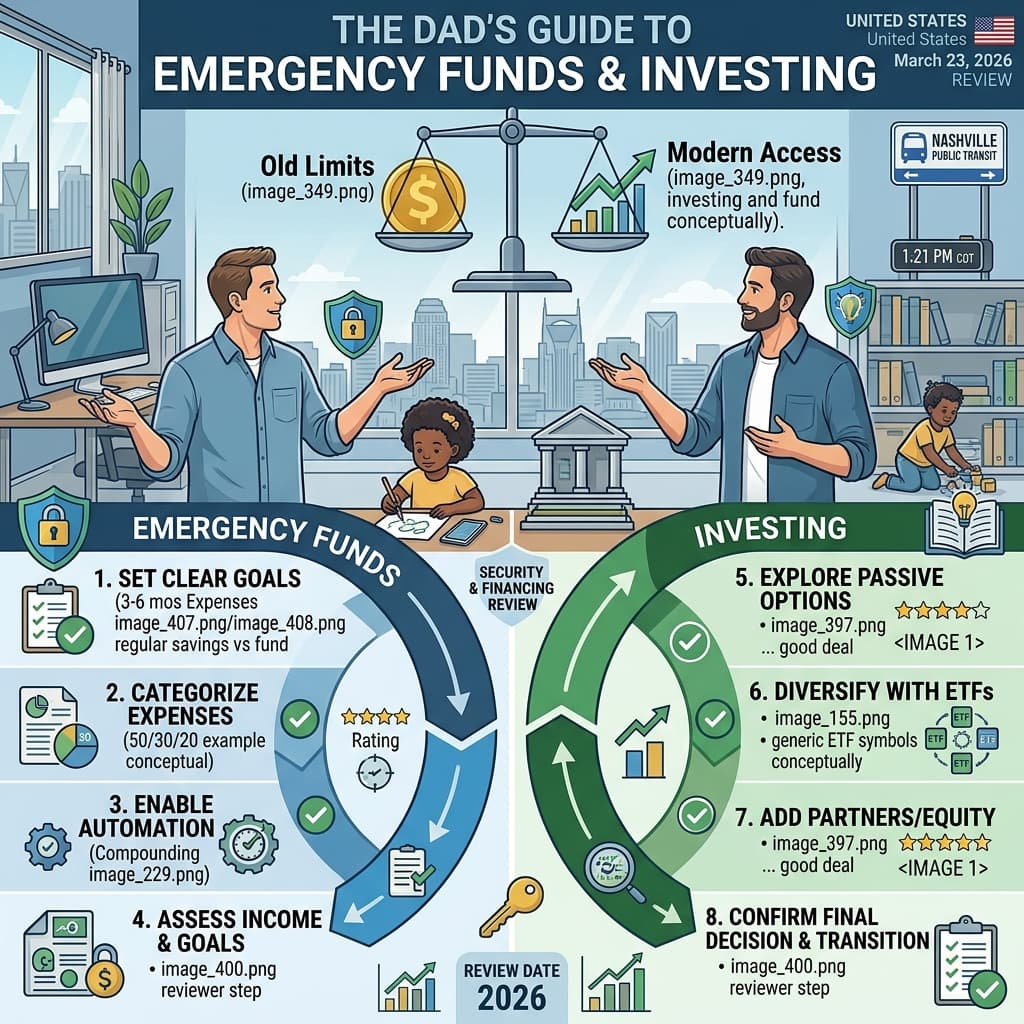
The Short Answer
Build a 3–6 month emergency fund in a high-yield savings account before investing aggressively — but don't wait to invest at all. Start with your employer's 401(k) match while building your safety net.
The Dad's Guide to Emergency Fund vs Investing: What Comes First?s & Investing: How Much to Save Before You Invest
Before you put a single dollar into the stock market, there's a financial foundation you need to build first — your emergency fund. Most financial experts agree that investing without an adequate cash cushion is like building a house on sand: one unexpected car repair, medical bill, or job loss can force you to sell investments at the worst possible time. This guide walks you through exactly how much to save, where to keep it, how to build it even while managing debt, and — most importantly — when you're truly ready to shift dollars from savings to investing. Whether you're just getting started or trying to optimize an already-decent financial situation, this article covers the complete picture of emergency savings and early investing for American dads in 2026.
The State of Emergency Savings in America
Here's a sobering reality check: most Americans are financially exposed to even a modest unexpected expense.
According to a January 2026 U.S. News & World Report survey of 1,216 American adults:
- 43% of Americans couldn't pay for a $1,000 emergency expense using savings
- 1 in 3 don't have enough savings to cover even one month of living expenses
- The median emergency fund balance has dropped to just $5,000 — half the $10,000 median reported in 2025
Bankrate's 2026 Emergency Savings Report (based on a December 2025 survey of 2,564 U.S. adults) found:
- Nearly 1 in 4 Americans (24%) have no emergency savings at all
- 30% have some savings, but not enough to cover three months of expenses
- 60% of Americans are uncomfortable with their current level of emergency savings
A separate Empower study reinforced the trend, finding the median emergency savings for Americans is just $500 — and that number has been trending downward. Half of all Americans (50%) admit they're stressed about not having enough saved for an emergency.
For dads with families depending on them, these numbers are especially stark. The Federal Reserve's own research, published in the 2024 Survey of Household Economics and Decisionmaking (SHED), found that 37% of adults said they would need to borrow money or sell assets to cover an unexpected $400 expense.
The good news: you can fix this. And once your emergency fund is in place, the path to investing becomes much clearer.
What Is an Emergency Fund — and What Isn't It?
An emergency fund is a dedicated pool of cash set aside for unexpected, unavoidable financial shocks. It's not a vacation fund, a down payment account, or a general savings stash. It's specifically designed to cover:
Legitimate emergency fund uses:
- Job loss or unexpected income disruption
- Major car repairs (the Kelley Blue Book 2025 average is $838 per repair)
- Medical or dental emergencies not covered by insurance
- Urgent home repairs (HVAC failure, water heater replacement, roof damage)
- Emergency travel for a family crisis
- Appliance failures that are critical to daily life
NOT what an emergency fund is for:
- Planned vacations
- Holiday gift purchases (a 2026 U.S. News survey found 23% of Americans tapped their emergency fund for holiday shopping — don't do this)
- Non-urgent home upgrades
- Elective purchases or "sales" on items you planned to buy anyway
The distinction matters because it changes how you think about your target balance. Your emergency fund should cover unexpected necessities — not life's predictable big-ticket items, which deserve their own dedicated savings goals.
How Much Should You Save? The 3–6 Month Rule (and When to Go Higher)
The near-universal recommendation from financial institutions, certified financial planners, and consumer finance experts is to maintain three to six months' worth of essential living expenses in your emergency fund.
Per the U.S. Bureau of Labor Statistics (BLS) 2024 Consumer Expenditure Survey released in December 2025, the average American household spends $78,535 per year ($6,545/month). By household type:
| Household Type | Average Monthly Spending | 3-Month Target | 6-Month Target |
|---|---|---|---|
| Single adult | ~$4,716/month | ~$14,148 | ~$28,296 |
| Married couple, no kids | ~$7,391/month | ~$22,173 | ~$44,346 |
| Married couple with kids | ~$8,809–$9,780/month | ~$26,427–$29,340 | ~$52,854–$58,680 |
Source: Ramsey Solutions / Bureau of Labor Statistics 2024 Consumer Expenditure Survey. Note: Target your essential expenses, not total spending. Eliminate discretionary costs like dining out, entertainment, and subscriptions when calculating your emergency baseline.
Fidelity, Vanguard, and Schwab recommends starting with a goal of $1,000 as your initial cash buffer, then building toward the full three-to-six month target over time. Vanguard's research goes even further: their data from over 12,000 investors shows that having even $2,000 in emergency savings leads to financial well-being scores 21% higher than having nothing saved. Individuals who had both $2,000 AND three to six months of expenses saved experienced a 34% higher financial well-being score.
How to Calculate Your Personal Emergency Fund Target
Don't use average household data — use your own numbers.
Step 1: List your essential monthly expenses:
- Housing (mortgage or rent + property taxes + insurance)
- Utilities (electricity, gas, water, internet)
- Groceries and essential food
- Transportation (car payment, insurance, gas)
- Insurance premiums (health, life, disability)
- Minimum debt payments (credit cards, student loans, car loans)
- Childcare or school-related necessities
- Prescription medications
Step 2: Add these up to get your monthly essential expenses baseline
Step 3: Multiply by your target (3 or 6 months — see the guide below)
Should You Save 3 Months or 6 Months?
Use this framework to decide:
Lean toward 3 months if:
- You have a stable, salaried job in a high-demand field
- Your household has two incomes
- You have relatively low fixed expenses
- You have minimal dependents
- You have strong disability insurance coverage
Lean toward 6 months (or more) if:
- You're self-employed or have variable income
- You work in a volatile or cyclical industry
- You're the sole income earner for your family
- You have young children or dependents with special needs
- You have significant health issues or high medical expenses
- You're in a single-income household with a mortgage
Per U.S. News financial experts, people with inconsistent income — including freelancers, contractors, and commission-based earners — should seriously consider saving even beyond six months.
The Priority Order: Where an Emergency Fund Fits in Your Financial Plan
Before we get into the mechanics of building your fund, it helps to understand where an emergency fund fits in the broader sequence of financial priorities. Here's the framework used by most certified financial planners:
The Financial Priority Stack
Step 1: Save $1,000 starter emergency fund This is your first firewall. Even if you have high-interest debt, having $1,000 set aside prevents a minor setback from becoming a debt spiral. Every financial expert — from Ramsey Solutions to Fidelity — agrees on this baseline.
Step 2: Capture your full employer 401(k) match This is the single highest guaranteed return available to most working Americans. An employer match is essentially a 50–100% immediate return on every dollar you contribute up to the match threshold. Fidelity's guidance explicitly recommends capturing the full employer match before attacking most debt.
Step 3: Pay off high-interest debt (especially credit cards) Average credit card APR sits above 20% as of early 2026. No investment vehicle offers a guaranteed 20%+ return. Pay off high-rate debt aggressively before building a full emergency fund or investing beyond the employer match.
Step 4: Build your full 3–6 month emergency fund Once high-interest debt is cleared and you're capturing your employer match, it's time to fund your full emergency reserve.
Step 5: Begin or accelerate investing With a funded emergency account and your employer match captured, you're ready to invest systematically — starting with tax-advantaged accounts (Roth IRA, maxing 401(k)) and then taxable open a brokerage accounts.
Step 6: Address moderate-interest debt (student loans, car loans) Per Fidelity's research, debt with an interest rate below 6% generally loses to long-term market returns. Focus on investing before accelerating payoff on lower-rate debt.
The 6% Rule: Fidelity's analysis found that for most investors, it makes sense to prioritize paying down debt with interest rates of 6% or higher before investing additional dollars beyond the employer match. Debt below 6% can often be serviced at minimum while you invest, since long-term market returns historically outpace that threshold.
Building Your Emergency Fund: Practical Strategies for Busy Dads
Starting from zero — or near zero — can feel overwhelming. Here are practical approaches that work even on a tight budget.
1. Start With a Hard Number, Not a Vague Goal
"Save more" is not a plan. "$15,000 in 18 months" is a plan. Calculate your specific three- or six-month target, divide it by your timeline in months, and you have a monthly savings target. Break it down further to weekly if that helps — it feels more manageable.
2. Automate Every Dollar
This is the single most effective savings habit, supported by every major financial study. Set up an automatic transfer from your checking account to your dedicated emergency savings account the day you get paid — before you have a chance to spend it. Empower's research found that automation is one of the top predictors of successful emergency savings behavior. Set it and forget it.
3. Use Windfalls Strategically
Tax refunds are one of the most powerful tools for building your emergency fund fast. The average U.S. tax refund in recent years has been around $3,000. If you receive a refund, deposit the majority directly into your emergency fund before it gets absorbed into daily spending.
Other windfalls to route to savings: bonuses, gifts, side businesses income, and any monetary overtime.
4. The 50/50 Split When You Have Debt
If you're simultaneously paying down debt and trying to build an emergency fund, a 50/50 split is a reasonable middle ground. For example, if you have $500 per month to allocate after minimum payments, put $250 toward debt and $250 toward your emergency fund. Adjust the ratio based on your debt's interest rate: the higher the rate, the more you should weight toward debt repayment.
5. Find and Redirect "Hidden" Cash
Review your last 60 days of spending and identify at least two or three subscriptions or recurring expenses you can eliminate or reduce. Put that money directly into savings. Common targets: redundant streaming services, gym memberships you rarely use, app subscriptions, and dining out.
6. Use a "Separate and Distant" Account
Don't keep your emergency fund in your everyday checking account — you'll spend it. Open a dedicated high-yield savings account at a different bank or online institution. Out of sight, out of mind. The slight friction of needing to transfer money creates a meaningful behavioral barrier to casual spending.
Where to Keep Your Emergency Fund
Your emergency fund has two core requirements: it must be safe and liquid (quickly accessible). It should never be invested in the stock market — you cannot afford the risk of needing the money during a market downturn.
The best vehicles for emergency funds in 2026:
High-Yield Savings Accounts (HYSAs)
This is the gold standard for emergency fund storage. HYSAs are FDIC-insured up to $250,000 per depositor, accessible instantly or within 1–3 business days, and — as of early 2026 — offering rates significantly above traditional savings accounts.
Current HYSA landscape (as of late February 2026):
- National average savings rate: 0.39% APY (FDIC data, February 17, 2026)
- Top HYSA rates: 4.00–5.00% APY at online banks
- Top institutions: Varo Money (up to 5.00%), Axos Bank (4.21%), Newtek Bank (4.20%), Bread Savings, CIT Bank, Marcus by Goldman Sachs
On a $20,000 emergency fund, the difference between 0.39% at a traditional bank and 4.50% at a top HYSA is roughly $822 per year in additional interest — real money for doing essentially nothing.
Key features to look for in an HYSA:
- FDIC insurance (non-negotiable)
- No monthly fees
- No or very low minimum balance requirements
- Easy online transfers linked to your checking account
- Competitive APY
Rate caveat: The Federal Reserve made several rate cuts in late 2025. HYSA rates are variable and may continue to decline if additional cuts follow. Locking in current rates by opening an account now still makes sense — even at lower rates, top online HYSAs significantly outpace traditional savings accounts.
Money Market Accounts (MMAs)
Money market accounts typically offer rates comparable to HYSAs but may come with minimum balance requirements and check-writing or debit card access. They're a solid alternative if you prefer having direct account access. Look for FDIC or NCUA insurance and compare APYs directly with HYSAs before choosing.
Certificates of Deposit (CDs) — Use Sparingly
CDs often offer higher rates than HYSAs in exchange for locking up your money for a fixed term (typically 3 months to 5 years). The problem: early withdrawal penalties. For most of your emergency fund, liquidity trumps yield. CDs may be appropriate for the portion of your emergency fund that's your "last resort" tier — money you'd only access for a serious income shock — but keep the bulk accessible.
What to Avoid
- Stock market / investment accounts: Your portfolio can be down 30–40% exactly when you need the money most
- Regular checking accounts: Too easy to spend, and minimal interest earned
- Cash at home: No interest, theft risk, and inflation risk
- Cryptocurrency: Extreme volatility makes it unsuitable as emergency reserves
The Emergency Fund–Investing Transition: When Are You Ready?
Here's the question that matters most for this guide: when do you have enough saved to start investing aggressively?
The answer depends on your specific situation, but here's a clear framework:
You're Ready to Start Investing When You Have:
- ✅ A starter emergency fund of at least $1,000 (Day 1 prerequisite)
- ✅ No high-interest consumer debt (generally, anything above 6–8% APR)
- ✅ You're capturing your full employer 401(k) match
- ✅ A fully funded emergency reserve of 3–6 months of essential expenses
You're NOT Ready to Invest Beyond the Employer Match If:
- ❌ You have credit card balances with 20%+ APR
- ❌ Your emergency fund is less than 1 month of expenses
- ❌ You're carrying other high-interest consumer debt (personal loans, payday loans, etc.)
The Simultaneous Strategy (When You Can't Wait)
Some financial planners advocate a parallel approach — building emergency savings and investing simultaneously — especially for younger dads who fear missing years of compound growth. If this is your situation, consider:
- Minimum: Always capture the full employer match before anything else
- Split contributions: After capturing the match, split remaining discretionary income between your emergency fund and a Roth IRA providers
- Threshold rule: Once your emergency fund reaches $5,000–$10,000, you can reasonably begin more aggressive investing even if you haven't hit your full three-month target
The Money Guy Show's "Financial Order of Operations" framework makes a compelling case for getting your employer match first regardless of emergency fund status — because that match represents a guaranteed 50–100% return on investment that no savings rate can match.
Maintaining Your Emergency Fund Over Time
Building the fund is step one. Protecting and managing it over time is equally important.
Replenishment After Use
If you dip into your emergency fund (that's what it's for!), make replenishing it your top financial priority afterward — above investing, above extra debt payments, above everything except minimum payments and essential bills. Treat it like a bill you owe yourself.
Annual Review
Your emergency fund target isn't fixed. Reassess it annually or after major life changes:
- New baby or added dependent → increase target
- Partner income lost or reduced → increase target
- New mortgage or significantly higher housing costs → recalculate
- Pay increase or reduced expenses → you may already be over your target
- Kids becoming financially independent → you may be able to reduce somewhat
Avoid Lifestyle Creep Erosion
As income grows, expenses often grow with it. Make sure your emergency fund grows proportionally. If your monthly expenses increase from $5,000 to $7,000, your target should increase from $15,000–$30,000 to $21,000–$42,000.
Avoid Over-Funding
Yes, you can have too much cash in a HYSA. Once you've reached six months of expenses, every additional dollar is working below its potential. A fully-funded emergency reserve is a floor, not a ceiling. Additional money should flow toward investing, retirement accounts, or other financial goals. AARP's financial planning guidance notes that a common mistake is holding far too much cash that should be invested.
Emergency Fund Checklist for Dads
Use this checklist to assess where you stand:
- Calculated your personal monthly essential expenses
- Determined your target emergency fund (3 months = stable income; 6 months = variable/self-employed/single income)
- Opened a dedicated high-yield savings account separate from your checking
- Set up automatic monthly transfers to your HYSA
- Reached the $1,000 starter threshold
- Paid off all credit card and high-interest consumer debt
- Confirmed you're capturing your full employer 401(k) match
- Reached your 3-month essential expenses target
- Reached your full 3–6 month funded emergency reserve
- Have a replenishment plan in case you ever use it
- Scheduled an annual review of your emergency fund target
FAQ: Emergency Funds and Investing
Q: Should I invest while building my emergency fund?
It depends on your timeline and existing debt situation. Always capture your employer's 401(k) match first — that's essentially free money. For additional investing, consider waiting until you reach at least $1,000–$2,000 in emergency savings. Once you've cleared high-interest debt, a parallel approach (splitting contributions between your emergency fund and a Roth IRA) is reasonable for most people.
Q: Is a HYSA better than a money market account?
Both are solid. HYSAs are typically simpler, have lower minimums, and are offered by a wider range of online institutions. Money market accounts sometimes offer debit card or check access and may have slightly higher rates in some environments. Compare current APYs and minimums, then choose based on your banking preferences.
Q: My emergency fund is in an investment account — is that okay?
No. An investment account exposed to stock market risk is not a reliable emergency fund. A 30–40% market decline — which can happen in any given year — could slash your "emergency fund" precisely when you need it most. Keep emergency savings in FDIC-insured, liquid accounts only.
Q: What if I use my emergency fund — do I need to stop investing to replenish it?
Yes, in most cases. After using your emergency fund, temporarily redirect investment contributions (beyond capturing your employer match) toward replenishing it. Once it's restored to its target level, resume full investment contributions.
Q: Can I use my Roth IRA contributions as an emergency fund?
Technically, yes — you can withdraw Roth IRA contributions (not earnings) at any time without penalty. But this is generally a bad idea. It disrupts the compound growth of your retirement savings, and the money can never be replaced beyond that year's contribution limit. Use a proper HYSA as your emergency fund, and treat your Roth IRA as untouchable retirement money.
Q: I'm self-employed. How large should my emergency fund be?
Self-employed dads should target the higher end — typically six to nine months of expenses. Variable income, unpredictable slow seasons, the absence of employer-provided unemployment insurance, and irregular cash flow all create greater financial exposure than a salaried employee faces. Consider keeping a separate "business emergency reserve" in addition to your personal fund.
The Bottom Line: Security Before Growth
The sequence matters. An emergency fund isn't the enemy of investing — it's the foundation that makes investing possible without catastrophic risk.
Here's the data-driven truth: Americans without emergency savings are far more likely to:
- Liquidate retirement accounts early (triggering taxes and penalties)
- Take on high-interest debt during a crisis
- Sell investments at a loss during downturns
- Experience cascading financial stress that derails long-term wealth building
Vanguard's research shows that people with adequate emergency savings have 34% higher financial well-being scores — and anecdotally, every financial planner will tell you that emergency savings is the single biggest differentiator between clients who build lasting wealth and those who don't.
For dads, the stakes are especially high. You're not just protecting yourself — you're protecting your family's ability to weather financial storms without going into crisis mode. Build the foundation first. Then build the portfolio.
Related Articles
- The Dad's Guide to Tax-Efficient Investing
- The Dad's Beginner's Guide to Investing
- [The Power of What Every Dad Should Know About Compound Interest: A Guide for Dads](/the-power-of-compound-interest-a-guide-for-dads)
Sources and References
-
U.S. News & World Report (February 2026) — 2026 Financial Wellness Survey. Survey of 1,216 U.S. adults via PureSpectrum, January 16–20, 2026. https://www.usnews.com/banking/articles/2026-financial-wellness-survey
-
Bankrate (2026) — Emergency Savings Report. Survey of 2,564 U.S. adults conducted by YouGov Plc, December 2–8, 2025. https://www.bankrate.com/banking/savings/emergency-savings-report/
-
Empower (2025) — "The Safety Net: Americans have $500 in emergency savings." Online survey of 2,202 Americans, June 3–5, 2025. https://www.empower.com/the-currency/money/safety-net-emergency-savings-research
-
Empower — "Over 1 in 5 Americans Have No Emergency Savings." https://www.empower.com/the-currency/money/over-1-in-5-americans-have-no-emergency-savings-research
-
Federal Reserve Board — "Report on the Economic Well-Being of U.S. Households in 2024" (SHED Survey), published May 2025. https://www.federalreserve.gov/publications/2025-economic-well-being-of-us-households-in-2024-income-and-expenses.htm
-
U.S. Bureau of Labor Statistics (December 2025) — "Consumer Expenditures–2024." Average annual household expenditures of $78,535. https://www.bls.gov/news.release/cesan.nr0.htm
-
Fidelity Investments — "How much emergency fund should you have and where should you keep it?" https://www.fidelity.com/viewpoints/personal-finance/save-for-an-emergency
-
Fidelity Investments — "Pay down debt vs. invest." The 6% rule guidance. https://www.fidelity.com/learning-center/personal-finance/pay-down-debt-vs-invest
-
Fidelity Investments — "Balancing debt and saving: Step-by-step guide." https://www.fidelity.com/viewpoints/personal-finance/how-to-pay-off-debt
-
Vanguard — "Comprehensive Guide to Building an Emergency Fund." https://investor.vanguard.com/investor-resources-education/emergency-fund
-
Vanguard — "Emergency fund: Why you need one." https://investor.vanguard.com/investor-resources-education/emergency-fund/why-you-need-one
-
NerdWallet — "Emergency Fund Calculator: How Much Should I Have?" https://www.nerdwallet.com/banking/learn/emergency-fund-calculator
-
NerdWallet — "Best High-Yield Savings Accounts for February 2026." https://www.nerdwallet.com/banking/best/high-yield-online-savings-accounts
-
Bankrate (March 2026) — "Best High-Yield Savings Accounts of March 2026 — Up to 4.09%." https://www.bankrate.com/banking/savings/best-high-yield-interests-savings-accounts/
-
Fortune (February 2026) — "Top high-yield savings rates: Up to 5.00% APY." Data sourced from Curinos. https://fortune.com/article/best-savings-account-rates-2-26-2026/
-
FDIC — National Rates and Rate Caps for Savings deposit products (national average 0.39% APY, accurate February 17, 2026). https://www.fdic.gov
-
Ramsey Solutions — "Emergency Fund: Why You Need One and How Much to Save." https://www.ramseysolutions.com/saving/quick-guide-to-your-emergency-fund
-
Ramsey Solutions — "paying off debt or Save for the Future?" Baby Steps framework. https://www.ramseysolutions.com/debt/pay-off-debt-before-retirement
-
Ramsey Solutions — "The Average American's Monthly Expenses." BLS data analysis by household type. https://www.ramseysolutions.com/budgeting/american-average-monthly-expenses
-
CNBC Make It (September 2025) — "Americans' emergency funds are shrinking—here's how much they have saved." https://www.cnbc.com/2025/09/15/american-emergency-funds-shrinking.html
-
CBS News (January 2025) — "Most Americans can't afford a $1,000 emergency expense, report finds." https://www.cbsnews.com/news/saving-money-emergency-expenses-2025/
-
The Motley Fool — "Average American Households' Monthly Expenses." https://www.fool.com/money/research/average-monthly-expenses/
-
The Motley Fool (February 2026) — "Best High-Yield Savings Accounts Offering up to 5.00% APY." https://www.fool.com/money/banks/articles/top-savings-account-rates-today-feb-26-2026/
-
U.S. News & World Report — "How Much Should You Save In an Emergency Fund?" https://money.usnews.com/money/personal-finance/saving-and-budgeting/articles/be-ready-for-the-unexpected-with-an-emergency-fund
-
Federal Reserve Bank of St. Louis (December 2025) — "When the Unexpected Happens, Be Ready with an Emergency Fund." Page One Economics. https://www.stlouisfed.org/publications/page-one-economics/2025/sep/when-unexpected-happens-be-ready-with-emergency-fund
-
Bankrate — "Pay off debt or save? Expert tips to help you choose." Includes Fidelity 6% rule. https://www.bankrate.com/banking/savings/these-guidelines-will-help-you-decide-whether-to-pay-down-debt-or-save/
-
Money Guy Show — "Financial Order of Operations (FOO)." Nine-step framework. https://moneyguy.com/guide/foo/
-
AARP — "How Big Should Your Emergency Fund Be When You're Retired?" https://www.aarp.org/money/personal-finance/how-much-in-emergency-fund/
-
Remitly — "US Emergency Savings Fund Statistics — Updated for 2025." https://www.remitly.com/blog/finance/us-emergency-savings-statistics/
-
BLS — The Economics Daily (2025) — "Which Generation Spends More?" 2023 Consumer Expenditure Survey data. https://www.bls.gov/opub/ted/2025/which-generation-spends-more.htm
Disclaimer: This article is for educational and informational purposes only and does not constitute financial, investment, tax, or legal advice. Individual financial situations vary. Please consult a certified financial planner or qualified financial advisor before making decisions about your savings, debt, or investment strategy. Data cited reflects published surveys and official government sources as of early 2026 and is subject to change. DadAlt may receive compensation from affiliate links to financial products mentioned in this article; this does not influence editorial coverage.
Recommended Reading
Frequently Asked Questions
How much should I have in my emergency fund?
3–6 months of essential expenses is the standard target. Single-income families should aim for 6 months. If you have a stable dual income, 3 months may be sufficient to start investing sooner.
Where should I keep my emergency fund?
A high-yield savings account earning 4–5% APY. Never invest your emergency fund in stocks or crypto — it needs to be liquid and stable. Online banks like Marcus and Ally offer the best rates.
Can I invest and build an emergency fund at the same time?
Yes — capture your employer's 401(k) match immediately (it's free money), then split remaining savings between your emergency fund and investing until you hit your target.

About the Author
Jared DeValk
Founder, DadAlt Investments
Father, alternative investment researcher, and founder of DadAlt Investments. 14+ years turning hard lessons into honest guidance for dads building real wealth.