
How Much Should You Have Invested by Age 30, 40, and 50? (2026 Guide)
Retirement savings benchmarks by age with catch-up strategies.
The Short Answer
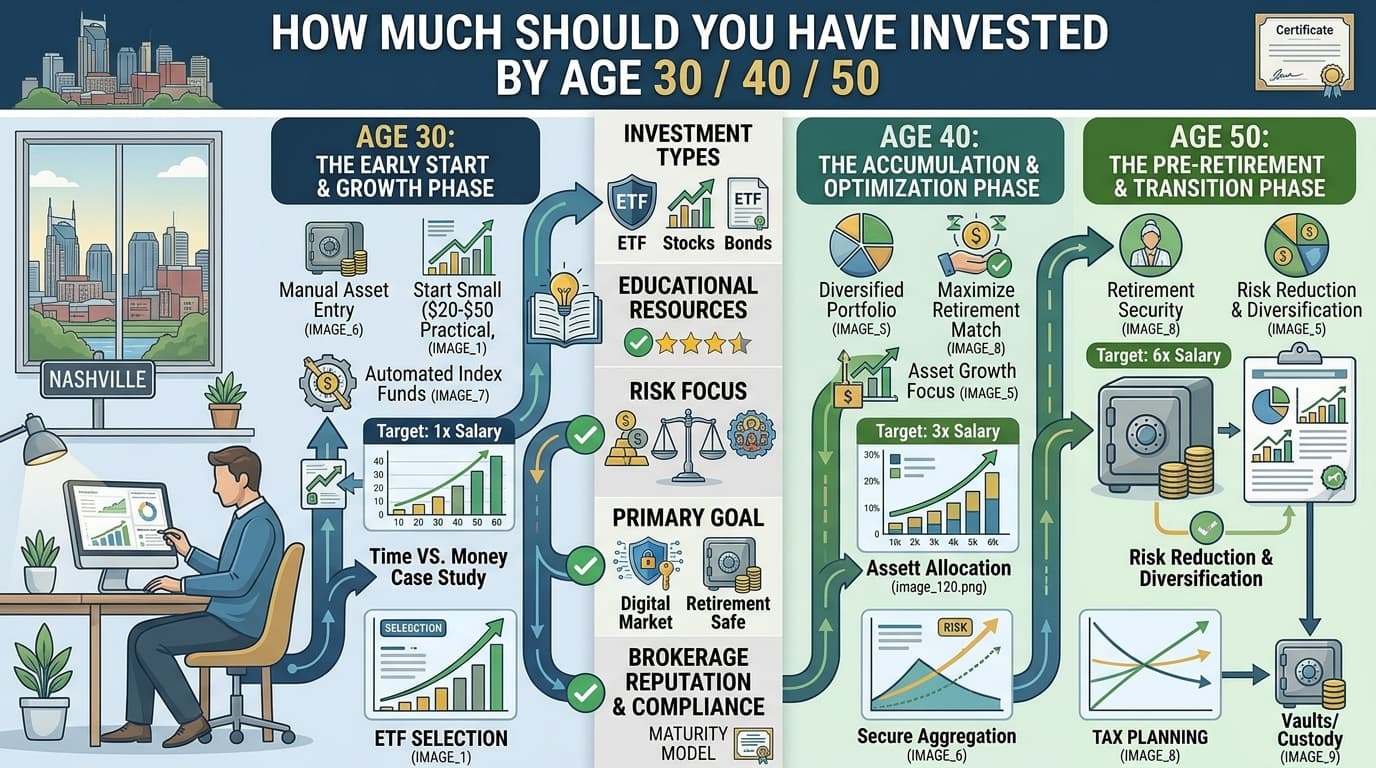
By 30 aim for 1x your salary invested, by 40 aim for 3x, and by 50 aim for 6x — but if you're behind, don't panic. Catch-up contributions and aggressive saving can close the gap faster than you think.
How Much Should You Have Invested by Age 30, 40, and 50? (2026 Guide)
By DadAlt Investments | Category: Personal Finance | Last Updated: March 2026
The retirement savings benchmarks for ages 30, 40, and 50 are not pass-or-fail tests — they are diagnostic tools. Knowing where you stand relative to a well-established guideline is the first step toward doing something about it, which is the only step that actually matters. The most widely used standard in the United States comes from Fidelity, Vanguard, and Schwab Investments, whose salary-multiple guidelines have become the industry's default benchmark: 1x your annual salary saved by age 30, 3x by 40, 6x by 50, 8x by 60, and 10x by retirement at age 67.1 But here's the reality check the benchmarks never headline: the median retirement savings for all U.S. households is just $87,000, according to the Federal Reserve's Survey of Consumer Finances — and roughly 65% of Americans believe their retirement savings are either off track or are not sure if they're on track.2 This is not a crisis of will. It is the entirely predictable result of student loan debt, housing costs, childcare expenses, and wage growth that hasn't kept pace with cost of living for most working families. This guide explains what the benchmarks actually mean, what they look like across different income levels, why most Americans fall short of them, and — most importantly — what to do right now whether you're 28, 38, or 52 and behind where you want to be.
Why Benchmarks Matter — and How to Use Them Without Panic
These Are Targets, Not Verdicts
The first thing to understand about retirement savings benchmarks is that being behind them is extraordinarily common, entirely fixable in most cases, and not a reason for shame or despair. They exist to orient you — to help you answer the question how am I doing? — not to render a judgment on your character or intelligence. A benchmark that puts you $80,000 behind your age-30 target is useful information. Without it, you have nothing to measure against. With it, you can calculate exactly how much additional savings per month would close the gap, which is an actionable problem.
Why Salary Multiples Are More Useful Than Dollar Amounts
You'll sometimes see retirement savings goals expressed as fixed dollar amounts: "you need $1 million to retire comfortably," or "the average American needs $1.26 million."3 These absolute dollar targets are less useful than salary multiples for two reasons:
- They don't scale to your actual income. A $1 million target means something very different to someone earning $50,000/year than to someone earning $150,000/year. The former needs 20x their annual income; the latter needs less than 7x.
- They don't adjust as your income grows. Salary multiples move with you. As your income increases over your career, so does the target — keeping the benchmark proportional to what you'll actually need to maintain your lifestyle in retirement.
The practical rule: You will need approximately 70–80% of your pre-retirement income to maintain your lifestyle in retirement (the standard "income replacement rate" used by financial planners). If you retire earning $100,000/year, you'll need roughly $70,000–$80,000/year in retirement income — from Social Security, investment withdrawals, and any pension. Fidelity's 10x salary target is designed to support roughly that income replacement rate over a 30-year retirement, combined with expected Social Security benefits.
How to Use a Benchmark Productively
The three-step process:
- Identify the gap. Calculate your current saved amount and compare it to the benchmark for your age and salary.
- Choose an action. Increase your contribution rate, reduce fees, adjust your asset allocation, or some combination.
- Measure progress. Reassess against the benchmark annually — ideally at the same time each year.
The benchmark only has value if it drives action. Checking it, feeling bad, and moving on accomplishes nothing. Checking it and making one concrete change — even a 1% increase in your 401(k) contribution — starts compounding immediately.
The Most-Used Benchmark: Fidelity's Savings Guidelines
Fidelity's retirement savings milestones are the most widely cited standard in U.S. personal finance. They appear in guidance from Bankrate, NerdWallet, Kiplinger, and most major financial institutions because they are backed by detailed actuarial modeling and updated regularly.1
The Full Milestone Table
| Age | Fidelity's Savings Target |
|---|---|
| 30 | 1× your annual salary |
| 40 | 3× your annual salary |
| 50 | 6× your annual salary |
| 60 | 8× your annual salary |
| 67 (retirement) | 10× your annual salary |
What These Milestones Assume
Fidelity's guidelines are built on four key assumptions:14
- Savings start at age 25 — not 22, not 30. Starting later compresses the compounding runway significantly.
- 15% total savings rate — this includes employee contributions and employer match. If your employer matches 3%, you contribute 12% to hit the 15% target.
- 7% average annual return on a diversified investment portfolio
- Retirement at age 67 — the current full Social Security retirement age for anyone born after 1960
These assumptions are aggressive by average American standards. Most people start saving meaningfully later than 25, many don't consistently hit 15%, and employer matches vary widely. This is why the benchmarks feel so daunting to so many people — and also why falling short of them, while significant, is a very common and very correctable situation.
What These Benchmarks Look Like at Different Income Levels
Salary multiples become concrete only when applied to your actual income. Here is what Fidelity's guidelines translate to in dollar terms at three common income levels:
Benchmark Targets by Salary
| Age | $60,000/yr salary | $90,000/yr salary | $120,000/yr salary |
|---|---|---|---|
| By age 30 | $60,000 | $90,000 | $120,000 |
| By age 40 | $180,000 | $270,000 | $360,000 |
| By age 50 | $360,000 | $540,000 | $720,000 |
| By age 60 | $480,000 | $720,000 | $960,000 |
| By retirement (67) | $600,000 | $900,000 | $1,200,000 |
The Reality Check: Where Americans Actually Are
These are the benchmarks. Here is where typical Americans actually stand, based on Federal Reserve Survey of Consumer Finances data and Empower Personal Dashboard data as of 2024–2025:
Federal Reserve median retirement savings by age group (2022 SCF, most recent data available):2
| Age Group | Median Retirement Savings | Average Retirement Savings |
|---|---|---|
| Under 35 | $18,880 | $49,130 |
| 35–44 | ~$60,000* | $141,520 |
| 45–54 | ~$100,000* | $313,220 |
| 55–64 | $185,000 | $537,560 |
| 65–74 | $200,000 | $609,230 |
*Approximate — median figures vary by source; Federal Reserve SCF is the authoritative dataset.
The critical takeaway: The average is always dramatically higher than the median because a small number of high-balance accounts pull the average upward. The median is the more honest measure of where a typical American household stands. A 45-year-old earning $90,000/year should have $270,000 by the Fidelity benchmark. The median 45–54-year-old has roughly $100,000. That is a significant gap — but one that, with 20+ years remaining until retirement, is entirely workable.
Important note on the data: The Federal Reserve releases the Survey of Consumer Finances every three years. The most recent published dataset is 2022. The 2025 survey data will be published in 2026. These numbers reflect a snapshot; they are not updated annually.
What the Benchmarks Assume — and Why Reality Often Differs
The Path Fidelity's Model Assumes
Fidelity's milestone model assumes a relatively smooth financial life: consistent employment from age 25, steady 15% savings, no major interruptions, and compound growth at 7% annually with no significant market losses during critical accumulation years. For a meaningful portion of Americans, this describes their experience. For most, it does not.
Why Most Americans Fall Short — and Why That's Understandable
The most common reasons people arrive at age 30, 40, or 50 behind the benchmarks are structural, not behavioral:
Student loan debt: The average federal student loan balance for borrowers who didn't complete their degree is over $20,000. For those who did, balances are often $30,000–$60,000+. Years of loan repayment directly compete with retirement savings contributions during the years when compounding has the most impact.
Housing costs: The average first-time homebuyer down payment represents years of saving that could otherwise have gone to retirement accounts. In high-cost metros, this is an even longer delay.
Childcare costs: The average annual cost of full-time center-based childcare in the United States exceeds $15,000 in most markets — a figure that, for many families, exceeds their mortgage payment. Parents who reduce work hours or exit the workforce entirely during child-rearing years also sacrifice employer retirement contributions and career earnings growth during those years.
Late career starts: Many professionals don't reach their earning stride until their 30s. Graduate school, residencies, apprenticeships, and career pivots all delay the point at which meaningful 15% savings becomes financially feasible.
The bottom line: Fidelity's model is designed for ideal conditions. Most people are not living ideal conditions. The benchmarks are useful as a target direction, not a judgment on your life's financial choices.
If You're Behind at 30: What to Do Right Now
Being behind at 30 is among the most fixable financial situations that exists. At 30, you have 37 years of compounding ahead of you before traditional retirement age. The decisions you make in your early 30s about savings rate and investment selection have the largest per-dollar impact of any financial decisions you will make in your life.
1. Open a Roth IRA Today If You Don't Have One
A Roth IRA is the single most powerful retirement savings tool available to most Americans under 35. Contributions grow tax-free, and qualified withdrawals in retirement are completely tax-free — including all the growth. For 2026, the contribution limit is $7,500/year (up from $7,000 in 2025) for those under age 50, subject to income limits.5
2026 Roth IRA income limits:
- Single filers: full contribution allowed up to $153,000 MAGI; phase-out from $153,000–$168,000
- Married filing jointly: full contribution up to $242,000 MAGI; phase-out from $242,000–$252,000
Opening a Roth IRA takes less than 15 minutes at Fidelity, Vanguard, or Charles Schwab. The minimum to open is $0 at all three. If you can contribute even $200/month ($2,400/year), you are building the foundation that will compound significantly over 35+ years.
2. Capture the Full Employer 401(k) Match
The employer 401(k) match is the only guaranteed 50–100% immediate return on investment available to you. A typical match — 100% of the first 3% of salary — is equivalent to a 100% return on that portion of your contribution, before any market returns.
At a $60,000 salary with a 3% match:
- You contribute 3% → $1,800/year
- Employer adds 3% → $1,800/year
- Total invested → $3,600/year, effectively doubling your investment immediately
Not capturing the full match is the most expensive financial mistake a young worker can make. Before worrying about Roth vs. traditional, individual stocks vs. index funds, or any other investment decision — make sure you are contributing enough to get every dollar of your employer's match.
3. Revised Target If Age 30 Has Already Passed
If you are 31–34 and did not hit the 1x salary target at 30, set a revised goal: reach 1x your salary by age 35. This is entirely achievable with a consistent savings rate of 12–15% on a median income. The compounding clock is not reset — every month you delay costs more in future growth than the month before, which is the best argument for urgency without panic.
4. The Power of Starting Now vs. Waiting 10 Years
Two hypothetical savers, each investing in a portfolio returning 7% annually:
- Alex starts at 30 and contributes $500/month until age 67 (37 years): final balance ≈ $1,110,000
- Jordan waits until 40 and contributes $500/month until age 67 (27 years): final balance ≈ $567,000
Alex contributed only $60,000 more in total ($222,000 vs. $162,000) but ends up with nearly $543,000 more at retirement. That difference is compounding — and it illustrates why urgency at 30 is entirely justified even when the retirement date feels impossibly far away.
If You're Behind at 40: Catch-Up Strategies
At 40, the tone shifts. You still have 27 years of compounding ahead of you, which is a substantial runway — but the cost of every additional year of delay is now significantly higher than it was at 30. The good news: most 40-year-olds are at or near their peak earning years, which means this is also the moment in many careers when meaningful catch-up becomes financially possible.
1. Increase Your Savings Rate by 1–2% Every 6 Months
The most powerful catch-up lever available to anyone behind at 40 is a systematic, gradual increase in savings rate. A 1% increase in savings rate on a $90,000 salary is $900/year — $75/month — which is small enough that most households can accommodate it without dramatic lifestyle change, but large enough to generate meaningful additional compounding over 25+ years.
The target: work toward a 20% gross savings rate (including employer match) if you are behind. This is aggressive relative to average American savings behavior but entirely achievable on typical professional salaries by age 40.
Practical method:
- Set a calendar reminder every 6 months to increase your 401(k) contribution percentage by 1%
- When you receive a raise, redirect at least 50% of the after-tax raise to increased retirement savings before it enters your budget system
- Many 401(k) plans offer automatic escalation — if yours does, turn it on
2. Move Out of High-Fee Managed Funds
Fund fees compound in the wrong direction. A fund charging 1.0% in annual expense ratio vs. an index fund charging 0.05% creates a 0.95% annual drag on returns. On a $250,000 portfolio over 20 years, that fee drag — before considering the impact on compounding — equals tens of thousands of dollars in foregone growth.
Action step: Log into your 401(k) or IRA and check the expense ratio on every fund you hold. Target funds charging under 0.15% annually. Vanguard, Fidelity, and Schwab all offer broad U.S. and international index funds at expense ratios of 0.03%–0.10%. If your 401(k) plan has limited low-cost options, contribute enough to capture the employer match, then direct additional savings to a low-cost IRA.
3. Apply Raises and Bonuses Before They Hit Your Lifestyle
Lifestyle inflation protection is the primary reason savings rates stagnate in the 40s. When a raise arrives, it is immediately absorbed into higher housing, car payments, dining, and discretionary spending — a phenomenon behavioral economists call "hedonic adaptation." The counter-strategy: redirect at least half of every raise or bonus to retirement savings before adjusting your lifestyle budget.
At $90,000 with a 4% raise:
- Raise amount: $3,600/year ($300/month after-tax roughly)
- Redirect 50%: $1,800/year to retirement savings
- Net lifestyle improvement: $1,800/year — still a meaningful raise, with half building your future
4. 2026 Contribution Limits to Maximize at 40
For 2026, the 401(k) contribution limit for workers under 50 is $24,500 (increased from $23,500 in 2025).6 The IRA limit is $7,500. Combined, that is $32,000/year in tax-advantaged retirement savings available to anyone at 40. Maxing both is a stretch goal for most households — but even reaching 50–60% of the maximum is transformative over 25+ years.
If You're Behind at 50: The Final Push
Fifty is not the end of the compounding story — it is the beginning of the most critical 15 years of your savings career. With the IRS's catch-up contribution rules, a 50-year-old who genuinely commits to maximum savings can recover more ground in the next 15 years than most people save in their entire careers before 50.
1. Catch-Up Contributions: The 50+ Advantage
The IRS allows workers age 50 and older to contribute additional amounts to retirement accounts beyond the standard limits. For 2026:6
| Account Type | Standard 2026 Limit | Catch-Up (Age 50+) | Total Maximum (50+) |
|---|---|---|---|
| 401(k) / 403(b) | $24,500 | +$8,000 | $32,500 |
| IRA (Traditional or Roth) | $7,500 | +$1,100 | $8,600 |
| Combined total | $32,000 | +$9,100 | $41,100 |
Special rule for ages 60–63 (SECURE 2.0 Act): Starting in 2025 and continuing in 2026, workers aged 60 to 63 can make a "super catch-up" 401(k) contribution of $11,250 instead of the standard $8,000 catch-up — for a total 401(k) limit of $35,750 in 2026.6
This is an extraordinary opportunity. A 50-year-old who maximizes the full $41,100 combined limit for 15 years at a 7% average return builds approximately $1.05 million from those contributions alone — not counting any prior savings. Catching up at 50 is genuinely possible.
2. Delay Social Security: The Most Underused Lever
Social Security is not a retirement high-yield savings accounts, but it is a critical part of retirement income — and the decision of when to claim it is one of the most consequential financial decisions a person can make.
- Claim at 62: You receive reduced benefits — permanently. Benefits claimed at 62 are approximately 30% lower than if you had waited until full retirement age.
- Claim at full retirement age (67 for those born after 1960): You receive your full calculated benefit.
- Delay to 70: Benefits increase by 8% for every year you delay past full retirement age, for a total increase of approximately 24%–32% depending on your full retirement age.
The math on delaying from 62 to 70: the total increase in monthly benefit is approximately 76%. For a person whose full benefit at 67 would be $2,000/month, delaying to 70 generates approximately $2,480/month — $5,760/year more in guaranteed income, adjusted for inflation, for the rest of their life.
For most people who are behind on retirement savings, delaying Social Security is the single highest-return "investment" they can make in their 50s: commit to working longer, and dramatically increase your guaranteed lifetime income.
3. Home Equity as an Underused Retirement Asset
Home equity is the largest single asset for most American households near retirement — and one of the least-discussed retirement planning tools. The Federal Reserve's Survey of Consumer Finances shows that median home equity for households aged 55–64 is approximately $250,000–$300,000.
This equity is not retirement savings, and should not be counted against the Fidelity benchmark. But it is part of the full retirement picture:
- Downsizing — selling a larger home and moving to a smaller one or lower cost-of-living market frees equity that can be invested directly
- Reverse mortgage — available at age 62; converts home equity to income without selling; complex and requires careful consideration
- HELOC for catch-up investing — generally not advisable; borrowing to invest introduces leverage risk
The point is not that you should use home equity to fund retirement. It is that a 55-year-old who is $200,000 behind the Fidelity benchmark but has $300,000 in home equity has more retirement security than the savings number alone suggests — and should include their full balance sheet in any retirement planning conversation.
FAQ
What If I Have Zero Retirement Savings at 40?
Start today, not tomorrow. The psychological barrier to starting is real — the gap feels so large that inaction can feel inevitable. It is not.
Practical first steps for someone with zero retirement savings at 40:
- Open a Roth IRA (if income-eligible) or a Traditional IRA — takes 15 minutes online
- Contribute to your employer's 401(k) at minimum enough to capture the full employer match
- Set a target savings rate — start at 10% of gross income and increase by 1–2% every 6 months
- Invest in low-cost index funds — a target-date fund set to your expected retirement year is an excellent default for anyone who doesn't want to manage allocation decisions actively
A 40-year-old who starts saving $1,000/month at a 7% average return will have approximately $567,000 by age 67 — not enough to replace a full professional income, but a meaningful asset combined with Social Security and any other savings or equity. The worst outcome is continuing to save nothing.
Should I Include My Home Equity in the Retirement Savings Benchmark?
No — for purposes of measuring against the Fidelity salary-multiple benchmark, do not include home equity. The benchmark is designed around liquid, investable retirement assets: 401(k), IRA, Roth IRA, and taxable open a brokerage accounts earmarked for retirement. Home equity is illiquid, has carrying costs (maintenance, taxes, insurance), and requires either selling your home or taking on debt (reverse mortgage) to access.
That said, a full retirement readiness assessment absolutely should include home equity as part of your overall balance sheet. If you own your home outright at retirement, your housing costs drop substantially — which reduces how much investment income you need. Your financial planner should model both your liquid investments and your complete balance sheet.
What Savings Rate Do I Need to Catch Up by Retirement?
This depends on your current age, current balance, and expected income trajectory, but here are directional targets:
- Starting at 25 with nothing: 15% gross savings rate puts you on track per Fidelity's model
- Starting at 30 with nothing: 18–20% gross savings rate puts you approximately on track
- Starting at 40 with nothing: 25–30%+ gross savings rate is required to approach benchmark targets by 67; maximizing all tax-advantaged accounts is essential
- Starting at 50 with nothing: 40%+ savings rate is needed to build meaningful retirement assets; delaying Social Security and extending your working years become critical factors
The 4% rule — a common retirement income guideline — means that every $100,000 in invested retirement assets generates approximately $4,000/year in sustainable retirement income. Social Security adds to this; so does any pension.
Should I Combine My 401(k) and IRA Balances When Measuring Against Benchmarks?
Yes — the Fidelity benchmark is designed to measure all retirement savings, not just 401(k) balances. Include:
- ✅ 401(k) and 403(b) balances (current and former employers)
- ✅ Traditional IRA and Roth IRA balances
- ✅ SEP-IRA, SIMPLE IRA balances (if self-employed)
- ✅ HSA balances (if invested and designated for retirement healthcare)
- ✅ Taxable brokerage accounts earmarked specifically for retirement
Do not include:
- ❌ Home equity
- ❌ emergency funds / savings account
- ❌ Children's 529 college savings
- ❌ Business equity (too illiquid and uncertain)
Add up all included accounts to get your total retirement investment balance, then compare against your current salary multiplied by the Fidelity benchmark for your age.
Related Guides
- [How to beginner's guide to investing If You're Behind](/article/how-to-start-investing-if-youre-behind) — practical catch-up strategies regardless of your age
- Best Roth IRA Providers for Beginners — where to open the Roth IRA referenced throughout this guide
- Compound Interest Explained — the math behind why starting early matters so much
- Best Platforms to Buy Index Funds — where to invest once you've opened your accounts
- How to Build a Family Financial Plan — the complete framework for retirement, college, and insurance
Sources and References
Disclaimer: This article is for informational and educational purposes only and does not constitute financial, tax, or investment advice. Retirement savings adequacy depends on many individual factors including retirement age, lifestyle expectations, Social Security benefits, debt, and healthcare costs. Always consult a qualified financial advisor or CFP before making significant changes to your retirement savings strategy. IRS limits referenced are for the 2026 tax year; confirm current limits at IRS.gov. DadAlt Investments may earn affiliate commissions from some links in this article at no cost to you.
Recommended Reading
- The Ultimate Beginner's Guide to Investing for Dads
- What Every Dad Should Know About Compound Interest
- How to Start Investing if You're Behind
Footnotes
-
Fidelity Investments. "How Much Do I Need to Retire?" Fidelity Viewpoints. https://www.fidelity.com/viewpoints/retirement/how-much-do-i-need-to-retire — Salary milestone benchmarks: 1x at 30, 3x at 40, 6x at 50, 8x at 60, 10x at 67; 15% savings rate recommendation; 7% return assumption. ↩ ↩2 ↩3
-
SmartAsset / Federal Reserve. "Average Retirement Savings: How Do You Compare?" December 2025. https://smartasset.com/retirement/average-retirement-savings-are-you-normal — Federal Reserve SHED 2024: 65% of Americans believe retirement savings are off track; median balance $87,000; one in four Americans has no retirement savings; average monthly Social Security benefit approximately $1,960 (November 2025). ↩ ↩2
-
Kiplinger. "The Average Retirement Savings by Age." December 2025. https://www.kiplinger.com/retirement/retirement-planning/average-retirement-savings-by-age — Federal Reserve Survey of Consumer Finances median/average balances by age group; "magic number" Americans believe they need: $1.26 million; 54% of Americans report no dedicated retirement savings. ↩
-
CalcBee. "Retirement Savings Benchmarks: How Much Should You Have By…" February 2026. https://www.calcbee.com/blog/retirement-savings-benchmarks/ — Fidelity benchmark assumptions: start saving at 25, retire at 67, 55–80% income replacement; compounding example (Alex vs. Jordan); Social Security average monthly benefit; HSA as stealth retirement account. ↩
-
SmartAsset / IRS. "Average 401(k) Balance by Age." December 2025. https://smartasset.com/retirement/average-401k-balance-by-age — 2026 Roth IRA contribution limit $7,500 under 50, $8,600 age 50+; Roth IRA phase-out: single $153K–$168K, married $242K–$252K MAGI; 401(k) 2026 limit $24,500, catch-up $8,000 for age 50+. ↩
-
Kiplinger. "401(k) Balances Grow By Double Digits For 3rd Straight Year." 2025. https://www.kiplinger.com/retirement/401ks/the-average-401k-balance-by-age — 2026 401(k) limit $24,500 (up from $23,500); catch-up age 50+: $8,000 (up from $7,500); SECURE 2.0 super catch-up ages 60–63: $11,250; total 401(k) limit ages 60–63 in 2026: $35,750. ↩ ↩2 ↩3
Frequently Asked Questions
How much should I have saved for retirement by 40?
The general benchmark is 3x your annual salary. If you earn $80,000, aim for $240,000 invested by 40. If you're behind, maximizing 401(k) contributions and opening a Roth IRA can accelerate your progress significantly.
What if I haven't started investing by 35?
You're not too late. A 35-year-old investing $1,000/month in index funds at 10% average returns would have over $760,000 by 60. The key is starting now and staying consistent.
Do these benchmarks include home equity?
Traditional retirement benchmarks focus on investable assets (401k, IRA, brokerage accounts), not home equity. However, your home is part of your net worth and does contribute to your overall financial picture.

About the Author
Jared DeValk
Founder, DadAlt Investments
Father, alternative investment researcher, and founder of DadAlt Investments. 14+ years turning hard lessons into honest guidance for dads building real wealth.