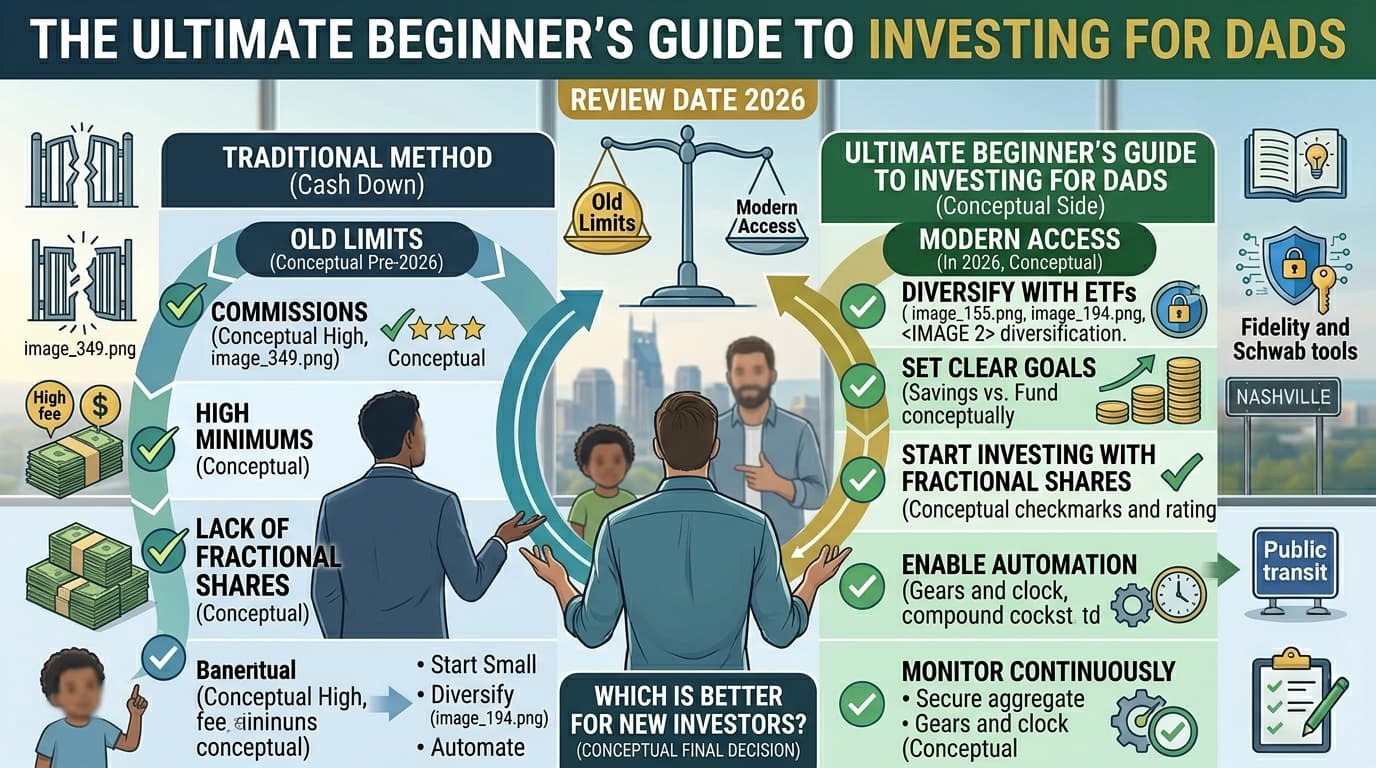
The Ultimate Beginner's Guide to Investing for Dads
Plain-English roadmap to get started.
The Short Answer
Start investing as a beginner by opening a brokerage or Roth IRA, setting up automatic contributions of even $50/month into a low-cost total market index fund, and committing to not touching it for 10+ years.
The Ultimate Beginner's Guide to Investing for Dads
Category: Personal Finance & Wealth Building Tags: Beginner Guides · Financial Independence · Guides & How-To's Target Keywords: beginner investing, investment basics
Disclaimer: This article is for educational and informational purposes only and does not constitute financial, investment, tax, or legal advice. DadAlt Investments may receive affiliate compensation from brokerages and financial companies referenced in this article. This never influences our editorial recommendations. Always consult a qualified fee-only fiduciary financial advisor before making significant financial decisions.
Summary
Most dads know they should be investing — but somewhere between understanding the idea and actually opening an account, something stalls. According to a 2024 Janus Henderson survey, nearly half of Americans (48%) hold no investment assets at all, with 30% citing a lack of understanding as the primary barrier. The S&P 500 has returned an average of roughly 10% annually since 1957, meaning every year you wait is a year of compounding you can't get back. This guide cuts through the confusion. It's a plain-English roadmap covering everything a busy dad needs to know to start investing: why starting now beats waiting for the "right time," how to use tax-advantaged accounts to keep more of what you earn, which asset types are worth your attention, and which brokerages actually make sense for first-time investors in 2026. No jargon. No Wall Street complexity. Just a practical starting point designed for the life you're actually living.
Introduction: The Dad Who Knows He Should Be Investing — But Isn't
Here's a scene a lot of dads recognize: you know investing is important. You've read the articles, you've heard the podcast clips about compound interest, and you genuinely intend to start. But when it comes to actually opening an account and putting money in — something stops you.
Maybe it's uncertainty about where to start. Maybe it feels like you need more money saved before it's worth it. Maybe the vocabulary (expense ratios, rebalancing, asset allocation) sounds like something that requires a finance degree to decode. Or maybe there's a quiet anxiety about making a wrong move with money your family depends on.
Whatever the reason, the cost of waiting is real.
According to data from the Federal Reserve Bank of Philadelphia's 2025 LIFE Survey, 57% of Americans do not personally own stocks. Among those non-investors, the most commonly cited reasons were a lack of available funds and — notably — a lack of knowledge. Gallup's annual Economy and Personal Finance survey found that 62% of Americans own stocks in some form in 2025, but that number drops sharply among lower-income households (28%) and those without college education (42%).
The gap between "I know I should" and "I actually am" is almost always a knowledge and confidence gap — not an income gap.
This guide closes that gap.
Why Investing Is Not Optional for Dads
Inflation Eats Your Savings
The average U.S. savings account earns well below the inflation rate. Inflation has averaged approximately 3% annually over the long term in the U.S. When the money sitting in your savings account earns less than inflation, your purchasing power shrinks every single year. A dollar saved today without being invested will buy less in 10 years than it does today.
Investing is how you stay ahead of inflation. The stock market — as measured by the S&P 500 — has historically delivered average annual returns of approximately 10% (9.46% over the last 150 years, per Trade That Swing using NYU Stern data). Adjusted for inflation, that's closer to 6–7% in real terms. Either way, it's significantly ahead of inflation.
Time in the Market Beats Timing the Market
One of the most well-documented findings in investing research is that the single most important variable in building wealth is how long your money is invested — not when you invest or which stocks you pick.
Here's a concrete example: if you invest $10,000 today in an S&P 500 platforms for index funds and don't add another dollar, at a 10% average annual return:
| Years Invested | Approximate Value |
|---|---|
| 10 years | ~$25,937 |
| 20 years | ~$67,275 |
| 30 years | ~$174,494 |
| 35 years | ~$281,024 |
The math doesn't lie. Every year you wait reduces the compounding time available to you. A dad who starts investing at 30 and stops at 65 has 35 years of compounding. A dad who waits until 40 has 25 years. That 10-year delay costs more than just 10 years of returns — it costs the compounding on all those returns, which is where the real wealth is built.
Social Security Won't Be Enough
The average monthly Social Security benefit in 2025 was approximately $1,976 per month for retired workers, according to the Social Security Administration. For context, the average American household spent $78,535 per year — about $6,545 per month — according to the Bureau of Labor Statistics' 2024 Consumer Expenditure Survey. Social Security alone covers less than a third of average household spending. The gap has to come from somewhere, and for most dads, that somewhere is a combination of personal savings and investment accounts.
Step 1: Build Your Financial Foundation First
Before investing a single dollar in the stock market, you need two foundational pieces in place. Skipping this step is one of the most common and costly mistakes beginner investors make.
Emergency Fund
Before investing, establish an emergency fund covering 3–6 months of essential living expenses in a liquid, federally insured account — ideally a high-yield savings account (HYSA). High-yield savings accounts in early 2026 are offering APYs in the 3.50–4.20% range at online banks like Marcus by Goldman Sachs, Ally Bank, and SoFi.
Why does this matter for investing? Because without an emergency fund, you'll be forced to liquidate investments at the worst possible moment — during a market downturn — to cover an unexpected expense. This is how people lock in permanent losses on money they intended to grow for decades.
Minimum target: $1,000 starter emergency fund before opening any investment account. Build to 3–6 months of essential expenses before aggressively adding to investments.
High-Interest Debt
Any debt with an interest rate above 7–8% should be paid off before investing. Credit card debt averaging 20–24% APR is a guaranteed negative return that no investment can reliably beat.
The math is simple: paying off a 22% credit card balance is equivalent to earning a guaranteed 22% return on that money. Nothing in the stock market reliably delivers that.
One exception: Always contribute enough to your employer's 401(k) to capture the full employer match before paying off any debt. An employer match is an immediate 50–100% return on those dollars — that beats even high-interest debt in most cases.
Step 2: Understand the Investment Accounts Available to You
The most important decision a beginner investor makes isn't which stocks to buy — it's which account type to use. Tax-advantaged accounts are the single most powerful tool available to everyday investors, and most dads are dramatically underutilizing them.
401(k): The Employer Retirement Plan
A 401(k) is a retirement savings account offered through your employer. You contribute pre-tax dollars (traditional) or after-tax dollars (Roth 401(k)), and the money grows tax-deferred or tax-free.
2026 contribution limits (IRS Notice 2025-67):
- Employee contribution limit: $24,500
- Catch-up contribution (age 50–59 or 64+): additional $8,000 (total $32,500)
- Super catch-up (age 60–63): additional $11,250 (total $35,750)
- Combined employee + employer limit: $72,000
The #1 rule of 401(k) investing: Contribute at least enough to capture your full employer match — always, before doing anything else. If your employer matches 50 cents on every dollar up to 6% of your salary, and you earn $80,000, they'll match up to $2,400 per year. Not contributing enough to capture that match is leaving free money on the table.
Traditional vs. Roth 401(k): Traditional contributions reduce your taxable income now (you pay taxes in retirement). Roth contributions use after-tax dollars (you pay no taxes on withdrawals in retirement). For most dads in their 30s and 40s who expect to be in a similar or higher tax bracket in retirement, a Roth 401(k) is often the better long-term choice — but this depends on your specific tax situation.
best Roth IRA providers: The Most Powerful Wealth-Building Account for Most Dads
A Roth IRA (Individual Retirement Account) allows you to contribute after-tax dollars and withdraw contributions and all growth completely tax-free in retirement. For dads in their prime earning years who aren't yet in the highest tax brackets, this is one of the most powerful financial tools available.
2026 Roth IRA limits (Vanguard, IRS Notice 2025-67):
- Contribution limit: $7,500/year (under age 50) | $8,600 (age 50+)
- Income phase-out begins at $153,000 MAGI for single filers; $242,000 for married filing jointly
- Full income limit: $168,000 (single); $252,000 (married filing jointly)
Key Roth IRA advantages:
- All growth is tax-free — after 59½ and 5 years, you pay zero taxes on any amount you withdraw
- Contributions (not earnings) can be withdrawn anytime without penalty — providing flexibility in emergencies
- No required minimum distributions (RMDs) during your lifetime
- You can contribute to both a 401(k) and a Roth IRA in the same year — the limits are separate
Where to open a Roth IRA: Fidelity, Vanguard, and Schwab and Charles Schwab are the two most recommended brokerages for Roth IRAs in 2026 — both offer $0 account minimums, $0 commissions, extensive index fund selections, and strong educational resources. NerdWallet named Fidelity its top pick for beginning investors for 2026.
Traditional IRA
A Traditional IRA allows pre-tax contributions that grow tax-deferred, with withdrawals taxed as ordinary income in retirement. The 2026 contribution limit is the same as a Roth IRA: $7,500/year ($8,600 for age 50+). Unlike a Roth IRA, a Traditional IRA has no income limits for contributions, though tax deductibility phases out at higher incomes if you're covered by a workplace retirement plan.
Traditional IRAs are worth considering if you're currently in a high tax bracket and want the immediate deduction, or if your income exceeds the Roth IRA phase-out limits (though a backdoor Roth IRA conversion may be worth exploring in that case — consult a financial advisor).
HSA: The Triple Tax Advantage Account
If you're enrolled in a high-deductible health plan (HDHP), a Health Savings Account (HSA) is arguably the best tax-advantaged account available — it's the only account that offers a triple tax benefit:
- Contributions are tax-deductible
- Growth is tax-free
- Withdrawals for qualified medical expenses are tax-free
2026 HSA contribution limits (IRS):
- Individual coverage: $4,400
- Family coverage: $8,750
After age 65, HSA funds can be withdrawn for any purpose (taxed as ordinary income, similar to a traditional IRA), but withdrawals for medical expenses remain permanently tax-free.
Many financially sophisticated investors "invest" their HSA funds in the market while paying current medical expenses out of pocket — then withdrawing the invested HSA balance tax-free decades later for medical costs. This is an advanced strategy but a powerful one for long-term wealth building.
Taxable open a brokerage account
Once you've maximized your tax-advantaged accounts, a taxable brokerage account gives you unlimited investment capacity without the contribution restrictions or withdrawal rules of retirement accounts. There are no special tax advantages, but also no penalties for accessing the money at any age.
Taxable brokerage accounts are commonly used for:
- Saving toward goals outside of retirement (college funding, home down payment, early retirement)
- Investing beyond the 401(k) and Roth IRA contribution limits
- Holding investments you expect to sell before retirement age
Step 3: Understand What You're Investing In
Investment accounts are just containers. What matters is what you put inside them. Here's a plain-English breakdown of the investment types every beginner dad needs to understand.
Index Funds and [How to Create Best Passive Income Investments for Beginners with ETFs](/article/passive-income-with-etfs)s: The Starting Point for Almost Every Investor
An index fund is a fund that holds every stock in a given market index — most commonly the S&P 500. Instead of trying to pick individual winners, you own a small slice of all 500 of the largest U.S. companies at once. An ETF (exchange-traded fund) is essentially the same idea but traded on a stock exchange like an individual stock, usually with slightly more flexibility and often lower minimum investments.
Why index funds and ETFs dominate beginner investing advice:
- Diversification by default: You own hundreds or thousands of companies with one purchase
- Extremely low cost: Fidelity's zero-fee index funds have no expense ratio; Vanguard's S&P 500 ETF (VOO) charges 0.03%
- Consistent long-term performance: Decades of research, including studies by Nobel Prize–winning economists, show that low-cost index funds outperform the majority of actively managed funds over 10+ year periods
- No stock-picking required: You don't need to research companies or monitor earnings reports
Key index funds to know:
- VOO (Vanguard S&P 500 ETF) — tracks the 500 largest U.S. companies; 0.03% expense ratio
- VTI (Vanguard Total Stock Market ETF) — tracks virtually the entire U.S. stock market; 0.03% expense ratio
- FXAIX (Fidelity 500 Index Fund) — S&P 500 index mutual fund; 0.015% expense ratio
- FZROX (Fidelity ZERO Total Market Index Fund) — 0.00% expense ratio (Fidelity accounts only)
Individual Stocks
An individual stock is an ownership share in a specific company — Apple, Microsoft, Amazon, or any of the thousands of publicly traded companies. Individual stocks offer the potential for higher returns than an index fund, but also significantly higher risk, since one company's fortunes can swing wildly based on earnings, management decisions, regulation, or competition.
DadAlt take on individual stocks: For beginning investors, individual stocks are best treated as a small, optional allocation — 5–10% of your portfolio at most — once you've already established a solid foundation in index funds. Picking individual winners consistently is harder than it looks, and the research required to do it well is substantial.
Bonds
Bonds are loans you make to a government (like U.S. Treasury bonds) or a corporation in exchange for interest payments. They're generally considered lower risk than stocks but produce lower returns over long periods. Bonds provide stability and are most valuable in portfolios as dads approach retirement age and want to reduce volatility.
For dads in their 30s and 40s: Your investment timeline is long enough that a heavy allocation to bonds is usually not necessary or advantageous. A common rule of thumb is to subtract your age from 110 to get a starting estimate of your stock allocation (so a 35-year-old might consider roughly 75% stocks, 25% bonds), but many financial advisors recommend even higher stock allocations for younger investors.
real estate investment options for dadsment Trusts (REITs)
A REIT is a company that owns income-producing real estate — office buildings, apartment complexes, shopping centers, data centers — and is required to distribute at least 90% of its taxable income to shareholders as dividends. REITs allow everyday investors to gain real estate exposure without buying physical property.
REITs can be purchased like any stock through a brokerage account. They're a popular option for investors who want real estate in their portfolio but don't yet have the capital for a down payment on an investment property.
Step 4: Build a Simple Starting Portfolio
A "starter portfolio" doesn't need to be complicated. For most beginning investor dads, a three-fund portfolio provides all the diversification you need with minimal complexity.
The Three-Fund Portfolio
This approach — championed by Vanguard founder John Bogle and widely recommended by financial advisors — uses just three index funds to cover the entire investable market:
| Fund | What It Covers | Example Fund |
|---|---|---|
| U.S. Total Stock Market | All U.S. stocks (large, mid, small-cap) | VTI or FSKAX |
| International Stock Market | All developed and emerging market stocks outside the U.S. | VXUS or FZILX |
| U.S. Bond Market | U.S. government and corporate bonds | BND or FXNAX |
Sample starting allocation for a dad in his mid-30s:
- 60% U.S. Total Stock Market
- 25% International Stock Market
- 15% U.S. Bond Market
As you age toward retirement, you gradually shift more into bonds and reduce stock exposure.
Even Simpler: Target-Date Funds
If three funds feels like too much to manage, target-date funds are a legitimate "set it and forget it" option. You pick the fund closest to your expected retirement year — such as Vanguard Target Retirement 2050 Fund (VFIFX) or Fidelity Freedom Index 2050 Fund (FIPFX) — and the fund automatically adjusts its allocation from aggressive (stocks-heavy) to conservative (bonds-heavy) as the target date approaches.
Target-date funds are frequently used in 401(k) plans. They're not the most optimized solution for everyone, but for dads who want a single investment that handles diversification and rebalancing automatically, they're a strong, well-researched choice.
Step 5: Choose the Right Brokerage
The good news: opening a brokerage account in 2026 is easier, cheaper, and faster than ever. All of the top brokerages for beginners charge $0 commissions on stock and ETF trades, have $0 account minimums, and can be opened online in 10–15 minutes.
Best Brokerages for Beginning Dad Investors in 2026
1. Fidelity Investments — Best Overall for Beginners
Fidelity earned NerdWallet's 2026 Best-of Award for best online broker for beginning investors and best investing app. It's the top recommendation across Bankrate, NerdWallet, and The Motley Fool for first-time investors.
- Account minimum: $0
- Commissions: $0 on stocks, ETFs, and options
- Fractional shares: Yes — buy any stock/ETF for as little as $1
- Index funds: Fidelity offers four zero-expense-ratio index funds (FZROX, FZILX, FZIPX, FZROX) available only in Fidelity accounts
- Education: Extensive — includes video tutorials, articles, tools, and calculators designed specifically for new investors
- Customer service: Among the best in the industry — phone, chat, and 200+ local branch offices
- Best for: First-time investors who want strong education resources, the lowest-cost index funds available anywhere, and robust customer support
2. Charles Schwab — Best for Research and Long-Term Investors
Schwab is one of the largest brokerages in the United States and NerdWallet's 2026 Best-of Award winner for best online broker for IRA investors.
- Account minimum: $0
- Commissions: $0 on stocks, ETFs, and options
- Fractional shares: Schwab Stock Slices allow purchases of S&P 500 companies for as little as $5
- Research tools: Considered one of the deepest research libraries of any brokerage — particularly strong after acquiring TD Ameritrade's thinkorswim platform
- Robo-advisor: Schwab Intelligent Portfolios (free, $5,000 minimum) auto-builds and rebalances a diversified ETF portfolio at no advisory fee
- Best for: Dads who want access to powerful research tools, or who want a free robo-advisor to manage their portfolio automatically
3. Vanguard — Best for Long-Term, Low-Cost Index Investing
Vanguard invented the index fund and continues to be synonymous with low-cost, long-term investing. Its ETFs (including VOO, VTI, and BND) are available at every major brokerage — you don't need a Vanguard account to access them.
- Account minimum: $0 for brokerage accounts; some mutual funds require $1,000–$3,000 minimum
- Commissions: $0 on stocks and ETFs
- Fractional shares: Available for Vanguard ETFs (not individual stocks)
- Expense ratios: Vanguard's ETFs have among the lowest expense ratios in the industry — often 0.03–0.04%
- Best for: Dads who have already settled on a long-term, passive index fund strategy and want to invest directly in Vanguard's flagship funds
Quick Comparison: Top 3 Brokerages for Beginning Dad Investors
| Feature | Fidelity | Charles Schwab | Vanguard |
|---|---|---|---|
| Account Minimum | $0 | $0 | $0 (brokerage); $1k–$3k (some funds) |
| Stock/ETF Commission | $0 | $0 | $0 |
| Fractional Shares | Yes ($1 min) | Yes ($5 min, S&P 500 only) | ETFs only |
| Zero-Fee Index Funds | Yes (4 proprietary funds) | No | No |
| Free Robo-Advisor | Fidelity Go (no min) | Schwab Intelligent Portfolios ($5k min) | Digital Advisor ($3k min) |
| Best For | Beginners + education | Research + IRA investing | Long-term index investing |
| NerdWallet 2026 Award | Best Broker for Beginners | Best for IRA Investors | — |
DadAlt recommendation: Start with Fidelity if you're opening your first account and want the best educational resources, zero-expense-ratio index funds, and strong customer support. Choose Schwab if you want the most powerful research tools or a free automatic portfolio management service.
Step 6: How Much to Invest — and How Often
The Priority Order for Your Investment Dollars
If you have limited money to invest each month, this is the sequence that maximizes your return on every dollar:
- 401(k) employer match — Contribute enough to capture 100% of your employer match (this is an immediate 50–100% return)
- High-yield emergency fund — 3–6 months of essential expenses
- Roth IRA — Contribute up to the annual limit ($7,500 in 2026)
- Pay off high-interest debt — Any remaining debt above 7–8% APR
- Max out 401(k) — Contribute up to the $24,500 annual limit
- HSA — If you have an eligible high-deductible health plan
- Taxable brokerage account — After exhausting all tax-advantaged options
How Much Is Enough?
The widely recommended benchmark for retirement savings is 15% of gross income per year, including employer 401(k) matches, per Fidelity's savings guidelines. That includes all sources — your 401(k), Roth IRA, and any other retirement-focused savings.
If 15% isn't achievable yet, start where you are. Contributing 5% today and increasing by 1–2% with every raise will get most dads to 15% within a few years without any dramatic lifestyle changes.
Dollar example: A dad earning $90,000/year who saves 15% for 30 years at a 7% average annual return (inflation-adjusted) would accumulate approximately $1.1 million.
The Power of Starting Small
One of the most common misconceptions about investing is that you need a significant lump sum to get started. You don't.
Because fractional shares are now available at Fidelity, Schwab, and most major brokerages, you can buy a fraction of a single share of any S&P 500 company or index fund for as little as $1.
Monthly contribution examples (at 10% average annual return):
| Monthly Contribution | Value After 20 Years | Value After 30 Years |
|---|---|---|
| $100/month | ~$75,900 | ~$226,000 |
| $250/month | ~$190,000 | ~$565,000 |
| $500/month | ~$380,000 | ~$1.13 million |
| $1,000/month | ~$760,000 | ~$2.26 million |
Start wherever you can. Increase contributions when income grows. Time and consistency do the heavy lifting.
Step 7: Automate Everything
The single highest-leverage habit in personal investing isn't stock selection, fund research, or market timing — it's automation.
Setting up automatic contributions means:
- You invest before you have a chance to spend the money
- You remove the psychological barrier of deciding whether to invest this month
- You benefit from dollar-cost averaging — buying more shares when prices are low, fewer when prices are high — without any active decision-making
Most 401(k) plans handle this automatically through payroll deductions. For a Roth IRA or taxable brokerage account, set up a recurring monthly transfer from your bank account on the day after payday — before the money is mentally earmarked for anything else.
This is the financial equivalent of paying yourself first, and it works.
Common Beginner Mistakes to Avoid
1. Waiting for the "Right Time" to Start
There is no right time to start investing. The market will always feel like it might drop tomorrow. The correct move — backed by decades of research — is to start immediately with whatever you can and add consistently over time. A 2022 Schwab study found that even investors who made a single lump-sum investment at the worst possible time each year (market peak) still significantly outperformed people who never invested at all over 20-year periods.
2. Panic Selling During Market Downturns
The S&P 500 loses 10% or more from peak values in most years and loses 20% or more (a bear market) roughly every 3–5 years on average. This is normal. It has happened after every recession, every financial crisis, and every geopolitical event — and every single time, the market recovered to reach new highs. Investors who sold at the bottom locked in permanent losses. Investors who held or bought more during downturns recovered everything and more.
The key rule: Only invest money you won't need for at least 5–10 years. If you might need the money within that window, it doesn't belong in the stock market.
3. Over-Concentrating in One Stock or Sector
Holding a single company's stock — or heavily concentrating in one sector — exposes you to company-specific risk that diversification eliminates. Even great companies can collapse (Enron, Lehman Brothers, WeWork). Index funds eliminate this risk by spreading your investment across hundreds of companies.
4. Chasing Performance
Last year's best-performing investment is rarely next year's best-performing investment. High returns in any asset class attract new money, which tends to drive prices up to levels that make future returns lower. Chasing recent performance — whether it's tech stocks, crypto, or any other trend — is one of the most reliable ways to buy high and sell low.
5. Ignoring Fees
A 1% difference in annual expense ratio may seem insignificant. Over 30 years, it isn't.
On a $100,000 portfolio growing at 7% annually:
- 0.03% expense ratio (Vanguard VOO): portfolio grows to ~$754,000
- 1.00% expense ratio (average actively managed fund): portfolio grows to ~$574,000
- Difference: ~$180,000 lost to fees
Use low-cost index funds. The research overwhelming shows that low-cost passive investing outperforms the majority of actively managed funds over long periods — net of fees.
The DadAlt Beginner Investing Roadmap
| Stage | Timeline | Priority Actions | Target |
|---|---|---|---|
| Stage 1: Foundation | Month 1–3 | Emergency fund ($1,000 starter), capture full 401(k) match, open Roth IRA account | 5–10% savings rate |
| Stage 2: Building | Month 4–12 | Expand emergency fund to 3 months, maximize Roth IRA contributions, pay off high-interest debt | 10–15% savings rate |
| Stage 3: Accelerating | Year 2–5 | Emergency fund to 6 months, increase 401(k) contributions toward $24,500 limit, begin taxable brokerage | 15%+ savings rate |
| Stage 4: Compounding | Year 5+ | All tax-advantaged accounts maximized, taxable brokerage growing, net worth tracking upward | 20%+ savings rate |
Frequently Asked Questions
Do I need a lot of money to start investing? No. Fidelity allows you to buy fractional shares of any stock or ETF for as little as $1. You can open a Roth IRA or brokerage account with $0 minimum at Fidelity and Schwab. The only requirement is a funded account — even $50 per month is a legitimate starting point.
Should I pay off my mortgage before investing? For most dads, no. Mortgage interest rates (especially those locked in before 2022) are low enough that the long-term expected return from investing in a diversified stock portfolio exceeds the guaranteed savings from paying down a 3–4% mortgage early. Consult a fee-only financial advisor for your specific situation.
What if I invest and the market drops? Market drops are normal and expected. The S&P 500 has recovered from every single downturn in its history, including the 2000 dot-com crash (-49%), the 2008 financial crisis (-57%), and the 2020 COVID crash (-34%). Investors who held through these periods recovered fully and earned significant returns. The correct response to a market drop — if your investment timeline is 10+ years — is to do nothing. The incorrect response is to sell.
I'm behind on retirement savings. Is it too late to start? No. A dad who starts investing at 45 and contributes consistently until 65 still has 20 years of compounding. With the $8,000 catch-up contribution available through a Roth IRA for those 50 and older, and the $32,500 catch-up total in a 401(k), the system is designed to help late starters accelerate. Start now — the next best time after 10 years ago is today.
Conclusion: The One Move That Changes Everything
The dad who builds real wealth isn't necessarily the one who earns the most. He's the one who started early, invested consistently, kept his costs low, and didn't let the fear of getting it wrong prevent him from getting started at all.
You don't need to understand every investment vehicle, every tax rule, or every market cycle to start building wealth today. You need three things:
- An account at a zero-fee brokerage (Fidelity or Schwab)
- A Roth IRA with automatic monthly contributions going into a low-cost total market index fund
- Enough time in the market for compound interest to do its work
That's the foundation. Everything else — asset allocation refinements, tax optimization, individual stock selection — can be layered in as your knowledge and portfolio grow.
Open the account today. Automate $100 a month. You've started.
→ Related: Simple Budget System for Busy Dads | How to Pay Off Debt and Still Invest | The Ultimate DadAlt Investment Playbook
Sources and References
-
Federal Reserve Bank of Philadelphia, Consumer Finance Institute — "Why Some Americans Don't Invest in the Stock Market" (2025 LIFE Survey) — 57% of Americans do not personally own stocks; lack of available funds and lack of knowledge are the most commonly cited reasons among non-investors; lack of knowledge cited significantly more among historically underrepresented groups. philadelphiafed.org
-
Janus Henderson Investors — "Risky Business? What Makes You Invest (or Not)" (October 7, 2024) — Nearly half of Americans (48%) hold no investment assets; 30% of non-investors cite lack of understanding of investment methods; 38% cite preference for liquid savings/checking accounts; 30% cite pre-existing debts or obligations. janushenderson.com
-
Gallup — "What Percentage of Americans Owns Stock?" (2025 Economy and Personal Finance survey) — 62% of Americans own stocks in 2025 (including mutual funds and retirement accounts); ownership highest among households earning $100,000+ (87%), college graduates (84%), and married adults (77%); stock ownership falls to 28% among households earning under $50,000. news.gallup.com/poll/266807/percentage-americans-owns-stock.aspx
-
Trade That Swing / NYU Stern School of Business — S&P 500 Historical Returns (data as of December 2025) — S&P 500 average annual return over last 150 years: 9.463% (dividends reinvested); over last 30 years: 10.316%; over last 20 years: 11.891%; over last 5 years: 14.776%. tradethatswing.com/average-historical-stock-market-returns-for-sp-500
-
SoFi — "Average Stock Market Return: S&P 500 Historical Performance" (updated May 2025) — Average annual stock market return: ~10% in the U.S.; 6–7% adjusted for inflation; S&P 500 delivered 23% return in 2024 and 24% in 2023; 5-year average return (through December 2024): 13.6%; 10-year average: 11.3%; 20-year average: 8.4%; 30-year average: 9%. sofi.com/learn/content/average-stock-market-return
-
Motley Fool — "S&P 500 Annual Returns and Historical Performance" — S&P 500 has averaged over 10% annually; since 1957 delivered average annual return of 10.33%; $10,000 invested in 1995 would be worth over $190,000; negative annual returns occurred in only 6 of the past 30 years; index delivered 20%+ returns in 13 of the last 30 years. fool.com/investing/stock-market/indexes/sp-500/annual-returns
-
U.S. Bureau of Labor Statistics — "Consumer Expenditures—2024" (USDL-25-1586, December 19, 2025) — Average annual expenditures for all consumer units in 2024: $78,535 (~$6,545/month); average income before taxes: $104,207. bls.gov
-
Social Security Administration — Monthly Statistical Snapshot (2025) — Average monthly Social Security retirement benefit for retired workers in 2025: approximately $1,976/month.
-
IRS — "401(k) Limit Increases to $24,500 for 2026, IRA Limit Increases to $7,500" (IRS Notice 2025-67, November 13, 2025) — 2026 employee 401(k) contribution limit: $24,500; catch-up (age 50+): $8,000 additional (total $32,500); super catch-up (age 60–63): $11,250 in lieu of standard catch-up; combined employee + employer limit: $72,000; Roth IRA limit: $7,500 (under 50), $8,600 (age 50+); single filer Roth phase-out: $153,000–$168,000 MAGI; married filing jointly phase-out: $242,000–$252,000. irs.gov/newsroom/401k-limit-increases-to-24500-for-2026-ira-limit-increases-to-7500
-
Vanguard — "Roth IRA Income and Contribution Limits for 2026" — 2026 Roth IRA limit: $7,500 ($8,600 for age 50+); full contribution phase-out for single filers: MAGI above $153,000 (eliminating at $168,000); married filing jointly: above $242,000 (eliminating at $252,000); catch-up of $1,100 for those 50+. investor.vanguard.com/investor-resources-education/iras/roth-ira-income-limits
-
Fidelity — "401(k) Contribution Limits 2025 and 2026" (updated December 19, 2025) — 2026 employee 401(k) limit: $24,500; combined employee + employer limit: $72,000; catch-up for age 50–59 or 64+: $8,000 additional; super catch-up for age 60–63: $11,250; Traditional IRA limit 2026: $7,500; guideline to save at least 15% of income including employer contributions. fidelity.com/learning-center/smart-money/401k-contribution-limits
-
Fidelity — "How Much You Can Contribute to Retirement Accounts in 2026" — 2026 IRA contribution limits confirmed at $7,500 (Traditional and Roth); both can be held simultaneously; catch-up of $1,100 for age 50+; recommendations to increase contribution rate and automate savings. fidelity.com/learning-center/personal-finance/retirement/2026-contribution-limits
-
NerdWallet — "Best Brokers for Beginners: Top Picks for 2026" (reviewed October 2025, updated February 2026) — Fidelity: 2026 Best-of Award winner for best broker for beginners and best investing app; commission-free trades, $0 account minimum, extensive research and educational tools; Charles Schwab: Best for IRA investors, $0 commissions and account minimum, access to thinkorswim platforms and paper trading; Schwab praised for research capabilities and customer support. nerdwallet.com/investing/best/online-brokers-for-beginners
-
Bankrate — "Best Online Brokers of 2026" — Fidelity named top broker for beginners (overall experience, customer support, beginning investor features); $0 account minimum; fractional shares available starting at $1; Schwab noted for $0 commissions and no account minimum, thinkorswim platform, and thousands of no-transaction-fee funds. bankrate.com/investing
-
White Coat Investor — "Schwab vs. Fidelity — 2026 Comparison" (December 16, 2025) — Both firms offer $0 minimums, $0 commissions, and extensive no-transaction-fee mutual funds; Fidelity noted as winner for cash interest rates, zero-fee mutual fund offering, and slightly lower management fees; both described as excellent choices for index fund investors; both offer taxable brokerage, retirement, custodial, and robo-advisor accounts. whitecoatinvestor.com/schwab-vs-fidelity
-
Fidelity — Savings Rate Benchmark Guidance — Recommended benchmark: save at least 15% of gross income annually toward retirement, including employer contributions; strategy includes contributing early, capturing full 401(k) match, and automating savings. fidelity.com/learning-center/smart-money/401k-contribution-limits
-
IRS — 2026 HSA Contribution Limits — Family coverage HSA limit for 2026: $8,750 (up from $8,550 in 2025); individual coverage: $4,400 (up from $4,300 in 2025); catch-up contribution for age 55+: $1,000 additional. Confirmed via Fidelity catch-up contributions article (January 23, 2026). irs.gov
-
Visual Capitalist — "The Pyramid of S&P 500 Returns: 152 Years of Market Performance" (January 29, 2026) — Roughly 3 of every 4 years in the S&P 500 end in positive territory (including dividends); most common annual return range: 10%–20%; stock market outperforms all other major asset classes over the 60-year period 1965–2025; two big bull runs drove most stock gains (1982–2000 and the post-2008 rebound). visualcapitalist.com/152-years-of-sp-500-returns-pyramid
Disclaimer: This article is for educational and informational purposes only and does not constitute financial, investment, tax, or legal advice. DadAlt Investments may receive affiliate compensation from Fidelity, Charles Schwab, Vanguard, and other financial companies referenced in this article. This never influences our editorial recommendations. Contribution limits, income thresholds, and brokerage features change regularly — verify current details directly with the IRS or your brokerage before making decisions. Always consult a qualified fee-only fiduciary financial advisor before making significant financial decisions.
Recommended Reading
Frequently Asked Questions
How much money do I need to start investing?
You can start with as little as $1 thanks to fractional shares. Most brokerages have no minimums. The important thing is starting — even $50/month invested consistently builds significant wealth over time.
What should a beginner invest in first?
A total stock market index fund (like VTI or FXAIX) is the simplest, most proven starting point. It gives you instant diversification across thousands of companies with fees under 0.04%.
Is now a good time to start investing?
The best time to start investing is always now. Time in the market consistently beats timing the market. Every year you delay costs you compounding growth that can never be recovered.

About the Author
Jared DeValk
Founder, DadAlt Investments
Father, alternative investment researcher, and founder of DadAlt Investments. 14+ years turning hard lessons into honest guidance for dads building real wealth.