Emergency Fund vs. Investing: What Comes First? (2026 Guide)
The correct sequence for building an emergency fund while investing, with specific dollar targets.
The Short Answer
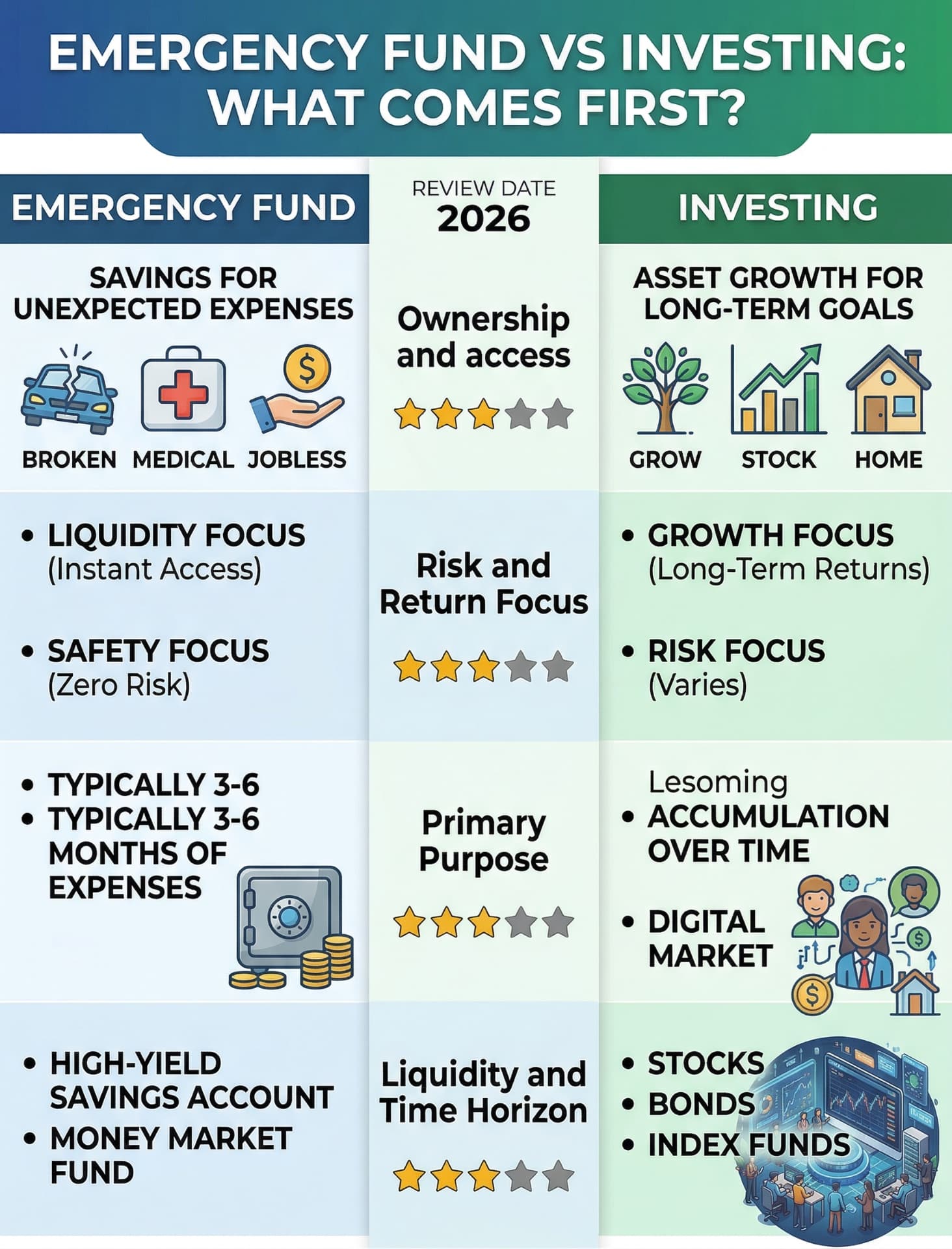
Build a starter emergency fund of $1,000–$2,000 first, then invest while building to 3–6 months of expenses — the optimal path isn't fully sequential, it's parallel. Start capturing your 401(k) match immediately.
our Emergency Funds & Investing guide vs. Investing: What Comes First? (2026 Guide)
By DadAlt Investments | Category: Personal Finance | Last Updated: March 2026
The emergency fund vs. investing debate is one of the most common money questions Americans face — and one of the most commonly answered wrong. The instinct is to frame it as either/or: "Should I save for emergencies or invest for the future?" The right answer is neither. It is a specific sequence, and the sequence matters more than the individual steps. According to a 2026 U.S. News survey, more than two in five Americans (43%) cannot cover a $1,000 unexpected expense with their savings, and Bankrate's 2026 Emergency Savings Report found that 27% of U.S. adults have no emergency savings at all. At the same time, millions of Americans are declining free money every paycheck by not capturing their employer's full 401(k) match. Both failures are preventable with the right priority order. This guide walks through the complete six-step sequence — from a $1,000 starter fund through maxing tax-advantaged accounts — explains the reasoning behind every step, addresses the legitimate case for investing before fully funding the emergency fund, and covers four specific situations including high-interest debt that changes the equation.
The Real Question: Why You Can't Just Do Both Equally
The core problem is that dollars are finite. Every dollar you send to a Roth IRA is a dollar not in a high-yield savings accounts account. Every dollar that sits in a savings account is a dollar not compounding in the market. When resources are limited, sequencing decisions are required — and understanding the priority logic prevents expensive mistakes in both directions.
The investing-without-an-emergency-fund trap: Investing without any cash reserve is structurally self-defeating. A single car repair — median cost $500–$900, according to industry repair data — can force you to sell an investment at whatever the current price happens to be, regardless of whether that price is good or bad. If the market is down 15% when your car needs a new transmission, you just locked in a 15% loss to fund a repair that a $1,000 savings buffer would have handled without touching investments at all.
The cash-hoarding-while-skipping-the-match trap: The other direction is equally damaging. Employees who accumulate cash savings while declining their employer's 401(k) match are leaving a guaranteed return on the table. The most common 401(k) match formula — 50% of contributions up to 6% of salary — represents an immediate 50% return on those dollars before the market moves a single point. No savings account rate comes close to that.1
The answer: Not "one first, then the other" — it is a specific, evidence-based sequence that optimizes both simultaneously where the math justifies it, and prioritizes correctly where it does not.
The Priority Sequence: Step by Step
The following sequence reflects the consensus of mainstream financial planning — from the "Financial Order of Operations" framework to Morningstar's Christine Benz to standard CFP-level advice — for managing savings and investing priorities when dollars are limited.2
Step 1: Build a $1,000 Starter Emergency Fund (Target: 30 Days)
Before anything else — before the 401(k) match, before the Roth IRA, before aggressive debt payoff — build a $1,000 cash buffer in a high-yield savings account (HYSA).
This single step changes the entire financial picture. With $1,000 in a dedicated savings account:
- A car repair does not become a credit card balance
- A medical copay does not derail your investing schedule
- An unexpected bill does not cause you to sell an investment at the worst possible time
The $1,000 figure is not arbitrary. It is the approximate cost of the most common financial emergencies: median car repair ($500–$900), typical ER visit copay ($300–$1,000), appliance replacement ($400–$800). Covering these without debt keeps the rest of the plan intact.
Where to keep it: A high-yield savings account (HYSA) earning approximately 4%–5% APY as of early 2026 — far above the FDIC national average savings rate of 0.39%. This $1,000 earns roughly $40–$50/year at current rates. Not transformative, but it is working while it waits.
30-day target: Set up an automatic weekly transfer from your checking account of $250/week for four weeks. Most people can find $250/week by temporarily pausing non-essential spending. Once the $1,000 is in place, move to Step 2.
Step 2: Capture 100% of Your Employer's 401(k) Match
The employer 401(k) match is the highest-returning financial move available to most working Americans. This step ranks second — above full emergency fund funding, above high-yield savings accumulation — because the math is simply unbeatable.
The most common 401(k) match formula in 2026, per Fidelity (which services approximately 25,000 plans): a dollar-for-dollar match on the first 3% of salary, plus 50% match on the next 2% — effectively a 4% employer contribution when you contribute 5% of your salary.1
A 50% partial match is a 50% guaranteed immediate return on those dollars. A 100% dollar-for-dollar match is a 100% guaranteed return before any market movement occurs. No savings account, no bond fund, no index ETF can match a guaranteed 50%–100% return on the same dollars.
The math on not capturing the match: An employee earning $70,000 with a 50% match up to 6% of salary who contributes only 2% instead of 6% loses approximately $1,400/year in free employer money. Over a 30-year career, with that $1,400/year growing at 7%, the cumulative cost of that decision exceeds $147,000 — for the sole reason of not adjusting a payroll contribution percentage.
Critical caveat — vesting schedules: Many employers have vesting schedules that prevent you from keeping the full match if you leave before a specified period (typically 3–6 years for graded vesting). According to Fidelity data, only 22% of 401(k) matches vest immediately. Before maximizing the match, confirm the vesting schedule and assess whether you intend to stay long enough to benefit.1
Step 3: Pay Off High-Interest Debt (Above 7%–8% APR)
With the $1,000 buffer in place and the 401(k) match captured, the next priority depends on your debt profile. Any debt carrying an interest rate above approximately 7%–8% APR should be paid off before building the full emergency fund.
The logic is mathematical: paying off a 20% APR credit card balance is equivalent to earning a guaranteed 20% risk-free return on that money. The S&P 500's long-run average return is approximately 10% annually — but that is not guaranteed, and it is not risk-free. Paying off a 20% credit card is a better financial decision than investing in the stock market in virtually every scenario.
Current context: As of 2026, the average credit card interest rate is approximately 22.83% APR — the highest in decades. Americans carry over $1.2 trillion in credit card debt. Any credit card balance at these rates represents a financial emergency that takes priority over building a 3–6 month cash reserve.3
The threshold: Debt at 7%–8% APR or higher (auto loans, personal loans, credit cards) should be eliminated before fully funding the emergency fund. Debt at below 5% APR (some student loans, mortgages) is typically low enough to coexist with emergency fund building and investing — the math favors investing over paying down ultra-low-rate debt.
Step 4: Build the Full Emergency Fund to 3–6 Months of Essential Expenses
With high-interest debt cleared and the 401(k) match captured, the full emergency fund becomes the priority. The standard recommendation of 3–6 months of essential expenses in liquid, FDIC-insured savings is the foundational financial security measure that enables everything else in the plan.
Where to keep the full emergency fund: A high-yield savings account at an online bank. As of early 2026, competitive HYSA rates range from approximately 4%–5% APY — dramatically more than the 0.39% national average at traditional banks. The emergency fund is not an investment; it is insurance. It should be liquid (accessible within 1–2 business days), FDIC-insured (up to $250,000 per depositor per institution), and completely separate from your checking account to prevent casual spending.
Step 5: Max Your Roth IRA, Then Additional 401(k) Contributions
Once the full emergency fund is in place, redirect the freed-up cash flow toward tax-advantaged retirement accounts:
Priority order within tax-advantaged accounts:
- Roth IRA first — $7,500 annual limit in 2026 for investors under age 50; $8,600 for age 50 and older. All growth is permanently tax-free. Same investments as any taxable account (VTI, FZROX, index ETFs) but with zero taxes on growth, dividends, and qualifying withdrawals. Open at Fidelity ($0 minimum, FZROX at 0.00% expense ratio) or Schwab ($0 minimum, free Intelligent Portfolios robo-advisor at $5,000).
- Additional 401(k) contributions — up to the 2026 limit of $23,500 (under age 50) after maxing the Roth IRA, if cash flow allows.
Roth IRA income phase-out for 2026:
- Single filers: phases out between $153,000–$168,000 MAGI
- Married filing jointly: phases out between $242,000–$252,000 MAGI
If your income exceeds these thresholds, a Backdoor Roth IRA conversion strategy may be appropriate — consult a tax professional.
Step 6: Taxable Brokerage Investing for Surplus Capital
After all tax-advantaged accounts are maxed and the emergency fund is fully funded, any remaining investable surplus goes into a taxable brokerage account at Fidelity, Schwab, or a similar platform. The taxable account holds the same index ETFs (VTI, SCHB, FZROX) as your Roth IRA — just without the permanent tax shelter.
Why the $1,000 Buffer Comes Before Anything
The $1,000 starter emergency fund comes before every other step — including the 401(k) match — because it breaks the debt cycle that derails every other financial priority.
The Federal Reserve's 2024 Survey of Household Economics and Decisionmaking (SHED) found that roughly 31% of U.S. adults could not pay an unexpected $400 expense using only savings — they would need to borrow or sell something. When these Americans encounter an unexpected expense and have no cash reserve, the standard response is to charge it to a credit card at 22.83% APR.3 That credit card balance then compounds monthly, costing far more than the original expense and making every other financial goal harder to achieve.
The $1,000 buffer is a circuit breaker. It interrupts the debt cycle at the most critical point: the moment an emergency occurs. With $1,000 available in cash, the overwhelming majority of common financial emergencies can be handled without adding debt. The single month of temporary sacrifice required to build it returns value for years afterward.
Why start here, not with the 401(k) match? Because a 401(k) match requires a sustained contribution rate that is impossible to maintain if every small emergency forces you into credit card debt. The $1,000 buffer stabilizes the foundation so every other step in the sequence can actually be executed consistently.
The 401(k) Match Exception: Why It Jumps the Queue
Once the $1,000 buffer is in place, the employer 401(k) match jumps the queue — before the full emergency fund, before paying off moderate-rate debt, before the Roth IRA — because no other available financial move offers a comparable guaranteed return.
The three match structures and their implied returns:
- Dollar-for-dollar match up to 6% of salary: Contribute $6,000 on a $100,000 salary → employer adds $6,000 → instant 100% return on those dollars before any investment return
- 50% match up to 6% of salary (most common): Contribute $6,000 → employer adds $3,000 → instant 50% return on those dollars
- No match: This changes the sequence — without an employer match, the Roth IRA should be prioritized before additional 401(k) contributions beyond the minimum
The average 401(k) employer match in 2026 is 4%–6% of salary, with the most common structure being a 50% partial match up to 6%. More than 85% of 401(k) plans for which Fidelity is the service provider offer some form of employer contribution.1
What skipping the match actually costs: An employee at $75,000/year with a 50% match up to 6% ($4,500/year employer cap) who contributes only 2% instead of 6% leaves $1,500/year on the table. At 7% average return over 30 years, that $1,500/year compounds to approximately $142,000 in foregone retirement wealth — for a decision that costs nothing to correct.
The vesting reminder: Some employers use cliff vesting (no match until 2–3 years of service) or graded vesting (match vests gradually over 3–6 years). Confirm your vesting schedule. If you plan to leave before fully vesting, the match calculation changes — though for most employees in stable positions, capturing the full match remains the right choice even with a multi-year vesting schedule.
The Opportunity Cost Argument for Investing Before Fully Funding the Emergency Fund
The most common challenge to the sequence above comes from investors who recognize the very real opportunity cost of holding cash in a savings account rather than investing it.
The valid concern: Markets compound daily. Every month a dollar sits in a savings account earning 4.5% instead of invested in the stock market (historically ~10%/year long-term) represents approximately 0.46% of foregone potential return per month. On $20,000 held in a savings account for 12 months instead of invested in the market, the opportunity cost could be several hundred to several thousand dollars in a strong market year.
The counter-argument — and why it wins: The emergency fund does not cost you market returns. It protects the market returns you have already earned and will earn in the future.
Consider this scenario: You invest $20,000 in VTI instead of keeping it in a savings account. Three months later, you lose your job and need cash. The market is down 30% (entirely normal during economic downturns — the S&P 500 fell 34% in early 2020 and 57% from peak during 2008–2009). You are forced to sell $15,000 in VTI to cover living expenses. That $15,000 sold at a 30% loss is worth only $10,500 — you permanently destroyed $4,500 in wealth because you had no cash buffer and were forced to sell at the worst possible time.
A $15,000 emergency fund in a HYSA at 4.5% APY would have earned approximately $675/year. The forced sale at a 30% market low cost $4,500. The "expensive" savings account was the right decision by a factor of nearly 7 to 1 in this scenario.2
The emergency fund IS part of the investment strategy. It is the protection layer that prevents behavioral destruction of the investment portfolio. Without it, the sequence of returns risk — the risk that a large negative return occurs at exactly the wrong time — transforms from a statistical concern into a personal financial crisis.
What "3–6 Months of Essential Expenses" Actually Means
The standard recommendation of "3–6 months of living expenses" sounds larger than it is — and discourages people from starting because the number feels overwhelming. The key word is essential expenses, not total spending.
Essential expenses include:
- Housing (rent or mortgage, property tax, insurance)
- Utilities (electricity, gas, water, internet)
- Groceries and basic food costs
- Health and life insurance premiums
- Vehicle payments and insurance
- Minimum debt payments
- Childcare costs essential for maintaining employment
Essential expenses do NOT include:
- Dining out and restaurants
- Entertainment subscriptions (streaming, gym)
- Discretionary shopping
- Vacations
- Any spending that would naturally pause during a financial emergency
A practical example: A family with $7,000/month in total spending might have $4,500/month in essential expenses. Their emergency fund target is $13,500 (3 months) to $27,000 (6 months) — not the $21,000–$42,000 it would be if calculated on total spending.
How Many Months?
The right target depends on your specific risk profile:
- 3 months: Single-income household with a stable, in-demand job in a growing field; dual-income household with no dependents
- 4–5 months: Dual-income household with children; employees in cyclical industries; those with variable income
- 6 months or more: Single-income households with dependents; self-employed individuals; employees in industries prone to layoffs; those in specialized or high-income roles that take longer to replace if lost
Historical context: During the Great Recession, median unemployment duration extended well beyond six months for many workers — particularly those in management and specialized professional roles that took longer to replace. A six-month fund would have been insufficient for a significant percentage of unemployed workers during that period.
Where to Keep It: HYSA, Not Savings
Your full emergency fund belongs in a high-yield savings account at an online bank, not a traditional savings account earning 0.39%. Top HYSA rates as of early 2026 range from approximately 4%–5% APY. On a $15,000 emergency fund:
- Traditional bank at 0.39%: earns approximately $59/year
- HYSA at 4.5%: earns approximately $675/year
The HYSA earns $616 more annually for the same balance — with identical FDIC insurance, identical liquidity, and no added risk.3
The emergency fund should be separate from your checking account — not in the same bank, ideally. Proximity creates temptation. When the fund is two clicks away at the same bank, it becomes a de facto discretionary spending buffer. When it requires a separate login at a separate institution, it stays where it belongs.
Special Case: What to Do If You Have High-Interest Debt AND No Emergency Fund
This is the most stressful financial position to be in, and unfortunately one of the most common. According to Bankrate's 2026 survey, 29% of Americans have more credit card debt than emergency savings. The correct sequence for this specific situation:
Step 1 — Build the $1,000 starter emergency fund first Do not begin an aggressive debt payoff before building the $1,000 buffer. Why: if you pay down $3,000 of credit card debt and then your car needs $800 in repairs, you will immediately re-accumulate $800 in credit card debt. The buffer prevents this cycle.
Step 2 — Capture the employer 401(k) match Even with credit card debt at 20%+ APR, capturing a 50%–100% guaranteed return from the employer match typically wins. A 50% employer match on a 6% contribution is a 50% guaranteed return — it still beats a 22% credit card interest rate mathematically, because the match is a guaranteed immediate 50% return while the credit card debt is a 22% guaranteed cost. This is the one exception that remains in place regardless of debt level.
Step 3 — Attack high-interest debt aggressively before building the full emergency fund Do not fully fund the emergency fund before eliminating 20%+ APR credit card debt. The math does not support it: keeping $15,000 in a HYSA at 4.5% while carrying $15,000 in credit card debt at 22% APR costs approximately $2,625/year in net interest. The right move is to use savings accumulation dollars to eliminate the high-rate debt first, then redirect that freed-up cash flow to emergency fund building.
Step 4 — Once high-interest debt is cleared, build the full emergency fund With credit card debt eliminated and the match captured, resume the standard sequence: full emergency fund to 3–6 months of essential expenses, then Roth IRA, then additional 401(k).
FAQ
Should I Invest or Save for an Emergency Fund If I'm Behind on Retirement?
Both — in the right order. Being behind on retirement does not change the sequence; it raises the urgency.
The critical question is whether you have an employer match available. If yes, capture the full match before any other investing — it is still the highest-returning move. Then build the full emergency fund. Then maximize Roth IRA contributions. Morningstar's Christine Benz specifically notes that a Roth IRA can serve as a partial emergency fund multitasker while you are behind — because Roth IRA contributions (not earnings) can be withdrawn at any time, for any reason, without penalty or taxes. If you contribute $7,500 to a Roth IRA this year and face an emergency in year two, you can withdraw up to $7,500 of those contributions without penalty — while the account has been growing tax-free in the meantime.2
This Roth IRA dual-function strategy is particularly useful for investors who are behind on retirement and do not want to delay investing entirely while building the emergency fund. Contribute to the Roth IRA, invest the contributions in a conservative money market fund or short-term bonds within the account, and treat the contributions as a secondary emergency reserve while building the primary HYSA fund. Once the HYSA is fully funded, shift the Roth IRA investments to index funds.
Can My Emergency Fund Be in a Roth IRA Instead of a HYSA?
Partially yes — with a specific caveat.
Roth IRA contributions (the money you put in) can be withdrawn at any time, penalty-free and tax-free, at any age. If you contributed $7,500 to a Roth IRA, you can withdraw up to $7,500 at any point without penalties. In this sense, a Roth IRA does provide emergency fund functionality for the contribution amount.
The caveat: Roth IRA earnings (the growth on your contributions) cannot be withdrawn before age 59½ without a 10% penalty and income taxes. Additionally, Roth IRA assets are invested in securities that fluctuate in value — if the market drops 30% when you need emergency funds, you would either withdraw at a loss or be unable to withdraw earnings without penalty.
The practical approach:
- Your primary emergency fund should be in an FDIC-insured HYSA — no market risk, fully liquid
- A Roth IRA contributions balance can serve as a secondary emergency backstop if your HYSA fund falls short
- Do not rely solely on a Roth IRA as an emergency fund if your balance is primarily investment earnings
How Long Should It Take to Build a 6-Month Emergency Fund?
With focused effort, most households can build the full emergency fund in 12–24 months after completing Steps 1 and 2.
A practical timeline for a household with $4,500/month in essential expenses targeting a $27,000 (6-month) fund, saving $500/month dedicated to the emergency fund:
- $500/month → $27,000 in 54 months (4.5 years) — too slow
- $1,000/month → $27,000 in 27 months (2.25 years) — achievable with focused effort
- $1,500/month → $27,000 in 18 months — aggressive but possible for many households
Ways to accelerate the timeline:
- Temporarily pause discretionary spending (subscriptions, dining out, entertainment)
- Apply tax refunds, work bonuses, or side income directly to the emergency fund
- Automate a transfer from every paycheck — treat it like a bill
- Use a separate HYSA account specifically labeled "Emergency Fund" — psychological labeling reduces temptation to spend it
The HYSA interest also accelerates the timeline: $675/year in interest on a $15,000 average balance during the accumulation phase adds roughly $56/month to the effective savings rate.
Is a HYSA or a Money Market Fund Better for an Emergency Fund?
Both are appropriate, with important differences:
High-Yield Savings Account (HYSA):
- FDIC-insured up to $250,000 per depositor per bank
- Earns approximately 4%–5% APY at top online banks (March 2026)
- Instantly accessible — transfers to checking within 1–2 business days
- Rate fluctuates with Federal Reserve policy — not locked in
Money Market Fund (at a brokerage):
- Not FDIC-insured — covered by SIPC up to $500,000 in securities (not the same protection)
- Earns approximately 4%–5% currently — competitive with HYSAs
- Accessible but may require selling shares and waiting for settlement (1 business day)
- Extremely stable history (money market funds have maintained $1/share with rare exceptions)
Money Market Deposit Account (at a bank):
- FDIC-insured like a HYSA
- Typically slightly higher minimum balance requirements
- Similar yields to HYSA
The recommendation: Use an FDIC-insured HYSA at an online bank as the primary emergency fund vehicle. The FDIC insurance provides cleaner protection than SIPC for a fund specifically designed to be available when you need it most — which may be during exactly the kind of economic disruption that stresses financial institutions. For balances above the $250,000 FDIC limit, spread funds across multiple FDIC-insured banks or use Treasury bills. Morningstar recommends "plain-vanilla cash investments: checking and savings accounts, CDs, and money market accounts" for emergency funds — not chasing extra yield with risk.2
Sources and References
Disclaimer: This article is for informational and educational purposes only and does not constitute financial, tax, or investment advice. Individual financial situations vary — the sequence described here represents general guidance that may not apply to every circumstance. Consult a qualified financial advisor for personalized advice. IRA contribution limits and income phase-outs cited are for the 2026 tax year. DadAlt Investments may earn affiliate commissions from some links in this article at no cost to you.
Recommended Reading
- The Dad's Guide to Emergency Funds & Investing
- How Much Should You Keep in Cash vs Investments?
- The Ultimate Beginner's Guide to Investing
Footnotes
-
Fidelity Investments. "How Does a 401(k) Match Work? Average 401(k) Match." June 2025. https://www.fidelity.com/learning-center/smart-money/average-401k-match — Most common 401(k) match formula at Fidelity: dollar-for-dollar on first 3% of salary + 50% on next 2% = 4% employer contribution when employee contributes 5%. More than 85% of Fidelity-serviced plans offer some employer contribution. 2026 401(k) contribution limit: $23,500 under age 50. Average 401(k) employer match in 2026: 4%–6% of compensation. Vesting: only 22% vest immediately; graded and cliff vesting schedules common. Carry.com (2026): most common structure is 50% partial match on contributions up to 6% of salary. Nasdaq/GoBankingRates (2025): average match 4%–6%; most common structure 50% partial match up to 6%. ↩ ↩2 ↩3 ↩4
-
Morningstar / Christine Benz. "How to Set and Invest Your Emergency Fund." December 2025 / March 2026. https://www.morningstar.com/personal-finance/how-set-invest-your-emergency-fund — Emergency fund should cover essential expenses only (housing, insurance, utilities, food) not total spending; 3–6 months standard; building emergency fund does not require halting long-term investing. Roth IRA contributions can be withdrawn penalty-free at any time — can serve as secondary emergency backstop while building primary HYSA. Emergency fund should be in FDIC-insured plain-vanilla cash: savings accounts, CDs, money market accounts. Do not invest emergency fund in stocks or bonds. SoFi/Brian Walsh CFP: short-term money priority is access and liquidity, not returns; HYSA or cash equivalent appropriate. ↩ ↩2 ↩3 ↩4
-
U.S. News Financial Wellness Survey. "Survey: 43% of Americans Don't Have Savings to Pay for a $1,000 Emergency." February 4, 2026. https://www.usnews.com/banking/articles/2026-financial-wellness-survey — 43% of Americans surveyed couldn't pay a $1,000 emergency expense from savings; median emergency fund balance $5,000 (down 50% from prior year); one-third don't have enough savings for one month of living expenses. Bankrate 2026 Emergency Savings Report (December 2025 survey): 27% of U.S. adults have no emergency savings; 29% have more credit card debt than emergency savings. Capital Counselor (2026): average credit card APR approximately 22.83%; Americans carry over $1.2 trillion in credit card debt; 53% living paycheck to paycheck. Federal Reserve SHED 2024 (published May 2025): roughly 31% of U.S. adults could not pay an unexpected $400 expense using only savings. HYSA rates as of early 2026: top online banks offering 4%–5% APY vs. FDIC national average 0.39%. ↩ ↩2 ↩3
Frequently Asked Questions
Should I save an emergency fund or invest first?
Do both simultaneously. Step 1: $1,000–$2,000 starter emergency fund. Step 2: Capture employer 401(k) match (free money). Step 3: Build emergency fund to 3–6 months while investing above the match.
How much emergency fund do I need before investing?
A $1,000–$2,000 starter fund covers most minor emergencies. Don't wait until you have 6 months saved — that could take years of missed compounding. Start investing with small amounts while your safety net grows.
Where should I keep my emergency fund?
A high-yield savings account earning 4–5% APY. It needs to be liquid (accessible within 1–2 business days), FDIC-insured, and completely separate from your investment accounts to avoid temptation.

About the Author
Jared DeValk
Founder, DadAlt Investments
Father, alternative investment researcher, and founder of DadAlt Investments. 14+ years turning hard lessons into honest guidance for dads building real wealth.