
How to Teach Your Kids About Money
Fun family financial literacy system.
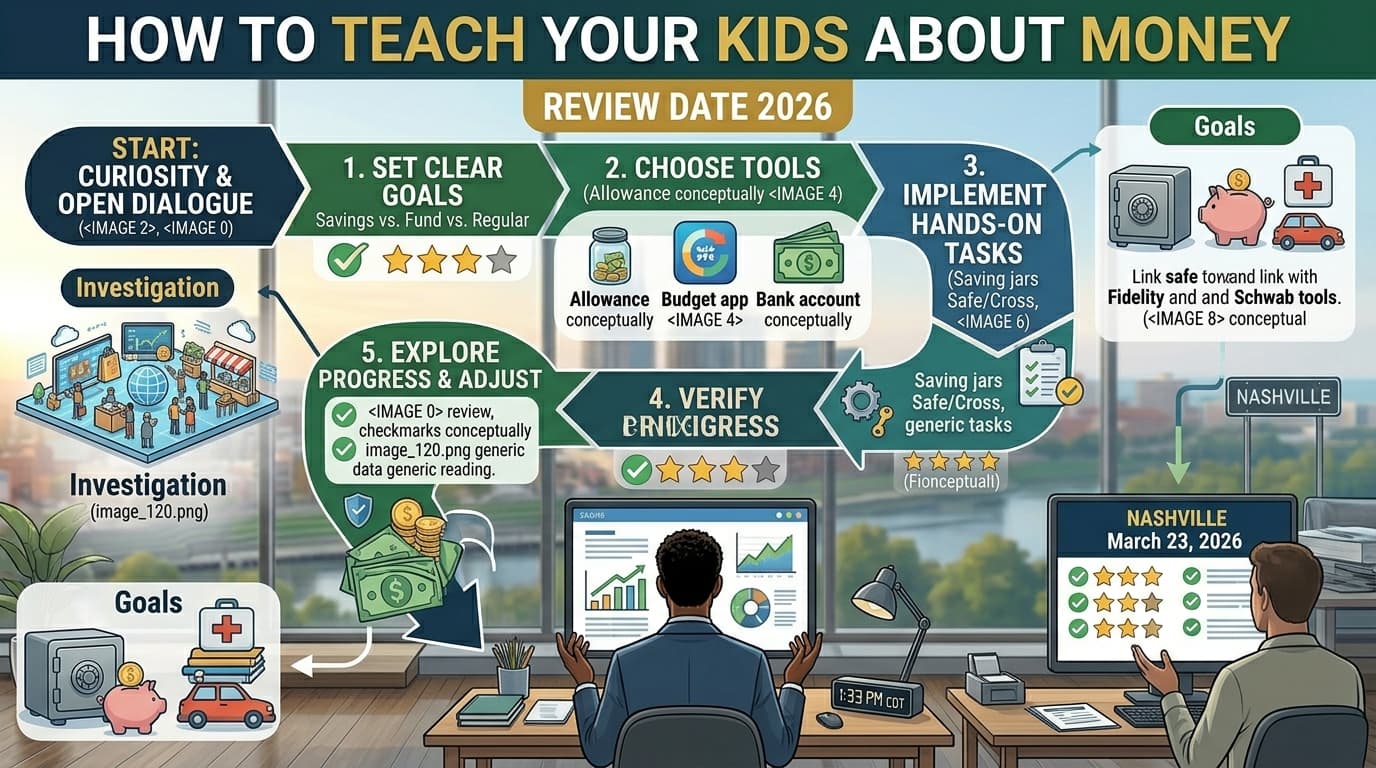
The Short Answer
The best way to teach kids about money is through hands-on experience — give them an allowance tied to choices, open a custodial investment account, and talk openly about family financial decisions at age-appropriate levels.
How to Teach Your Kids About Money
Category: Beginner Guides | Investment Mindset | Guides & How-To's Target Keywords: teach kids money, financial literacy, kids and money Tags: Beginner Guides · Investment Mindset · Guides & How-To's
Disclaimer: This article is for educational and informational purposes only and does not constitute financial, investment, tax, or legal advice. DadAlt Investments may receive affiliate compensation from Greenlight, Fidelity, Vanguard, and Schwab, Charles Schwab, and other financial companies referenced in this article. This never influences our editorial recommendations. Product features, pricing, and tax rules may change; always verify current details directly with product providers and consult a qualified financial or tax professional before opening accounts for minors.
Summary
Financial literacy isn't taught in most American schools — and even where it is, it's not enough. As of 2024, 35 states require a personal finance course for high school graduation, according to the Council for Economic Education's biennial Survey of the States. That sounds promising until you consider what it means for the other 15 states, where millions of kids can graduate without a single lesson on budgeting, credit, or compound interest. Even in states that do require it, a semester-long class at 17 years old is far too late to establish foundational money habits. Research from the University of Michigan and West Virginia University has found that children begin forming core money attitudes and behaviors as early as age five to seven — which means the real classroom for financial literacy is your home, and the teacher is you. The good news is that you don't need a finance degree to do this well. You just need a simple, age-appropriate system and the willingness to start the conversation. This guide walks through exactly that: how to teach your kids about money from the earliest years through college and beyond, with practical tools, research-backed activities, and the specific financial products that make each stage of the journey more effective.
Introduction: Financial Education Starts at Home — Not at School
Here's an uncomfortable truth that most dads don't hear often enough: the financial habits your children develop before they leave your house will shape their relationship with money for the rest of their lives. Not the half-semester they spend in a high school personal finance class, not the YouTube videos they watch in college, and not the hard lessons they learn after their first credit card bill arrives.
Research published in the Journal of Behavioral Decision Making by University of Michigan Professor Scott Rick and colleagues found that children as young as five already show distinct emotional reactions to spending and saving — and that these reactions predict real-world financial behavior as they grow. A 2025 Penn State Extension review confirmed this, finding that children who receive money lessons by age seven develop stronger lifelong money habits than those whose financial education begins in their teen years.
Financial literacy among U.S. adults remains alarmingly low, with the average financial literacy rate standing at just 48%, according to a 2024 Moneyzine article. Generation Z demonstrates the lowest financial literacy rate among all U.S. generations, with only 38% able to correctly answer basic financial questions.
Those are your kids' future peers. But here's the flip side: 81% of children surveyed trust their parents the most to teach them about money, according to Acorns' 2024 Money Matters Report for Kids. They're already looking to you. The question is whether you'll take that opening.
This guide lays out a clear, stage-by-stage financial education plan from ages 5 through 18 and beyond — one that evolves as your kids do, introduces real tools at the right time, and builds the kind of financial independence that will make you proud and spare them a lot of pain.
Why Financial Education Starts at Home
Before diving into the how, it's worth understanding why the school system can't be your backup plan.
As of 2024, 35 states now require personal finance courses and 28 mandate economics for high school graduation, according to the Council for Economic Education's 2024 Survey of the States. As of April 2025, 27 states require high school students to take a personal finance course to graduate, up from just six in 2019, according to the National Endowment for Financial Education (NEFE).
That momentum is real progress. But progress still leaves tens of millions of students without any mandated financial instruction at all. And for those who do receive it, a single semester in the final year of high school is teaching money skills to someone who has already developed a decade-plus of financial attitudes and habits — mostly from watching you.
A majority of teens, 75%, rely on their families for financial education, while only 52% learn about personal finance at school.
Polling from NEFE's fall 2025 survey found that 70% of respondents who did not take financial education stated their current quality of life would be better if they had the opportunity to take it.
The conclusion is clear: you don't need to be a financial expert to give your kids a strong foundation. You need to be intentional, consistent, and willing to use the windows of opportunity that each developmental stage opens up.
Ages 5–8: The Foundation — Money Is Earned, Not Given
The Core Concept
The most important lesson for young children isn't about interest rates or investing — it's far simpler and far more powerful: money comes from work. Not from wallets, not from ATMs, and not from tapping a phone. Before kids can understand any other financial concept, they need to feel, in their bones, the relationship between effort and earning.
This is also the stage where emotional patterns around money are established. Research from the University of Michigan found that children as young as five already exhibit "spendthrift" or "tightwad" tendencies — distinct emotional reactions to spending — that predict adult financial behavior. The good news: these patterns can be shaped. Early, consistent money conversations make a measurable difference.
The Tool: The 3-Jar System
The most effective tool for this age group is breathtakingly simple. Three clear jars, labeled and placed somewhere visible in the home:
- Spend — for immediate purchases: a candy bar, a small toy, a book
- Save — for a specific goal they can see and name: a Lego set, a game, a special outing
- Give — for someone or something beyond themselves: a family charity, a school fundraiser, a gift for a sibling
When your child earns money — through chores, birthday gifts, or a small "job" around the house — they divide it among the three jars with your guidance. The split doesn't need to be precise. A rough starting ratio of 60% spend, 30% save, 10% give works for most young kids and can be adjusted as they develop their own preferences and goals.
Finance researchers and educators have found that children begin forming money habits between three and seven years of age. Spending and saving are the most basic money concepts you can introduce at this stage.
Why jars and not an app or a bank account? Because at this age, tangibility is everything. Watching real coins accumulate in a clear jar, physically counting them, and feeling the jar get heavier as savings grow are experiences that abstract digital numbers can't replicate. Cash makes the lesson stick.
40% of kids who receive an allowance associate money with feeling happy, confident, and excited, compared to just 30% of kids who don't earn an allowance. 21% of kids who don't earn an allowance reported feeling stressed about money, compared to just 13% of kids who do.
The Activity: Chores Tied to an Allowance
At this age, connect a small weekly allowance to age-appropriate chores. The work doesn't need to be sophisticated — picking up toys, helping set the table, feeding a pet, matching socks from the laundry. What matters is the connection: work happens → money is earned → money is divided → decisions get made.
A commonly used starting guideline is $1 per year of age per week — so a 6-year-old earns $6/week. The exact amount matters less than the consistency of delivery and the ritual of dividing it into the three jars together.
The Lesson: Delayed Gratification
Once the Save jar has some money in it, have your child set a specific goal. Write the goal on a slip of paper and tape it to the jar. Put a picture of the item next to the jar. Every time allowance is divided, talk about how much closer they are to the goal.
This is teaching delayed gratification — one of the most powerful and predictive traits in childhood development. Decades of research (including the famous Stanford Marshmallow Study and its successors) connect the ability to delay reward at young ages with better outcomes across financial, academic, and life metrics. The Save jar is one of the simplest and most consistent ways to practice this skill.
Ages 9–12: Building Good Habits — Budgeting and Opportunity Cost
The Core Concept
By age nine or ten, kids shift from purely emotional to increasingly rational financial decision-making. This is the window to introduce two abstract-but-critical concepts:
- Budgeting: you have a fixed amount of money, and choices about where it goes have real consequences
- Opportunity cost: every time you choose to spend on one thing, you're choosing not to spend on something else
These aren't just economics vocabulary. They're life skills. A 10-year-old who understands that buying the $40 video game means waiting two more months for the new sneakers is thinking like a financially capable adult.
The Tool: Greenlight Debit Card
This is the right age to graduate from physical jars to a digital money management tool — one that still maintains parental visibility and control. Greenlight is the leading kids' debit card and financial education platform in the United States.
How Greenlight works:
- Parents load money onto the card (allowance, earnings, gifts)
- Kids can only spend what's on the card — there's no overdraft or debt
- Parents set spending controls by merchant category (or specific stores) and receive real-time notifications for every purchase
- The app allows parents to automate allowance on a weekly, bi-weekly, or monthly schedule — including setting chore completion as a requirement before allowance is released
- Kids can split their balance into Save, Spend, and Give categories within the app (a digital evolution of the jar system)
- An optional investing feature (on higher-tier plans) lets kids learn about stocks with parental approval on every trade
- Greenlight offers Level Up™ — gamified, age-appropriate financial literacy lessons built directly into the app
The Greenlight debit card has been awarded "Best Checking for Kids and Teens" for 2026 by FinanceBuzz. Over six million people have used Greenlight as of January 2025. There is no minimum age requirement for the Greenlight debit card, and plans support up to five kids.
Greenlight pricing (2026):
| Plan | Monthly Cost | Key Features |
|---|---|---|
| Core | $4.99/month | Debit card, spending controls, allowance automation, basic savings |
| Max | $9.98/month | Everything in Core + investing + 1–5% savings reward |
| Infinity | $14.98/month | Everything in Max + identity protection, driving reports, family location sharing |
All plans include cards for up to 5 children. One free month trial available.
Greenlight is FDIC-insured through Community Federal Savings Bank and is registered with the SEC as Greenlight Investment Advisors, LLC — a member of FINRA and SIPC.
The Activity: The Clothing Budget Test
One of the most effective real-world exercises at this age is giving your child a clothing budget and letting them manage it. Before back-to-school shopping, tell your 10- or 11-year-old: "We have $150 for clothes this season. You're in charge of deciding how to spend it." Then take them to the store — or browse online together — and let them make the decisions.
What happens is remarkable. Kids who are spending "their" budget are suddenly interested in sale racks, comparison shopping, and trade-offs they'd completely ignore when you're paying. The $55 hoodie feels very different when it consumes 37% of their total budget. That's opportunity cost in action — no worksheet required.
The Lesson: Wants vs. Needs
This is also the age to have direct conversations about the difference between wants (things that make life more fun or comfortable) and needs (things required to function). Grocery shopping is an ideal classroom. When you're at the store, narrate your own decisions out loud: "These brand-name crackers cost $4.50. The store brand is $2.00. They taste almost identical to me, so I'm buying the store brand and saving $2.50."
You don't need to lecture. You need to model — and then ask questions. "Which of these is a need and which is a want?" is one of the most educational questions you can ask a child in a grocery aisle.
Ages 13–17: Introduction to Investing — Time Is the Asset
The Core Concept
Teenagers can finally grasp abstract financial concepts like compound interest, market returns, and the relationship between time and wealth. This is the age to make investing real — not theoretical — by giving them actual skin in the game, even if it's a small amount.
The single most powerful lesson you can teach a teenager about money is this:
$7,500 invested at age 15, left untouched, could grow to approximately $880,000 by age 65 — assuming a 10% average annual return consistent with long-run S&P 500 performance.
That number comes from Motley Fool's analysis of a single annual Roth IRA providers contribution. The math is straightforward: 50 years of compound growth at 10% turns one year's maximum Roth IRA contribution into nearly a million dollars. No additional contributions required.
This is why the teen years — not the 30s, not the 40s — are when the most powerful investing decisions get made. Every year of delay costs exponentially more to recover in later life.
Tool #1: Fidelity Youth Account
The Fidelity Youth Account is a teen-owned brokerage account for ages 13–17. It is one of the most powerful financial education tools available to American teenagers.
Key features:
- No fees, no minimums, no subscription cost — completely free to open and maintain
- Teens own the account outright (not a custodial account — the teen is the legal account holder)
- Teens can invest in stocks, passive income strategies, and mutual funds, with parent visibility and monitoring
- Includes a debit card for spending (with parental oversight)
- Access to the Fidelity Investments app with a dedicated learning tab featuring interactive lessons, videos, articles, and calculators built specifically for teens
- Teens who complete financial literacy levels earn reward dollars deposited directly into their account
- As of March 2026, the dedicated Fidelity Youth app is transitioning into the main Fidelity Investments app, where teens will gain access to more advanced investing tools
The Fidelity Youth Account is a teen-owned brokerage account that lets teens save and invest in one account. Teens can also request a debit card to spend from their account. It is not a joint account or a custodial account. There are no subscription fees, no account fees, and no minimums to open the account.
To open a Fidelity Youth Account, a parent must also hold a Fidelity account. The parent has oversight — visibility into balances and transactions — but the teen makes all investment decisions independently.
Tool #2: Schwab Custodial Account
For families who prefer a more traditional structure with full parental control over investment decisions, Charles Schwab's custodial brokerage account (a UTMA/UGMA account) is an excellent alternative.
In a custodial account, the parent or guardian controls all investment decisions until the child reaches the age of majority (18 in most states, 21 in a few). The account belongs to the child as a legal matter — assets are an irrevocable gift — but the adult manages the portfolio until the child takes over.
Key features of Schwab custodial accounts:
- No minimum balance, no account fees, $0 commissions on online stock and ETF trades
- Full access to Schwab's research, tools, and investment universe
- Parent controls all buys and sells until transfer of ownership
- Can be invested in best platforms for index fundss, ETFs, individual stocks, or any Schwab-eligible security
- Transfers to the child automatically at the age of majority
Fidelity Youth vs. Schwab Custodial — which is right for your teen?
| Feature | Fidelity Youth Account | Schwab Custodial (UTMA/UGMA) |
|---|---|---|
| Who controls investments? | Teen (with parent oversight) | Parent (until age of majority) |
| Account type | Teen-owned brokerage | Custodial (adult-managed) |
| Fees | $0 | $0 |
| Minimum | $0 | $0 |
| Age requirement | 13–17 | Any minor |
| Learning tools | Built-in educational content | Standard Schwab research tools |
| Converts at 18? | Teen already owns it | Transfers to teen at 18/21 |
Recommendation: Use the Fidelity Youth Account if your goal is to teach your teen to make their own investment decisions with real money, real consequences, and real ownership. Use a Schwab custodial account if you want to make investment decisions on behalf of a younger child and gradually hand over control as they mature.
The Activity: Pick One Stock or ETF and Track It
Give your teenager $50–$100 to invest in whatever they want — but require them to research it first. Ask them to answer three questions before they buy:
- What does this company do to make money?
- How has the stock performed over the past 5 years?
- What could go wrong?
Let them buy it. Let them watch it go up and down. Talk about why markets move. This exercise teaches more in six months than a semester of classroom theory — because it's real money, real decisions, and real outcomes.
For teens who are more interested in broad market exposure than stock-picking, a simple index ETF like VTI (Vanguard Total Stock Market ETF) or VOO (Vanguard S&P 500 ETF) teaches the same compound interest lesson with far less volatility and research burden.
The Lesson: Patience and Long-Term Thinking
The hardest thing to teach a teenager about investing is the thing that matters most: staying the course when markets fall.
Every teen who starts investing will eventually watch their portfolio drop. A market correction, a bad earnings report on their chosen stock, a broader economic downturn — it will happen. How they respond to that first major drop will set a pattern that lasts for decades. Talk about market history. Show them charts of the S&P 500 across multiple recessions — 2000, 2008, 2020 — and what happened to investors who held versus those who panic-sold. The lesson isn't that markets always go up immediately. The lesson is that long-term investors who stay invested historically come out ahead.
Ages 18+: Real-World Money Skills — The Launchpad
By the time your child leaves home, they need practical, functional skills — not more theory. This stage is about real accounts, real credit, real consequences, and the financial independence every parent hopes to see their kid achieve.
1. Open a Custodial Roth IRA the Moment They Have Earned Income
This is the single highest-leverage financial action you can take for your 18-year-old — or even your 14-year-old with a summer job. The moment your child has any earned income from a W-2 job, babysitting, mowing lawns, or freelance work, they are eligible to open a custodial Roth IRA.
2026 Roth IRA for Kids rules (confirmed by IRS, Fidelity, and U.S. Bank):
- Contribution limit: $7,500 or 100% of the child's earned income for the year — whichever is less
- Eligible income: W-2 wages, self-employment (babysitting, lawn mowing, pet sitting, etc.) — not allowance or cash gifts
- No minimum age — even a 10-year-old with documented earned income qualifies
- Under 18, a parent opens and manages the account as custodian; control transfers to the child at 18 (or 21 in some states)
- Parents can contribute to the account on the child's behalf, up to the child's total earned income
- Contributions (not earnings) can be withdrawn at any time without taxes or penalties
- Earnings grow entirely tax-free and can be withdrawn tax-free in retirement
The math is staggering. As a hypothetical example, just one $7,500 deposit into a Roth IRA for kids at age 15 could be worth over $200,000 after 50 years, assuming a 7% annual return. If the child continues to contribute up to the annual limit each year, they could have almost $4 million after 50 years.
Taking it a step further, if your child is 15 and you contribute the annual maximum to their IRA — $7,500 for 2026 — based on the long-term total return of the S&P 500, that single investment could grow to approximately $880,000 by the time they turn 65.
Where to open a custodial Roth IRA:
- Fidelity Roth IRA for Kids — no minimum, no account fees, $0 commissions on online stock and ETF trades; widely considered the best option for simplicity and educational tools
- Charles Schwab — no minimum, excellent service, solid research tools
- Vanguard — best for long-term index fund investing if you want a hands-off portfolio
Strategy tip: If your teen earns $3,000 this summer, let them keep their earnings to spend and enjoy. You contribute $3,000 of your own money to their Roth IRA. The rules allow this — the only requirement is that the total contribution doesn't exceed the child's actual earned income. You're effectively matching their summer wages with a retirement contribution that could compound into hundreds of thousands of dollars tax-free.
2. Teach the Basics of Credit Cards Before They Get One
Most 18-year-olds receive their first credit card offer within weeks of turning legal age. Without preparation, this is a trap. With preparation, a credit card is one of the most valuable financial tools available.
The core principles to teach:
- A credit card is not free money — it's a 30-day loan with an automatic repayment option
- Pay the full balance every month, every time — carrying a balance at 20%+ APR is financially destructive
- The credit score begins building the moment the card is used responsibly — on-time payments and low utilization are the two most important factors
- Never spend money you don't already have in your bank account — the card is a payment tool, not a spending expansion
One practical strategy: add your teen as an authorized user on one of your existing credit cards during high school. They get a card in their name, you see every transaction, and their credit history starts building before they ever apply on their own. When they turn 18, they already have a credit profile — which matters for apartment rentals, car loans, and even some job applications.
3. Student Loans: Understand What You're Signing
74% of U.S. teens lack confidence in their personal finance knowledge, yet 75% rely on their families for financial education — and nowhere is this gap more expensive than with student loans. College freshmen routinely sign loan documents worth $10,000–$20,000 per year without any real understanding of what they're agreeing to.
Before your child signs any financial aid paperwork, make sure they can answer:
- What is the total loan amount over four years?
- What will the monthly payment be after graduation?
- What percentage of your expected starting salary will go to loan payments?
- What are the federal income-driven repayment options if you can't afford standard payments?
A simple rule: total student loan debt at graduation should not exceed your expected first-year salary. If the degree program leads to a $45,000 starting salary, borrowing more than $45,000 for the degree puts you in a difficult financial position from day one.
4. Budgeting Their First Paycheck
When your child lands their first real job, sit down with them — before the first paycheck arrives — and build a simple budget together. Use the DadAlt 3-Bucket System from our Simple Budget System for Busy Dads article:
- Bucket 1 (50–60%): Non-negotiables — rent, utilities, groceries, minimum debt payments, transportation
- Bucket 2 (20–30%): Life — dining out, entertainment, clothing, discretionary
- Bucket 3 (10–20%): Future Self — 401(k) contributions (especially if there's an employer match), Roth IRA, emergency fund
The most important habit to establish immediately: automate Bucket 3 first. Set up a 401(k) contribution through their employer on day one — at minimum enough to capture any employer match. Set up a monthly transfer to a Roth IRA or savings account on the same day their paycheck hits. Then build their life around what remains.
Family Money Conversations That Actually Work
The tools and milestones matter — but the ongoing conversation matters more. Research consistently shows that children of financially engaged parents make better money decisions as adults, not because their parents taught them the right formulas, but because money became a normal, comfortable topic at home rather than a source of tension or shame.
Here are five conversation strategies that work at any age:
1. Be transparent about principles, not necessarily dollar amounts
You don't need to share your exact income or net worth with your kids. But you can absolutely share the principles behind your financial decisions: "We're saving for three months before buying that TV because we don't use credit for things we want — only things we need." That's more valuable than any number.
2. Use real-world moments as teaching opportunities
Every grocery trip, restaurant meal, vacation, and car purchase is a classroom. "I'm comparing prices on these two items — the store brand saves us $1.50." "We're taking a road trip instead of flying because it costs about $800 less for our family." Narrate your financial reasoning out loud. It normalizes the thought process.
3. Celebrate financial wins as a family
When you pay off a debt, hit a savings milestone, or make a smart purchase, celebrate it. "We just paid off the car — that's $450/month we can redirect to the vacation fund." Financial progress should feel like an achievement, not a private transaction.
4. Let them experience natural consequences
If a 10-year-old spends their entire week's allowance on candy on Monday and can't go to the movies on Friday, resist the urge to rescue them. The lesson — you can't spend the same dollar twice — delivered gently and without shame at age 10 is far less painful than the credit card version of that lesson at age 22.
5. Recommend age-appropriate books and resources
For teens and young adults, three books stand out for their accessibility and impact:
- Rich Dad Poor Dad by Robert Kiyosaki — a foundational introduction to the difference between assets and liabilities, and the mindset of financial independence vs. financial dependence
- The Richest Man in Babylon by George S. Clason — timeless principles about saving, investing, and building wealth, presented as parables set in ancient Babylon; highly readable for teens
- I Will Teach You to Be Rich by Ramit Sethi — a practical, no-nonsense guide aimed at young adults in their 20s; covers bank accounts, credit cards, 401(k)s, and automatic investing in plain language
None of these books require financial background. They're designed for beginners, and reading any one of them before or during college is worth more than most personal finance courses.
The DadAlt Financial Education Roadmap by Age
| Age Group | Core Concept | Primary Tool | Key Activity | Big Lesson |
|---|---|---|---|---|
| 5–8 | Money is earned, not given | 3-Jar System (Spend/Save/Give) | Chores tied to allowance | Delayed gratification |
| 9–12 | Budgeting and opportunity cost | Greenlight debit card | Clothing budget exercise | Wants vs. needs |
| 13–17 | Compound interest and investing | Fidelity Youth Account or Schwab Custodial | Pick and track one stock or ETF | Patience and long-term thinking |
| 18+ | Real-world money systems | Custodial Roth IRA, first credit card | Build first paycheck budget | Financial independence |
Conclusion: The Best Investment You'll Ever Make
Every financial article on this site is ultimately about building wealth and achieving independence. But none of the investments covered here — stocks, real estate, gold, crypto, retirement accounts — will have a greater total impact on your family's financial future than the financial education you give your children before they leave your home.
The research is unambiguous: money habits form early, family is the primary educator, and the gap between financially literate and financially illiterate adults is enormous — in wealth, in stress, in life outcomes. You don't have to be a financial expert. You just have to be intentional.
Start with three jars and a weekly allowance. Graduate to a Greenlight card. Open a Fidelity Youth Account when they're old enough to care about investing. Set up a Roth IRA the summer they earn their first paycheck. Talk about money at the dinner table — not with lectures, but with stories, decisions, and honest conversations about trade-offs.
That's the whole system. And 20 years from now, when your kids are financially independent adults making smart decisions with their own children, they'll know exactly where it started.
→ Related: Simple Budget System for Busy Dads | The Ultimate DadAlt Investment Playbook | paying off debt
Sources and References
-
University of Michigan / Michigan Ross — "New Research Shows Children Form Attitudes About Money at Young Age" — Study co-authored by Professor Scott Rick and colleagues, published in the Journal of Behavioral Decision Making; found that children as young as five have distinct emotional reactions to spending and saving money that translate into real-world financial behaviors; spending and saving tendencies in childhood were found to be independent of parental behavior; Professor Rick: "If parents wait until their children are teenagers to have serious discussions about money, they've already let a pretty formative decade pass." michiganross.umich.edu
-
Pennsylvania State Extension — "Empowering Youth by Building Early Financial Literacy Skills" (2025 review) — A 2025 Penn State Extension review found that "children as young as five years old had meaningful opinions about spending and saving money"; West Virginia University research reports that children who receive money lessons by age seven develop stronger lifelong money habits; Pew Research Center (2024) reports that only 41% of U.S. adults aged 18–29 feel knowledgeable about handling their finances; young adults with low financial literacy are more inclined to make poor financial decisions. extension.psu.edu
-
Cricket Media — "Building Money Smarts: How Early Financial Education Empowers the Next Generation" (February 25, 2025) — Financial literacy among U.S. adults stands at just 48% (2024 Moneyzine data); Generation Z has the lowest financial literacy rate at 38%; 74% of U.S. teens lack confidence in their personal finance knowledge; 75% rely on their families for financial education vs. 52% who learn at school; 63% of Americans believe personal finance should be taught in schools. cricketmedia.com
-
Acorns — "2024 Money Matters Report for Kids" — Survey conducted October 4–21, 2024 by Opinium Research; sample of 2,000 U.S. consumers ages 6–14 and 2,000 parents of Gen Alpha; 81% of children surveyed trust their parents the most to teach them about money; 40% of kids who receive an allowance associate money with feeling happy, confident, and excited vs. 30% of kids who don't; 21% of kids who don't earn an allowance reported feeling stressed about money vs. 13% who do. acorns.com/learn/acorns/money-matters-kids-report-2024
-
Council for Economic Education — "2024 Survey of the States" (March 2024) — Biennial survey of K–12 economic and personal finance education in all 50 states and D.C.; 35 states now require personal finance courses for high school graduation; 28 states mandate economics for graduation; 2023 cited as a "banner year" for financial education progress; council notes that "over a quarter of all students across the country will live in a state without a personal finance graduation requirement." councilforeconed.org/survey-of-the-states
-
National Endowment for Financial Education (NEFE) — "Poll: Majority of U.S. Adults Continue to Want Financial Education in High Schools" (April 2025) — SurveyUSA poll of 800 U.S. adults, March 3–5, 2025; 83% say their state should require a semester- or year-long personal finance course for graduation; 82% say they wish they were required to complete a personal finance class; 61% say their high school did not offer a personal finance class; 27 states currently require a personal finance course to graduate (as of April 2025). nefe.org/news/2025/04
-
NEFE — "Back-To-School Poll: Financial Education Considered an Essential Subject" (October 2025) — Verasight survey of 1,200 U.S. adults, August 11–15, 2025; "Economics/Personal Finance Education" and "Mathematics" were the only subjects selected by at least 75% of respondents as ideal core subjects; 70% of respondents who did not take financial education stated their current quality of life would be better if they had; four states — Kentucky, Colorado, Texas, and Delaware — passed financial education graduation requirement bills in 2025, bringing the total to 30 states with signed or pending laws. nefe.org/news/2025/10
-
PenFed Credit Union — "For Parents: Kids' Allowance Strategies That Really Work" — Greenlight app users between the ages of five and 19 received an average allowance of $12.98/week in 2024; According to Till Financial, the average weekly allowance for six-year-olds in 2024 was $5, and $28 for college-bound 18-year-olds; finance researchers and educators have found that children begin forming money habits between ages three and seven; 3-jar system (Spend/Save/Give) recommended as a core tool for young children. penfed.org
-
FinanceBuzz — "Greenlight Debit Card Review [2026]: One of the Best for You + Your Kids" (updated August 28, 2025) — Greenlight awarded "2026 Best Checking for Kids and Teens" by FinanceBuzz; over six million people have used Greenlight as of January 2025; BBB-accredited since December 2017 (B rating); Trustpilot score 3.8/5 from 5,500+ reviews; no minimum age; plans support up to five kids; FDIC-insured through Community Federal Savings Bank; registered with the SEC as Greenlight Investment Advisors, LLC; FINRA and SIPC member. financebuzz.com/greenlight-review
-
Nasdaq / WealthUp — "Our 5 Top Debit Cards for Kids & Teens" — Greenlight pricing: Core $4.99/month, Max $9.98/month, Infinity $14.98/month; all plans include cards for up to five children; free one-month trial available; Fidelity Youth Account features: dedicated Learn tab with financial literacy content, reward dollars for completing educational levels, debit card with parental oversight. nasdaq.com/articles/our-5-top-debit-cards-for-kids-teens
-
Fidelity Investments — Fidelity Youth Account Overview — Teen-owned brokerage account for ages 13–17; not a custodial account; teen is sole decision-maker; no subscription fees, no account fees, no minimums; teens can invest in stocks, ETFs, and mutual funds; debit card available upon request; parent must hold a Fidelity account; Fidelity Youth app transitioning to Fidelity Investments app in March 2026, with enhanced tools. fidelity.com/go/youth-account
-
Fidelity Investments — "Roth IRA for Kids" — Contribution limit: up to 100% of the child's earned income, maximum $7,000 for 2025 and $7,500 for 2026; eligible income includes babysitting, pet-sitting, mowing lawns, and other self-employment; no minimum age requirement; parent opens and manages account as custodian until age of majority (18 or 21 depending on state); contributions can be withdrawn at any time without taxes or penalties; earnings grow federal tax-free. fidelity.com/retirement-ira/roth-ira-kids
-
U.S. Bank — "Start a Roth IRA for Kids" — 2026 Roth IRA contribution limit for minors: $7,500 or total annual earned income, whichever is less; hypothetical example: one $7,500 deposit at age 15 could be worth over $200,000 after 50 years at 7% annual return; if a child contributes up to the annual limit each year, they could have almost $4 million after 50 years at the same rate; custodial Roth IRA stays a custodial account until the child reaches the age of majority (18 in most states), then converts to an individual Roth IRA. usbank.com/retirement-planning/roth-ira-for-kids
-
Motley Fool — "Roth IRA for Kids" (updated 2026) — 2026 Roth IRA limit rises to $7,500 (under 50); a $7,500 investment at age 15 could grow to approximately $880,000 by age 65 based on long-term S&P 500 returns; phase-out for Roth IRA single filers in 2026 begins at $153,000 and eliminates at $168,000; parents may contribute to a child's Roth IRA as long as total contributions do not exceed the child's earned income; self-employment income from babysitting, lawn mowing, etc. qualifies. fool.com/retirement/plans/roth-ira/for-kids
-
NerdWallet — "Custodial Roth IRA: Roth IRAs for Children" — 2026 Roth IRA limit: $7,500 or total of minor's earned income for the year, whichever is less; no minimum age — even babies with earned income can contribute; earned income includes W-2 employment and self-employment gigs such as babysitting or dog walking; contributions can be withdrawn at any time, tax-free and penalty-free; earnings follow standard Roth IRA qualified distribution rules (5-year rule + age 59½). nerdwallet.com/retirement/learn/why-your-kid-needs-a-roth-ira
-
Charles Schwab — "Roth IRA for Kids" — Custodial IRA overview; no account-opening or maintenance fees; minor must have earned income to contribute; Roth IRA structure especially advantageous for minors because most children owe little or no federal income tax, making the after-tax contribution essentially tax-free from the start; example from Schwab: starting at age 15 with $2,300/year until retirement vs. starting at 30 — early starter's account significantly outperforms later starter despite far fewer total dollars contributed. schwab.com/learn/story/roth-ira-for-kids
-
Vanguard — "Roth vs. Traditional IRA" — Confirmed 2026 Roth IRA income limits: single filers must earn less than $153,000 to contribute; married filing jointly must earn less than $242,000; yes, a minor with earned income can own and contribute to an IRA — income limits are based on the minor's income, not the parent's; IRA is controlled by a parent or custodian until the minor reaches the applicable age of majority. investor.vanguard.com/iras/roth-vs-traditional-ira
-
PBS NewsHour / Beth Kobliner — "Money Habits Are Set by Age 7: Teach Your Kids the Value of a Dollar Now" — By age 3, kids can grasp basic money concepts; by age 7, many of their money habits are already set; source is Beth Kobliner, personal finance journalist and author of Make Your Kid a Money Genius; served on President Obama's Advisory Council on Financial Capability for Young Americans; recommends cash allowance through high school to reinforce the tangible reality of spending, transitioning to debit apps before college. pbs.org/newshour/economy
-
InCharge Debt Solutions — "12 Useful Tips for Teaching Kids About Money" — Consumer Financial Protection Bureau research cited: children are "developmentally capable" of saving money at age 5; three-jar system (Save/Spend/Share) recommended as a core foundational tool; ties allowance to expectations and parental guidance — not just free money — for maximum educational impact; positive financial role modeling by parents is critical to child financial development. incharge.org/financial-literacy/budgeting-saving/teach-kids-to-save
Disclaimer: This article is for educational and informational purposes only and does not constitute financial, investment, tax, or legal advice. DadAlt Investments may receive affiliate compensation from Greenlight, Fidelity, Charles Schwab, Vanguard, and other financial companies referenced in this article. This never influences our editorial recommendations. Product features, pricing, and tax rules may change; verify current details directly with product providers. Roth IRA contribution limits, income thresholds, and tax treatment are based on 2026 IRS rules (IRS Notice 2025-67) and may change in future years. Compound interest calculations are hypothetical and for illustrative purposes only — actual returns will vary and past market performance does not guarantee future results. Consult a qualified fiduciary financial advisor and tax professional before opening investment accounts for minors.
Recommended Reading
Frequently Asked Questions
At what age should I start teaching my kids about money?
Start as early as age 3–4 with basic concepts like saving vs. spending. By age 7–8, introduce earning and budgeting. By 12–13, they're ready for investing concepts and custodial accounts.
Should I give my kids an allowance?
Yes — an allowance gives kids real practice making financial decisions. Whether tied to chores or given unconditionally, the key is letting them experience spending, saving, and regretting purchases with their own money.
How do I open an investment account for my child?
Open a custodial brokerage account (UTMA/UGMA) at Fidelity, Schwab, or Vanguard. You manage it until they're 18–21. Start with an index fund and let them watch compound growth in action.

About the Author
Jared DeValk
Founder, DadAlt Investments
Father, alternative investment researcher, and founder of DadAlt Investments. 14+ years turning hard lessons into honest guidance for dads building real wealth.