What Every Dad Should Know About Compound Interest
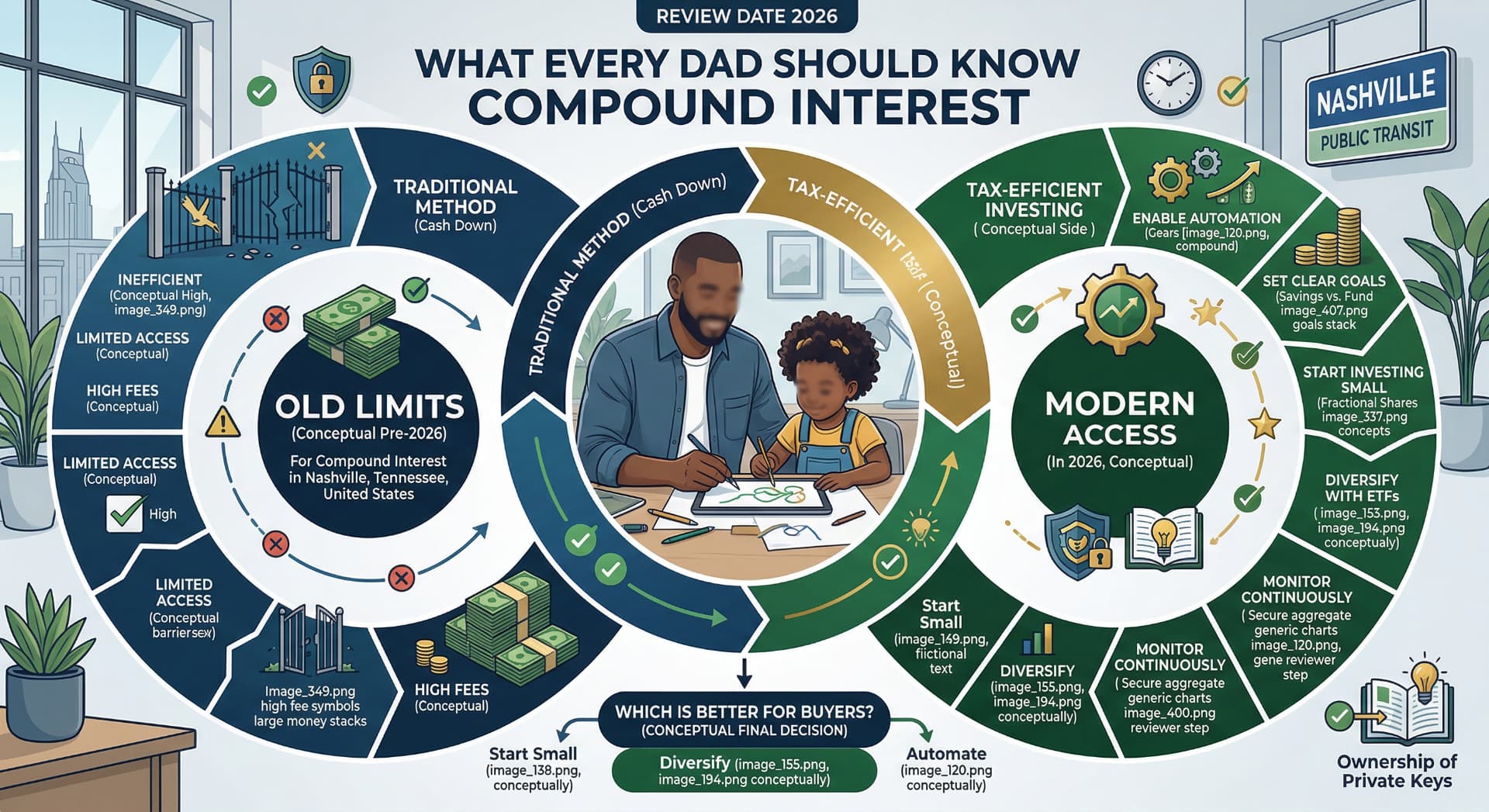
Explaining compound growth visually.
The Short Answer
Compound interest means your money earns returns on both your original investment and all accumulated interest — turning $500/month into over $1 million in 30 years at average market returns.
What Every Dad Should Know About Compound Interest
Category: Personal Finance & Wealth Building Tags: Beginner Guides · Financial Independence · Guides & How-To's Target Keywords: compound interest, how compound interest works, compound interest explained, rule of 72
Disclaimer: This article is for educational and informational purposes only and does not constitute financial, investment, tax, or legal advice. DadAlt Investments may receive affiliate compensation from brokerages and financial companies referenced in this article. This never influences our editorial recommendations. Always consult a qualified fee-only fiduciary financial advisor before making significant financial decisions.
Summary
Compound interest is one of the most important financial concepts a dad can understand — and one of the most misunderstood. In simple terms, it means you earn interest on your interest, not just on your original investment. The result is exponential growth that, given enough time, turns even modest contributions into serious wealth. A $10,000 investment growing at 10% annually doesn't just add $1,000 per year — it snowballs, reaching over $174,000 in 30 years without a single additional dollar added. But compound interest has a darker side that most financial guides skip: it works just as powerfully against you on debt. The average credit card APR for accounts carrying a balance hit 22.3% as of November 2025, according to Federal Reserve data, and because that interest compounds daily, even a manageable balance can spiral quickly. This guide explains how compound interest works for you, how it works against you, how to use the Rule of 72 as a mental shortcut, and the most important steps every dad can take to put this force to work in his favor — starting today.
Introduction: The Force Einstein Probably Didn't Discover — But Wish He Had
You've probably heard the quote: "Compound interest is the eighth wonder of the world. He who understands it, earns it; he who doesn't, pays it." The quote is often attributed to Albert Einstein, though historians have found no credible evidence he ever said it — the phrase first appeared in a 1916 advertising copy for an insurance company.
But here's the thing: whether or not Einstein said it, the math is undeniably powerful.
Compound interest is the engine behind how wealth is actually built over a lifetime. It's also the engine behind why credit card debt is so notoriously hard to escape. Understanding how it works — in both directions — is one of the most practical things a dad can do for his family's financial future.
Most dads have a vague sense that starting to invest early is important. Fewer understand why it's so dramatically important. The answer is compound interest, and once you see the actual numbers, the urgency of starting sooner becomes difficult to ignore.
What Is Compound Interest? (And How Is It Different from Simple Interest?)
To understand compound interest, it helps to start with simple interest — the easier concept.
Simple Interest
Simple interest is calculated only on the original principal — the initial amount you deposit or borrow. The formula is:
Simple Interest = Principal × Rate × Time
Example: You invest $10,000 at a 10% simple interest rate for 10 years.
- Interest per year: $10,000 × 10% = $1,000/year
- Total interest after 10 years: $10,000
- Final balance: $20,000
The math is straightforward: you earn exactly $1,000 per year, every year, because the interest is always calculated on the original $10,000.
Simple interest is commonly used for:
- Car loans
- Some personal loans
- Certain short-term lending products
- Some types of bonds
Compound Interest
Compound interest is calculated on the principal plus all previously accumulated interest. The interest you earned last year gets added to your balance, and next year you earn interest on that larger number. Then the year after that, you earn interest on that new balance. And so on.
The formula is:
A = P(1 + r/n)^(nt)
Where:
- A = Final amount
- P = Principal (initial investment)
- r = Annual interest rate (as a decimal)
- n = Number of times interest compounds per year
- t = Number of years
Example: Same $10,000 at 10%, compounded annually for 10 years.
| Year | Starting Balance | Interest Earned | Ending Balance |
|---|---|---|---|
| 1 | $10,000.00 | $1,000.00 | $11,000.00 |
| 2 | $11,000.00 | $1,100.00 | $12,100.00 |
| 3 | $12,100.00 | $1,210.00 | $13,310.00 |
| 5 | $14,641.00 | $1,464.10 | $16,105.10 |
| 10 | $23,579.48 | $2,357.95 | $25,937.43 |
After 10 years, you have $25,937 instead of $20,000. The extra $5,937 came entirely from earning "interest on interest." And notice: the interest earned in year 10 ($2,357) is more than double what was earned in year 1 ($1,000), because the balance has grown.
That's compounding in action. And it only gets more powerful the longer it runs.
The Core Difference at a Glance
| Feature | Simple Interest | Compound Interest |
|---|---|---|
| What earns interest | Original principal only | Principal + accumulated interest |
| Growth pattern | Linear (straight line) | Exponential (accelerating curve) |
| Best for borrowers? | Yes — costs less over time | No — costs more as balance grows |
| Best for investors? | No — grows slower | Yes — grows faster |
| Common uses | Car loans, some personal loans | Savings accounts, investments, credit cards |
How Compounding Frequency Changes Everything
One detail most people miss: how often interest compounds matters enormously.
The more frequently interest is compounded, the more you earn (or owe). Common compounding frequencies include:
- Daily — most savings accounts, all credit cards
- Monthly — many savings products, some mortgages
- Quarterly — some investment accounts, CDs
- Annually — some bonds, simple investment examples
Example: $10,000 at 6% annual rate for 10 years
| Compounding Frequency | Final Balance | Interest Earned |
|---|---|---|
| Annually | $17,908.48 | $7,908.48 |
| Quarterly | $18,061.11 | $8,061.11 |
| Monthly | $18,193.97 | $8,193.97 |
| Daily | $18,220.43 | $8,220.43 |
The difference between annual and daily compounding in this example is about $312 over 10 years. Not dramatic at $10,000 and 6% — but scale it up to a $100,000 portfolio over 30 years, and the difference becomes meaningful. The key takeaway: more frequent compounding = more money in investment accounts, and more debt in credit card accounts.
The Power of Time: Why Starting at 25 vs. 35 Is Not Just a 10-Year Difference
This is where compounding gets genuinely jaw-dropping for dads.
Because compound interest accelerates over time, the difference between starting at 25 versus 35 isn't just 10 years of returns. It's the compounding on all those returns — the interest on the interest on the interest.
The Classic Two-Dad Comparison
Dad A starts investing at age 25:
- Contributes $500/month for 10 years (age 25–35)
- Then stops completely and never adds another dollar
- Money grows at 10% annually until age 65
- Total contributions: $60,000
Dad B starts investing at age 35:
- Contributes $500/month for 30 years (age 35–65)
- Never misses a month
- Same 10% annual return
- Total contributions: $180,000
Result at age 65:
| Dad A | Dad B | |
|---|---|---|
| Contributions | $60,000 | $180,000 |
| Years invested | 40 years (stopped at 35) | 30 years |
| Portfolio at 65 | ~$1,918,000 | ~$1,130,000 |
Dad A contributed 1/3 as much money and still ended up with approximately 70% more wealth at retirement. The sole reason: time and compounding.
This example isn't hypothetical math designed to make a point. It's the actual mechanics of compound interest — and it's why every year you wait to start investing has a cost that far exceeds the dollar amount of the contributions you skipped.
A Single Lump-Sum Over Time
If you invest $10,000 today in an S&P 500 platforms for index funds — and don't add another dollar — at a 10% average annual return:
| Years Invested | Approximate Value |
|---|---|
| 10 years | ~$25,937 |
| 20 years | ~$67,275 |
| 30 years | ~$174,494 |
| 35 years | ~$281,024 |
| 40 years | ~$452,593 |
The move from 30 years to 40 years — just one more decade — adds an additional $278,000. That's not $10,000 compounding. That's the previous 30 years of compounded growth, compounding again.
Where Compound Interest Works For Dads
1. Index Funds and Stock Market Investing
When you invest in an S&P 500 index fund, compounding works through two mechanisms:
- Capital appreciation: The value of your shares rises over time. When your portfolio grows from $10,000 to $11,000, that extra $1,000 is now also growing.
- Dividend reinvestment: Most S&P 500 index funds pay quarterly dividends. When you enable automatic reinvestment (DRIP — Dividend Reinvestment Plan), those dividends purchase additional shares, which then generate their own future dividends and appreciation. According to data from Wealthy Corner, the S&P 500's annual return without dividends reinvested averaged 6.34% over 100 years — but with dividends reinvested, that figure rises to 10.4%.
The S&P 500 has returned an average of approximately 10.33% annually since 1957, per Motley Fool citing S&P data. At that rate, $1,000 invested today becomes roughly $4,177 in 15 years, $11,918 in 25 years, and $45,259 in 40 years — without adding another penny.
2. Tax-Advantaged Retirement Accounts (Roth IRA, 401(k))
Tax-advantaged accounts supercharge compound interest by eliminating or deferring the tax drag on growth:
- Roth IRA providers: Your contributions grow entirely tax-free. After age 59½ and the 5-year holding requirement, you withdraw everything — principal and all compounded growth — without paying a single dollar in taxes. You earn full compound interest on 100% of your gains.
- Traditional 401(k): Contributions reduce your taxable income now. All the money that would have gone to taxes instead stays invested, compounding year after year, until you withdraw in retirement.
Example of tax drag: On a $100,000 portfolio growing at 10% annually over 30 years:
- In a taxable brokerage account (assuming taxes reduce effective return to ~7%): grows to approximately $761,000
- In a Roth IRA (full 10% compounding, no annual tax drag): grows to approximately $1,745,000
The difference — roughly $984,000 — comes entirely from eliminating the tax that would otherwise be extracted from your compounding returns each year.
3. High-Yield Savings Accounts (HYSA)
For your emergency fund, compound interest works in smaller but still meaningful ways. High-yield savings accounts in early 2026 are offering APYs in the 3.50%–4.20% range at online banks. These accounts typically compound daily and pay interest monthly.
On a $15,000 emergency fund at 4.00% APY compounded daily:
- After 1 year: ~$15,611 (+$611)
- After 5 years: ~$18,300 (+$3,300)
Not life-changing returns on an emergency fund — that's not the goal. But it beats letting the same money sit in a checking account earning near-zero interest while inflation eats its purchasing power.
Where Compound Interest Works Against Dads
This is the section most guides skip. Compound interest is a powerful force when it works for you — but it is a devastating force when it works against you. And for many American families, it's doing both simultaneously.
Credit Card Debt: The Dark Side of Compounding
Credit card interest doesn't compound annually, or even monthly. It compounds daily.
The average credit card APR for accounts assessed interest was 22.3% as of November 2025, according to Federal Reserve data published by NerdWallet. The Consumer Financial Protection Bureau's 2025 Consumer Credit Card Market Report found that in 2024, the average APR for general purpose cards reached 25.2% — the highest level since at least 2015 — with consumers paying $160 billion in total interest charges that year, up from $105 billion just two years earlier.
Here's how daily compounding works on a credit card:
Example: $5,000 balance at 22% APR
- Your daily interest rate = 22% ÷ 365 = 0.0603%/day
- Day 1 interest: $5,000 × 0.000603 = $3.01
- Day 2 balance: $5,003.01 — now earning interest on this higher amount
- And so on, every single day
After 1 month: approximately $92 in interest added After 1 year (minimum payments only): the original $5,000 could take 10+ years to pay off and cost thousands more in total interest
If you only make minimum payments on a $5,000 balance at 22% APR, you could pay more than $7,600 in total interest and remain in debt for over a decade, according to calculations consistent with Bankrate's paying off debt data.
The same force that turns $10,000 into $174,000 in a retirement account over 30 years can turn $5,000 in credit card debt into a persistent, expensive trap.
Student Loans
Federal student loans compound interest on a daily basis as well. During periods of deferment or when payments don't cover all accruing interest, the unpaid interest can capitalize — meaning it gets added to the principal balance, and future interest is then charged on that larger amount. This is called negative amortization, and it's how some borrowers end up owing more after years of payments than they did when they graduated.
Car Loans (Less Dangerous, But Worth Understanding)
Most car loans use simple interest — meaning the interest is calculated on the outstanding principal balance each month, but that interest doesn't compound on itself. As you pay down the principal, you pay less in interest each month. This makes car loan interest significantly less dangerous than credit card interest — though the APR can still be high, particularly for buyers with lower credit scores.
The Rule of 72: A Dad's Mental Math Shortcut
The Rule of 72 is a simple trick that lets you estimate how long it takes for money to double at a given interest rate — without a calculator.
The formula:
Years to Double = 72 ÷ Annual Interest Rate (%)
How It Works
| Interest Rate | 72 ÷ Rate | Years to Double |
|---|---|---|
| 3% (inflation) | 72 ÷ 3 | ~24 years |
| 4% (conservative portfolio) | 72 ÷ 4 | ~18 years |
| 6% (moderate portfolio) | 72 ÷ 6 | ~12 years |
| 8% (S&P 500 inflation-adjusted avg) | 72 ÷ 8 | ~9 years |
| 10% (S&P 500 historical avg) | 72 ÷ 10 | ~7.2 years |
| 22% (average credit card APR) | 72 ÷ 22 | ~3.3 years |
A $50,000 portfolio invested at the S&P 500's historical 10% average return will double roughly every 7 years:
- Age 35: $50,000
- Age 42: ~$100,000
- Age 49: ~$200,000
- Age 56: ~$400,000
- Age 63: ~$800,000
Now flip it: a $10,000 credit card balance at 22% APR doubles in 3.3 years if you're only making minimum payments. By year 10, that original $10,000 could theoretically represent over $60,000 in compounded debt obligations.
The Rule of 72 and Inflation
The Rule of 72 also shows why keeping money in a low-yield account is a financial mistake.
At 3% inflation (the long-term U.S. average), money's purchasing power halves in 24 years. A $10,000 emergency fund in a checking account earning 0.01% APY will be worth roughly $5,000 in real purchasing power by the time your youngest child graduates college.
The antidote: keep long-term money invested where it can grow at a rate that outpaces inflation.
The Cost of Waiting: Every Year Has a Price Tag
Most dads understand that starting to invest earlier is better. Fewer have actually calculated the price of waiting.
At a 10% average annual return, here's the approximate cost of every year you delay starting a $500/month investment:
| Starting Age | Monthly Contribution | Total Invested | Portfolio at 65 |
|---|---|---|---|
| 25 | $500 | $240,000 | ~$3,247,000 |
| 30 | $500 | $210,000 | ~$1,974,000 |
| 35 | $500 | $180,000 | ~$1,178,000 |
| 40 | $500 | $150,000 | ~$684,000 |
| 45 | $500 | $120,000 | ~$381,000 |
The difference between starting at 25 vs. 35: approximately $2,069,000 — despite contributing only $60,000 more.
That $60,000 in additional contributions accounts for less than 3% of the final gap. The other 97% of that $2 million difference is compound interest doing its work over 10 extra years.
The cost of waiting 10 years to start isn't $60,000. It's roughly $2,069,000.
How to Make Compound Interest Work in Your Favor: A Practical Action Plan
Understanding compound interest is worthless without acting on it. Here is the practical playbook for making compounding work in your direction:
1. Start Immediately — Even If the Amount Is Small
Because compounding is time-dependent, starting with $100/month today is more valuable than starting with $500/month in five years.
At 10% annual return:
- $100/month starting at age 30: ~$339,000 by age 65
- $500/month starting at age 35: ~$1,178,000 by age 65
The $500/month is more (4.7× more per month, contributed for 30 years), and it still results in the person who started with just $100 at age 30 having a meaningful, growing balance.
Start now. Increase contributions as income grows.
2. Use Tax-Advantaged Accounts First
Compound interest grows fastest when it isn't interrupted by annual taxes. The priority order:
- 401(k) up to the employer match — This is an immediate 50–100% return on your contribution before compounding even starts.
- Roth IRA — All compounding occurs tax-free. The 2026 contribution limit is $7,500/year (under age 50) or $8,600 (age 50+), per IRS Notice 2025-67.
- Max out 401(k) — 2026 employee limit is $24,500 (or $32,500 with catch-up for age 50+).
- Taxable brokerage account — After exhausting tax-advantaged options.
3. Reinvest All Dividends
When your index fund pays quarterly dividends, turn on automatic reinvestment (DRIP). Every dividend reinvested purchases additional shares, which generate additional future dividends and appreciation. The Fidelity, Vanguard, and Schwab 500 Index Fund (FXAIX), for example, paid quarterly dividends throughout 2025, with each reinvested payment purchasing more shares at prevailing prices — compounding the underlying position.
Without dividend reinvestment, you capture only the price appreciation portion of your return (~6.3% historically for the S&P 500). With reinvestment, you capture the full total return (~10.4%).
4. Keep Investment Costs Low
Every dollar paid in fees is a dollar that isn't compounding. Over 30 years, this matters enormously.
On a $100,000 investment growing at 7% annually:
- At 0.03% expense ratio (Vanguard VOO or similar): grows to approximately $754,000
- At 1.00% expense ratio (average actively managed fund): grows to approximately $574,000
- Cost of the 0.97% fee difference: ~$180,000
That $180,000 "fee cost" isn't what you paid in fees over 30 years. It's the compound growth that never happened because those dollars were extracted annually rather than continuing to compound. Choose low-cost index funds. Fidelity's zero-expense-ratio funds (FZROX, FZILX) charge 0.00%. Vanguard's VOO charges 0.03%.
5. Eliminate High-Interest Debt Before Compounding Against You
The Rule of 72 is equally applicable to debt. A credit card at 22% APR doubles your balance in about 3.3 years. Before investing beyond your employer's 401(k) match, eliminate any debt with an interest rate above 7–8% — because no investment reliably delivers guaranteed 22% returns.
The exception: Always capture your full 401(k) employer match before paying down any debt. An employer match is an immediate 50–100% return — it beats even high-interest debt in most cases.
6. Automate Contributions
Dollar-cost averaging — investing a fixed amount on a regular schedule regardless of market conditions — is the practical mechanism for taking full advantage of compounding.
When you automate $500/month into your Roth IRA:
- You invest when prices are high (buying fewer shares)
- You invest when prices are low (buying more shares)
- Over time, your average cost per share tends to be lower than if you tried to time the market
- And most importantly: you don't skip months because life got in the way
Set it up once. Let it run. Time and compounding do the heavy lifting.
The Danger of Stopping: Sequence of Returns and Staying Invested
Even investors who understand compound interest sometimes undermine it by stopping contributions during market downturns — the worst possible time to exit.
The S&P 500 declined approximately:
- 49% in the 2000–2002 dot-com crash
- 57% in the 2007–2009 financial crisis
- 34% in the 2020 COVID crash
In all three cases, the market subsequently recovered to new all-time highs. Investors who stayed invested through the entire period — including the declines — captured the full compound growth of the recovery. Investors who sold at the bottom locked in permanent losses and missed the recovery.
A 30-year investment timeline includes multiple severe downturns. This is not a risk to fear — it's the price of admission for long-term compound growth. The compounding doesn't pause during downturns. Your shares continue to accumulate. Your reinvested dividends purchase more shares at lower prices.
The rule: Only invest money you won't need for at least 5–10 years. Money needed within that window doesn't belong in the stock market.
Compound Interest in the Real Lives of Dads: Three Scenarios
Scenario 1: The New Dad at 30
Situation: Just had a baby. Has $500/month to invest but isn't sure where to start.
Action plan:
- Opens a Roth IRA at Fidelity ($0 minimum, $0 commissions)
- Invests $500/month in FZROX (0.00% expense ratio)
- Sets up automatic monthly contributions
- Enables dividend reinvestment
30-year projection at 10% average return: ~$1,131,000 at age 60 — entirely in a Roth IRA, withdrawable tax-free.
Scenario 2: The Dad with Credit Card Debt
Situation: Has $8,000 spread across two credit cards at 22% and 19% APR. Has been making minimum payments for 18 months while the balances barely move.
Understanding the math:
- At 22% APR, that $8,000 would take over 12 years to pay off with minimum payments, costing approximately $11,000+ in total interest
- Every month the debt persists is a month compound interest is working against him
Action plan:
- Pause all investing except the 401(k) match
- Apply a debt avalanche: throw all extra money at the 22% card first
- Once paid off, roll that payment toward the 19% card
- Then resume full Roth IRA contributions
Eliminating 22% compound interest is equivalent to earning a guaranteed 22% return — which no investment reliably provides.
Scenario 3: The Dad Who Started Late
Situation: 47 years old. Has $28,000 in a 401(k) from a job 10 years ago. Hasn't been consistently investing.
The realistic math:
- 18 years of compounding remain until age 65
- At 10% average annual return, $28,000 becomes approximately $159,000 by age 65 without any additional contributions
- Adding $1,000/month for the next 18 years grows the total to approximately $880,000
It's not the same as starting at 30. But it's far from nothing. The 2026 contribution limits are designed to help late starters: the 401(k) catch-up is an additional $8,000/year (total $32,500) for those 50 and older, and the Roth IRA catch-up for those 50+ allows $8,600/year.
Start now. The compounding that happens between 47 and 65 is real.
Frequently Asked Questions
What's the easiest way to benefit from compound interest? Open a Roth IRA or contribute to a 401(k) and invest in a low-cost S&P 500 index fund. Enable automatic monthly contributions and dividend reinvestment. That's it. You don't need to actively manage anything — the compounding happens on its own.
Does compound interest work the same in a high-yield savings account as in a stock account? Both use compound interest, but the rates are very different. A high-yield savings account in early 2026 earns roughly 3.5–4.2% APY — meaningful for an emergency fund, but not enough to build long-term wealth. The S&P 500 has historically returned ~10% annually, which means money doubles roughly every 7.2 years via the Rule of 72 vs. every 18 years in a 4% HYSA. Use the HYSA for short-term savings and emergency funds; use investments for long-term wealth building.
My 401(k) plan has high fees. Does that really matter? Yes, dramatically. A 1% annual expense ratio difference costs approximately $180,000 on a $100,000 portfolio over 30 years, as shown in the fee section above. If your 401(k) doesn't offer low-cost index fund options, contribute enough to capture your full employer match, then direct additional retirement savings to a Roth IRA where you can choose your own low-cost funds.
Can I teach my kids about compound interest? Absolutely. A practical exercise: show them the online compound interest calculator at investor.gov (the SEC's official calculator). Input a small amount — like $1,000 at age 18 — and show what happens at 10% over 50 years vs. what happens if you wait until age 28. The visual is powerful and age-appropriate for teenagers. Fidelity also offers the Youth Account for ages 13–17.
How does compound interest work differently in a Roth IRA vs. a taxable account? In a taxable account, you pay taxes on dividends each year — which reduces the amount available to compound. In a Roth IRA, you pay no taxes on dividends or growth while the money is in the account, so 100% of your returns continue compounding. This tax-free compounding is why the Roth IRA is one of the most powerful wealth-building vehicles available to most American dads.
The DadAlt Compound Interest Summary
Here is everything you need to remember:
- Compound interest means earning interest on interest — your money grows exponentially, not linearly.
- Time is the most powerful variable. A dollar invested today is worth far more than a dollar invested 10 years from now — not because of the dollar itself, but because of all the compounding it triggers.
- The Rule of 72 lets you estimate doubling time: divide 72 by your interest rate to get the approximate years to double.
- Compound interest works against you on debt. The average credit card APR of 22.3% (Federal Reserve data, November 2025) means debt doubles in roughly 3.3 years on minimum payments.
- Tax-advantaged accounts supercharge compounding by eliminating the annual tax drag that would otherwise slow your growth.
- Low fees preserve compounding. A 1% fee difference compounds to approximately $180,000 on a $100,000 portfolio over 30 years.
- Starting small beats waiting to start big. $100/month started at 30 significantly outperforms the long-run trajectory of $500/month started at 40.
- Automate everything so compounding isn't dependent on your willpower or memory.
The action is simple. Open a Roth IRA at Fidelity or Charles Schwab. Set up automatic contributions. Choose a low-cost total market index fund. Enable dividend reinvestment. And then do the hardest thing: leave it alone.
That's how compound interest builds wealth. One quiet, compounding month at a time.
→ Related: The Ultimate Beginner's Guide to Investing for Dads | Best Apps Dads Can Use to Manage Investments | Simple Budget System for Busy Dads
Sources and References
-
Corporate Finance Institute — "Simple Interest vs. Compound Interest" — Compound interest calculates total interest using a variable principal that grows as accumulated interest is added; simple interest calculates on a fixed principal only; compound interest generates "interest on interest" and leads to exponential growth. corporatefinanceinstitute.com
-
Western Southern Financial Group — "Simple vs. Compound Interest Guide: Definitions and Formulas" (April 30, 2025) — Simple interest results in linear growth; compound interest results in exponential growth; compound interest significantly outperforms simple interest for long-term savings; at 5% compounding annually, $10,000 grows to $11,576.25 after 3 years vs. $11,500 with simple interest. westernsouthern.com
-
GeeksforGeeks — Compound Interest Formula, Definition and Examples (November 27, 2025) — Compound interest formula: A = P(1 + R/100)^t; $10,000 at 10% interest compounded yearly for 10 years grows to $25,937.43; compound interest is used in banking and finance sectors for calculating investment growth and depreciation. geeksforgeeks.org
-
Capital One — "Simple Interest vs. Compound Interest" — Compounding periods for savings include annual, semiannual, quarterly, monthly, and daily; more frequent compounding yields more money, all other factors equal; credit cards compound daily; lending products using compound interest include credit cards, student loans, and personal loans. capitalone.com
-
Amerant Bank — "Compound vs Simple Interest" — Savings accounts, money market accounts, CDs, 401(k)s, and IRAs all accrue compound interest; the more frequently interest is compounded, the faster interest will accrue; retirement accounts may offer tax advantages in addition to compounding. amerantbank.com
-
SmartAsset — "Simple Interest vs. Compound Interest: What to Know" (October 12, 2025) — $2,000 at 8.5% compounding twice a year for 5 years yields $3,032.43, earning $1,032.43 in interest versus $850 in the simple interest example; compound interest is better for investing since it allows funds to grow at a faster rate. smartasset.com
-
Wikipedia — "Rule of 72" — Rule of 72: divide 72 by the interest rate to get approximate number of years for investment to double; formula derives from natural logarithm of 2 (≈0.693); most accurate for compounding rates in the 6–10% range; has been documented since at least 1494 by mathematician Luca Pacioli. en.wikipedia.org
-
Bankrate — "Rule of 72: What Is It and How Can You Use It?" (September 26, 2025) — Divide 72 by expected annual interest rate to get approximate doubling time; at 4% interest, money doubles in 18 years; Rule of 72 can also be applied to inflation to estimate purchasing power halving; works best in the 5–10% return range. bankrate.com/investing/what-is-the-rule-of-72
-
BetterExplained — "The Rule of 72" — At 6% interest, money doubles in 12 years; at 15% credit card interest, debt doubles in 4.8 years; at 3.5% inflation, purchasing power halves in 20 years; Rule of 72 approximation based on mathematical derivation from natural log of 2 (0.693), rounded to 72 for easier divisibility. betterexplained.com
-
PocketGuard — "What Is the Rule of 72 and Compound Interest?" (September 23, 2025) — $10,000 at 9% return doubles to $20,000 in 8 years, then $40,000 in 16 years, $80,000 in 24 years — without additional contributions; Rule of 72 also works for debt: $5,000 credit card debt at 24% APR doubles in 3 years. pocketguard.com
-
NerdWallet — "What Is the Average Credit Card Interest Rate?" (November 8, 2025) — Average APR for credit card accounts assessed interest: 22.3% as of November 2025 (Federal Reserve data); rates vary based on credit score; higher credit scores lead to lower APRs. nerdwallet.com/credit-cards/learn/what-is-the-average-credit-card-interest-rate
-
LendingTree — "Average Credit Card Interest Rate in US Today" — Average APR for all accounts in Q4 2025: 20.97%, down from 21.39% in Q3; average for accounts accruing interest fell to 22.30% in Q4 2025; Americans' total credit card balance reached $1.277 trillion in Q4 2025, the highest since Federal Reserve Bank of New York began tracking in 1999; national average card debt among cardholders with unpaid balances in Q3 2025: $7,886. lendingtree.com
-
Consumer Financial Protection Bureau — "Consumer Credit Card Market Report" (published Federal Register, January 7, 2026) — In 2024, average APR for general purpose credit cards reached 25.2%, highest since at least 2015; private label cards reached 31.3%; consumers paid $160 billion in interest charges in 2024, up from $105 billion in 2022; increase driven by higher APRs, 9.5% increase in cardholders, 18% increase in average monthly balance. federalregister.gov
-
CBS News / PDS Debt — "How Are Credit Card Interest Charges Compounded?" — Credit card companies calculate interest using a daily periodic rate (APR ÷ 365 or 360); applied to average daily balance; creates compounding effect occurring daily, not monthly; $1,000 balance at 24% APR compounded daily would accrue about $6.20 in interest every day. cbsnews.com; pdsdebt.com
-
Bankrate — "Current Credit Card Interest Rates" — $5,000 of credit card debt at 20% APR with minimum payments only takes about 23 years to pay off and costs about $7,723 in total interest; credit card interest accrues every single day. bankrate.com/credit-cards/advice/current-interest-rates
-
Financer — Compound Interest Calculator (2025) — Credit card interest averaging 22.83% APR and compounding daily means a $5,000 balance takes over 10 years to pay off with minimum payments, costing nearly $7,627 total; Warren Buffett's wealth largely attributed to compound interest; phrase "compound interest is the eighth wonder of the world" first appeared in 1916 advertising copy, not from Einstein. financer.com
-
Wealthy Corner — "The Power of Reinvested S&P 500 Dividends" — Annual S&P 500 return without dividends reinvested: 6.34% over 100 years; annual S&P 500 return with dividends reinvested: 10.4%; most S&P 500 index funds distribute dividends quarterly; DRIP (Dividend Reinvestment Plan) allows automatic reinvestment to compound returns. wealthycorner.com
-
Motley Fool — "S&P 500 Annual Returns and Historical Performance" — S&P 500 has averaged over 10% annually; delivered average annual return of 10.33% since 1957; negative annual returns occurred in only 6 of the past 30 years. fool.com/investing/stock-market/indexes/sp-500/annual-returns
-
Fidelity — "5 Things to Know About passive income strategies" — Most ETFs distribute dividends quarterly; some reinvest dividends as received then distribute as cash on payout date; Fidelity allows commission-free dividend reinvestment; S&P 500 Index standard includes reinvestment of dividends for total return calculation. fidelity.com
-
IRS — "401(k) Limit Increases to $24,500 for 2026, IRA Limit Increases to $7,500" (IRS Notice 2025-67, November 13, 2025) — 2026 employee 401(k) contribution limit: $24,500; catch-up (age 50+): $8,000 additional; Roth IRA limit: $7,500 (under 50), $8,600 (age 50+). irs.gov/newsroom/401k-limit-increases-to-24500-for-2026-ira-limit-increases-to-7500
-
Federal Reserve / NerdWallet (November 2025) — Average credit card APR for accounts assessed interest: 22.3% as of November 2025 (Federal Reserve G.19 Consumer Credit data). federalreserve.gov
Disclaimer: This article is for educational and informational purposes only and does not constitute financial, investment, tax, or legal advice. DadAlt Investments may receive affiliate compensation from Fidelity, Charles Schwab, Vanguard, and other financial companies referenced in this article. This never influences our editorial recommendations. Interest rates, contribution limits, and financial product features change regularly — verify current details directly with the IRS, your brokerage, or a fee-only financial advisor. Always consult a qualified fee-only fiduciary financial advisor before making significant financial decisions. All investment examples assume a hypothetical 10% average annual return, consistent with the S&P 500's long-term historical average; actual returns will vary and past performance does not guarantee future results.
Recommended Reading
Frequently Asked Questions
How does compound interest work in simple terms?
You earn interest on your interest. If you invest $1,000 and earn 10%, you have $1,100. Next year you earn 10% on $1,100, not just $1,000. Over decades, this snowball effect is massive.
How much do I need to invest monthly to become a millionaire?
At a 10% average annual return, investing $500/month gets you to $1 million in about 30 years. Start at 25, and you're a millionaire by 55. Start at 35, and you'll need about $1,200/month.
Why is starting to invest early so important?
Because of compounding. An investor who starts at 25 with $300/month will have more by 65 than someone who starts at 35 with $600/month. Time is literally worth more than money when compounding is involved.

About the Author
Jared DeValk
Founder, DadAlt Investments
Father, alternative investment researcher, and founder of DadAlt Investments. 14+ years turning hard lessons into honest guidance for dads building real wealth.