
How Much Should You Keep in Cash vs. Investments? (2026 Guide)
Tiered framework for how much cash to hold versus invest, with math and worked examples.
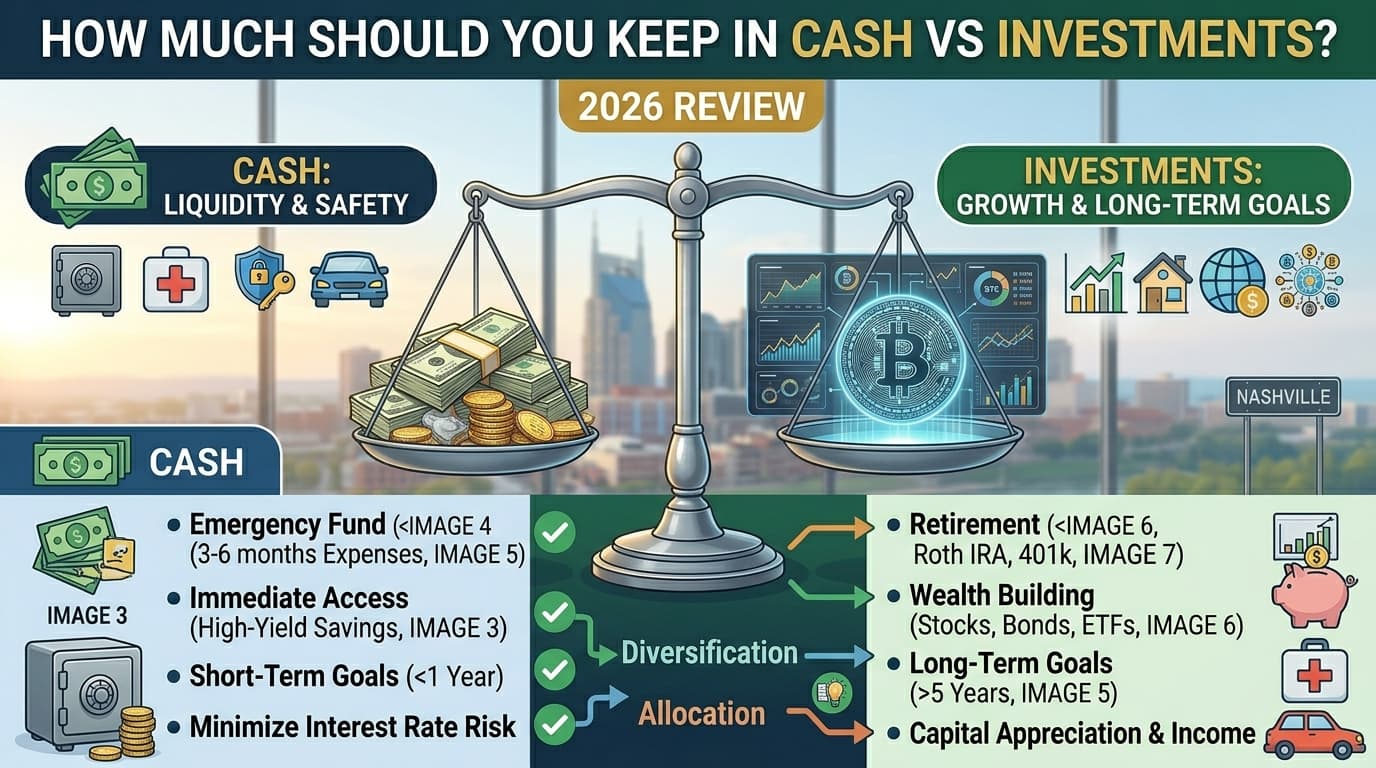
The Short Answer
Keep 3–6 months of expenses in a high-yield savings account as your emergency fund, then invest everything above that threshold — holding too much cash is one of the biggest wealth-building mistakes dads make.
How Much Should You Keep in Cash vs. Investments? (2026 Guide)
By DadAlt Investments | Category: Personal Finance | Last Updated: March 2026
The question of how much cash to keep versus how much to invest is one of the most consequential — and most commonly mishandled — decisions in personal finance. Hold too little cash and a single unexpected expense forces you to sell investments at the worst possible time. Hold too much, and you are quietly paying an opportunity cost that compounds against you every year. The math is unforgiving: $50,000 sitting in an average bank savings account earning 0.39% APY grows to roughly $55,000 over 20 years. The same $50,000 invested in a diversified stock portfolio averaging 7% annually grows to approximately $193,000 over the same period — a gap of nearly $138,000 that costs you nothing in effort, only in decision-making.1 Yet today, U.S. investors are holding more than $7.7 trillion in money market funds and cash-equivalent securities — more than at virtually any point in modern financial history — much of it well beyond what any rational emergency fund versus investing or short-term goal requires.2 The answer to "how much cash" is not a single number. It is a tiered framework: specific cash reserves for specific purposes, with a clear rule that everything above those tiers belongs in the market. This article builds that framework from the ground up — with the math, the exceptions, and a practical worked example — so you can calculate the right cash balance for your family and move the rest to work.
The Opportunity Cost of Holding Too Much Cash
Before building the framework, it's worth understanding exactly what holding excess cash actually costs — because most people dramatically underestimate it.
The 20-Year understand compound interest Gap
The comparison below uses a 7% average annual market return (the standard long-term estimate used by Fidelity, Vanguard, and Schwab and most financial planning models, reflecting historical S&P 500 returns after inflation) against two savings account scenarios: the national average (0.39% APY per FDIC, February 2026) and a competitive HYSA (4.00% APY):
| Starting Balance | After 20 Years at 0.39% | After 20 Years at 4.00% HYSA | After 20 Years at 7% Invested |
|---|---|---|---|
| $25,000 | $27,050 | $54,778 | $96,742 |
| $50,000 | $54,100 | $109,556 | $193,484 |
| $100,000 | $108,200 | $219,112 | $386,968 |
Even at a competitive 4.00% HYSA — which requires actively choosing an online bank and is not where most people's savings sit — you still sacrifice roughly $84,000 in growth on a $50,000 balance over 20 years compared to investing at 7%. Cash is not "safe" in the long run. It is a low-cost guarantee of falling behind inflation and market growth over any meaningful time horizon.3
The Inflation Problem
A 3% annual inflation rate means that $10,000 in cash today will have the purchasing power of approximately $7,441 in 10 years — a real loss of 26%, even if the dollar balance stays the same. For cash earning the national average of 0.39% APY, the real (inflation-adjusted) return is approximately negative 2.6% per year. You are not "keeping" that money safe. You are watching it lose purchasing power while it sits still.1
Cash Is a Tool, Not a Strategy
The most important reframe: cash is not a conservative investment. It is a tool with a specific purpose — covering near-term, known obligations where capital preservation and immediate liquidity matter more than growth. Every dollar of cash you hold beyond that specific purpose is a dollar you are voluntarily choosing not to compound. Rob Haworth, senior investment strategy director at U.S. Bank Asset Management Group, puts it directly: "Investors should be aware that as the Fed lowers interest rates, yields on cash-equivalent instruments fall. That results in an even bigger opportunity cost when leaving long-term money tied up in short-term investments."2
Tier 1: Your Emergency Fund — The Non-Negotiable Cash Layer
The first and most important cash reserve is the emergency fund: a dedicated pool of liquid savings that covers essential living expenses if your income is interrupted or a large unexpected expense hits. For a complete guide to building your emergency fund, see The Dad's Guide to Emergency Funds & Investing.
How Much: The Right Amount Depends on Your Income Situation
| Household Type | Recommended Emergency Fund |
|---|---|
| Stable dual-income household (two earners, W-2 jobs) | 3 months of essential expenses |
| Single-income household | 6 months of essential expenses |
| Self-employed, freelancer, or variable income | 9–12 months of essential expenses |
| Job in a volatile industry or hard-to-replace specialty | 6–9 months of essential expenses |
The 3–6 month range cited by most financial advisors — including RBC Wealth Management, U.S. Bank, and Vanguard — is not arbitrary.4 It reflects the median time it takes a U.S. worker to find comparable employment after an involuntary job loss, combined with the typical delay before alternative income or assistance kicks in.
What Counts as "Essential Expenses"
The emergency fund calculation uses essential expenses only — not your total monthly spending:
Include:
- Housing payment (mortgage or rent)
- Utilities (electricity, gas, water, internet)
- Groceries (actual food budget system, not dining out)
- Insurance premiums (health, auto, home/renters)
- Minimum debt payments (credit card minimums, car loan, student loan minimums)
- Childcare and essential transportation costs
Do not include:
- Dining out and entertainment
- Clothing and personal care beyond basics
- Streaming subscriptions and recreational spending
- Vacation savings and discretionary categories
A family spending $7,000/month total but only $4,500/month on essentials has an emergency fund target of $13,500–$27,000 (3–6 months × $4,500). Using the full $7,000 figure overstates the target by nearly 56% — which is extra cash sitting idle for no reason.
Where to Keep It
The emergency fund belongs in a high-yield savings account (HYSA) at an online bank — not in the stock market, not in a CD with early withdrawal penalties, and not mixed with your checking account where it might get spent.
- Not in the stock market: The S&P 500 fell 34% in early 2020, 20% in 2022, and 50% in 2008-2009. If you lose your job during a downturn — which often coincides — your "emergency fund" could be worth 30-50% less precisely when you need it most. That is not an emergency fund. That is a coincidence machine.
- Not in CDs: CDs typically have early withdrawal penalties of 3–12 months' interest. If your emergency fund is in a 12-month CD and your furnace dies in month 3, you pay a penalty to access your own money.
- In a HYSA: Liquid within 1–3 business days, FDIC-insured up to $250,000, currently earning 3.20–4.21% APY. Your emergency fund should be working while it waits — just not in anything that could lose value or restrict access.
Tier 2: Upcoming Large Expenses — Goal-Based Cash
The second cash tier covers known, near-term expenses that are too large for your monthly cash flow and have a specific timeline.
The 3-Year Rule
Any money you will need within the next 3 years should not be in the stock market. This is one of the most important rules in personal finance — and one of the most violated by investors who "invest" their house down payment or car savings in equities because they feel safer "doing something" with the money.
Here is why the rule exists: a diversified stock portfolio can lose 30-40% of its value in a bear market. Bear markets typically last 1–2 years but can run longer. If you need $60,000 for a down payment in 18 months and it's currently in the market, a downturn can push your timeline back by years or force you to buy with less than you planned. The market doesn't care about your timeline.
Goal-based cash examples and appropriate vehicles:
| Goal | Timeline | Appropriate Vehicle |
|---|---|---|
| Car replacement | 6–18 months | HYSA |
| Home down payment | 1–3 years | HYSA or 1–2 year CD |
| Home renovation | 6–24 months | HYSA |
| Family vacation fund | 3–12 months | HYSA |
| Private school tuition | 1–2 years | HYSA or no-penalty CD |
| Any goal under 3 years | Under 3 years | HYSA or short-term CD — never stocks |
For goals with a defined timeline of 12+ months where you're confident you won't need early access, a CD (Certificate of Deposit) can lock in a slightly higher rate than a HYSA — top 1-year CDs are currently offering approximately 4.10–4.15% APY as of March 2026.
Keep Goal-Based Cash Separate from Emergency Fund
The most important operational discipline: keep these two pools in separate, clearly labeled accounts. An emergency fund that also contains your vacation savings is neither — it's a pool of money you'll be tempted to raid for non-emergencies because the vacation money is "there."
Ally Bank's Savings Buckets feature, or separate dedicated HYSA accounts, solve this cleanly.
Tier 3: Operating Buffer — The Checking Account Layer
The third cash tier is the simplest and most overlooked: a small float in your primary checking account that prevents overdrafts and eliminates the stress of bill timing.
How Much: 1–2 Months of Expenses
A $3,000–$7,000 buffer (depending on your monthly expenses) sitting in your checking account is not a savings goal — it is a friction reducer. Its purpose is purely operational:
- Prevents overdraft fees when two large bills land in the same week
- Eliminates the anxiety of timing paycheck deposits against mortgage auto-payments
- Acts as a micro-cushion for unexpected small expenses before you can transfer from the HYSA
This is not part of your emergency fund. It is not "savings." It is the lubricant that makes your financial machinery run without friction. Think of it as the equivalent of keeping gas in your car: not an investment, just operational necessity.
The Checking Account Is Not a Savings Account
A common and expensive mistake: keeping 3–4 months of expenses in a checking account "just in case" — at most banks paying 0.01% APY. Every dollar sitting in your checking account beyond your operational buffer is losing ground to inflation and earning virtually nothing. Move everything above the buffer into a HYSA. The same account is accessible within 1–3 business days in a true emergency.
Tier 4: Everything Else Should Be Invested
Once Tiers 1 through 3 are funded, every additional dollar of cash beyond those specific reserves has a clearly better home: invested in a tax-advantaged account (Roth IRA, 401(k)) or a taxable brokerage account in a diversified portfolio.
The Cash Drag Problem
"Cash drag" is the measurable performance penalty on a portfolio from holding cash beyond what is needed for liquidity. The Investment Company Institute reports total money market fund assets have surpassed $7.7 trillion — a record reflecting the comfort many investors found in 4–5% yields during 2023-2024's higher rate environment.2 As the Federal Reserve's rate cuts bring cash yields down, the drag intensifies. Cash that earned a competitive 5% last year now earns 3–4%, while stock market long-term historical returns average 7–10% annually. Holding cash "a little longer" to wait for the right moment or to feel safer is one of the most thoroughly debunked strategies in investing research — not because markets always go up in the short term, but because the cost of being wrong about timing systematically exceeds the benefit of avoiding short-term losses.
The "Rainy Day" Trap
One of the most common reasons people hold excess cash is what financial planners call the "rainy day" trap: a vague sense that more cash is always more secure, regardless of how much already exists. This is psychologically understandable but financially costly. If your Tier 1 emergency fund already covers 6 months of essential expenses, what specific emergency does the extra $30,000 in savings protect against that $30,000 invested does not?
The answer, for most families, is "nothing that a credit card bridge and HYSA transfer couldn't handle." Every dollar above a fully funded emergency fund that remains in a savings account has an implicit cost: the gap between 4% HYSA returns and 7% long-term market returns, compounding for decades.
The Investment Priority Order
For cash beyond Tiers 1–3, direct it in this order based on tax efficiency:
- Employer 401(k) to the full match — this is an immediate 50–100% return on the matched portion; no investment in your life will ever beat it
- Roth IRA providers to the 2026 limit ($7,500 for those under 50; $8,600 for 50+) — tax-free growth for decades
- Back to 401(k) to the 2026 limit ($24,500 for those under 50; $32,500 for 50+)
- Taxable brokerage account — for anything beyond tax-advantaged limits, invested in low-cost best platforms for index fundss
Special Cases for Self-Employed and Variable-Income Earners
The standard 3–6 month framework is built for W-2 employees with predictable, monthly income. If you are self-employed, freelance, or have meaningfully variable income, the framework expands on two dimensions.
Larger Emergency Fund: 9–12 Months
Self-employed income is irregular by nature. Clients pay late. Contracts don't renew. A slow quarter can compound into a slow six months. The standard 3 months that works for a salaried employee offers almost no cushion for an independent contractor. Financial advisors at RBC Wealth Management recommend going up to 12 months for those who "feel like you have more risk in your life" — self-employment qualifies.4
For a self-employed family with $5,000/month in essential expenses, this means $45,000–$60,000 in emergency reserves — a larger number, but one that reflects the real risk profile of irregular income, not excessive caution.
Separate Tax Reserve Account
Self-employed individuals who pay quarterly estimated taxes to the IRS face a unique cash management challenge: a portion of every dollar earned belongs to the IRS, not to you. The most reliable system is a separate, dedicated HYSA exclusively for tax reserves — never mixed with personal emergency savings or operating cash.
A practical rule: transfer 25–30% of every net payment received into the tax reserve HYSA the day you receive it. Earn 3–4% APY on it until the quarterly payment is due (April 15, June 15, September 15, January 15). Then pay the IRS and replenish on the next payment.
Mixing tax reserves with personal savings creates the risk of spending money you owe — the most expensive financial mistake a self-employed person can make.
Business Operating Reserves (If Applicable)
If you operate a business entity (LLC, S-Corp) rather than freelancing as an individual, your business should maintain its own operating reserves — typically 1–3 months of business operating expenses — completely separate from personal finances. Business cash is not your emergency fund. Personal cash is not a business operating reserve. These pools must be structurally separated, ideally at different banks, to prevent commingling that creates both legal and financial management problems.
A Practical Cash Allocation Example
Abstract frameworks become useful when applied to a real household. Here is a worked example following the four-tier structure:
Profile: 35-year-old, dual-income household, stable W-2 employment for both partners, $5,000/month in essential expenses, $8,500/month total take-home income, $90,000 in combined savings.
Step 1: Calculate Each Tier
| Tier | Purpose | Calculation | Amount |
|---|---|---|---|
| Tier 1 | Emergency fund (3 months, dual-income) | $5,000 × 3 | $15,000 |
| Tier 2 | Goal-based cash (kitchen renovation in 18 months) | Quoted cost | $12,000 |
| Tier 3 | Checking account buffer (1 month expenses) | $5,000 × 1 | $5,000 |
| Total cash to hold | $32,000 |
Step 2: Identify Excess Cash
Total savings: $90,000 Required cash (Tiers 1–3): $32,000 Excess cash available to invest: $58,000
Step 3: Deploy the Excess
| Account | 2026 Limit | Allocation |
|---|---|---|
| Roth IRA (partner 1) | $7,500 | $7,500 |
| Roth IRA (partner 2) | $7,500 | $7,500 |
| Taxable brokerage account | No limit | $43,000 |
| Total invested | $58,000 |
This family had $58,000 sitting in a savings account — earning roughly 4% HYSA yields ($2,320/year) — that could instead be building long-term wealth at an average 7% market return ($4,060/year initially, compounding significantly over time).
The General Rule for Most Families
For a family with stable W-2 employment, moderate expenses, and no major near-term purchases planned, the right total cash balance is typically $20,000–$50,000 across all three tiers. Rarely more. The specific number scales with your monthly essential expenses and near-term goals — not with your net worth or income level.
Holding $80,000–$100,000+ in savings when you have a fully funded emergency fund and no purchase within 3 years is not prudence. It is expensive caution — and the cost compounds quietly, year after year.
FAQ
Is Having $100,000 in Savings Too Much Cash?
For most families, yes — if the entire $100,000 is sitting in a savings or money market account beyond specific near-term needs. Whether it is too much depends on your Tier 1–3 calculation:
- If your emergency fund requires $18,000, your goal-based savings total $25,000, and your checking buffer is $5,000, your cash need is $48,000. The remaining $52,000 has no defined purpose in cash and is experiencing unnecessary cash drag.
- If you have a $200,000 home renovation starting in 6 months, $100,000 in savings may be exactly right — all of it is goal-based cash with a defined, near-term, high-stakes use.
The question is never "how much is in savings?" It is "does every dollar in savings have a specific, near-term purpose that requires it to be in cash?" If the answer to any portion of that balance is no, that portion belongs invested.
Should I Keep My Emergency Fund in a HYSA or a Money Market Fund?
For most families: HYSA. A high-yield savings account at an online bank (Marcus, Ally, LendingClub, SoFi) is FDIC-insured, fully liquid, and currently earning 3.20–4.21% APY — the right combination of safety, accessibility, and yield for emergency reserves.
A money market fund inside a brokerage account (Fidelity SPAXX, Vanguard VMFXX) is a reasonable alternative for investors who already have significant brokerage assets and want to consolidate. The practical considerations:
- Money market funds are not FDIC-insured — they are covered by SIPC (brokerage failure protection, not loss protection). Government money market funds carry near-zero credit risk, but this is a meaningful legal distinction.
- Yields are currently competitive with HYSAs and sometimes exceed them
- Access is fast within the brokerage platform but slightly less separated from investment accounts psychologically
The psychological separation argument for a standalone HYSA is real: an emergency fund inside your brokerage account is one click away from being invested, and proximity to investment accounts makes it easier to rationalize spending it on non-emergencies.
How Much Cash Should I Have Before I Start Investing?
You do not need a fully funded emergency fund before you invest — but you need a meaningful start on one. A practical sequence that balances both:
- Build $1,000 in checking as a starter emergency buffer (prevents overdrafts and gives a basic cushion)
- Contribute to your 401(k) enough to capture the full employer match (this is an immediate 50–100% return; nothing else competes)
- Build to 3 months of essential expenses in HYSA (the core emergency fund)
- Open a Roth IRA and begin contributing (tax-free growth for decades)
- Continue building emergency fund to 6 months if applicable (single income, variable income)
- Maximize all tax-advantaged accounts, then invest in taxable brokerage
The employer 401(k) match is the one exception to "emergency fund first" — skipping the match to finish building cash is leaving guaranteed money on the table. Everything else follows the sequence above.
What If I'm Nervous About a Market Crash — Should I Hold More Cash?
This is one of the most common and most costly investment mistakes. The research on market timing is unambiguous: investors who hold excess cash waiting for a crash, then invest after the recovery, consistently underperform those who stay invested through downturns.
The reason is structural. You have to be right twice: right about when the crash happens, and right about when to reinvest. Missing the 10 best trading days in the market over a 20-year period historically cuts your total return roughly in half — and those best days typically cluster immediately after the worst days, when fear is highest and most people are still holding cash.
What actually protects you from market crashes:
- A fully funded emergency fund (Tier 1) so you don't have to sell investments to cover expenses
- Not investing money you need within 3 years (Tier 2 stays in cash)
- An asset allocation appropriate for your timeline — more bonds as you near retirement, not more cash permanently
If market volatility makes you so anxious that you're holding $80,000 in cash on a $150,000 salary, the conversation is not about cash vs. investments. It's about whether your risk tolerance has been properly translated into your investment allocation. More bonds and fewer stocks provides genuine, structured downside protection — without the long-term drag of excess cash.
Sources and References
Disclaimer: This article is for informational and educational purposes only and does not constitute financial, investment, or tax advice. All investment decisions involve risk, including the possible loss of principal. Past market returns do not guarantee future results. Consult a qualified financial advisor before making significant changes to your cash or investment allocation. DadAlt Investments may earn affiliate commissions from some links in this article at no cost to you.
Recommended Reading
- The Dad's Guide to Emergency Funds & Investing
- Best High-Yield Savings Accounts for 2026
- The Ultimate Beginner's Guide to Investing for Dads
Footnotes
-
SmartAsset. "Cash vs. Investments: What Percentage Should You Keep?" June 2025. https://smartasset.com/investing/what-percentage-cash-vs-investments — Stock market long-term return 8–10% annually; HYSA opportunity cost vs. equities; inflation erosion example ($10,000 at 3% inflation over 10 years = $7,441 purchasing power); cash drag on portfolio performance. ↩ ↩2
-
U.S. Bank Asset Management Group. "Cash Management and Investing Strategies When Interest Rates Are Changing." February 2026. https://www.usbank.com/investing/financial-perspectives/market-news/keep-cash-on-the-sideline-or-invest.html — $7.7 trillion in money market fund assets (Investment Company Institute); Rob Haworth quote on opportunity cost of long-term cash; Fed cut 1% in H2 2024 plus three 0.25% cuts in 2025; two additional 0.25% cuts expected in 2026. ↩ ↩2 ↩3
-
Hennion & Walsh. "How Much Is Too Much Cash in My Portfolio?" December 2025. https://www.hennionandwalsh.com/insights/how-much-is-too-much-cash-in-your-portfolio/ — Cash opportunity cost vs. equities (4–5% cash vs. 7–10% equities historically); inflation compounds cash erosion; 6–12 months of living expenses guidance from financial advisors. ↩
-
RBC Wealth Management. "The Case for Cash: How Much Do I Really Need for a Healthy Portfolio?" https://www.rbcwealthmanagement.com/en-us/insights/the-case-for-cash-how-much-do-i-really-need-for-a-healthy-portfolio — Fred Rose quote: "Three to six months of cash is what you always want to have on hand; sometimes you could go up to twelve months if you feel like you have more risk in your life"; Eric Edstrom on three pools of cash (operating, reserves, investable); advisor guidance on reviewing cash allocation. ↩ ↩2
Frequently Asked Questions
How much cash should I keep in savings?
3–6 months of essential expenses (mortgage, food, insurance, utilities). For most families, that's $15,000–$30,000 in a high-yield savings account. Single-income households should aim for the higher end.
Is keeping too much cash a bad thing?
Yes — excess cash loses purchasing power to inflation every year. At 3% inflation, $50,000 in cash loses about $1,500 in real value annually. Money beyond your emergency fund should be working for you.
Where should I keep cash I might need in 1–3 years?
A high-yield savings account (4–5% APY) or short-term Treasury bills. Avoid CDs with early withdrawal penalties unless you're certain you won't need the money. Don't invest short-term cash in stocks.

About the Author
Jared DeValk
Founder, DadAlt Investments
Father, alternative investment researcher, and founder of DadAlt Investments. 14+ years turning hard lessons into honest guidance for dads building real wealth.