
What Is the Safest Way to Invest in Gold? (2026 Guide)
Compare all six ways to own gold ranked by safety profile.
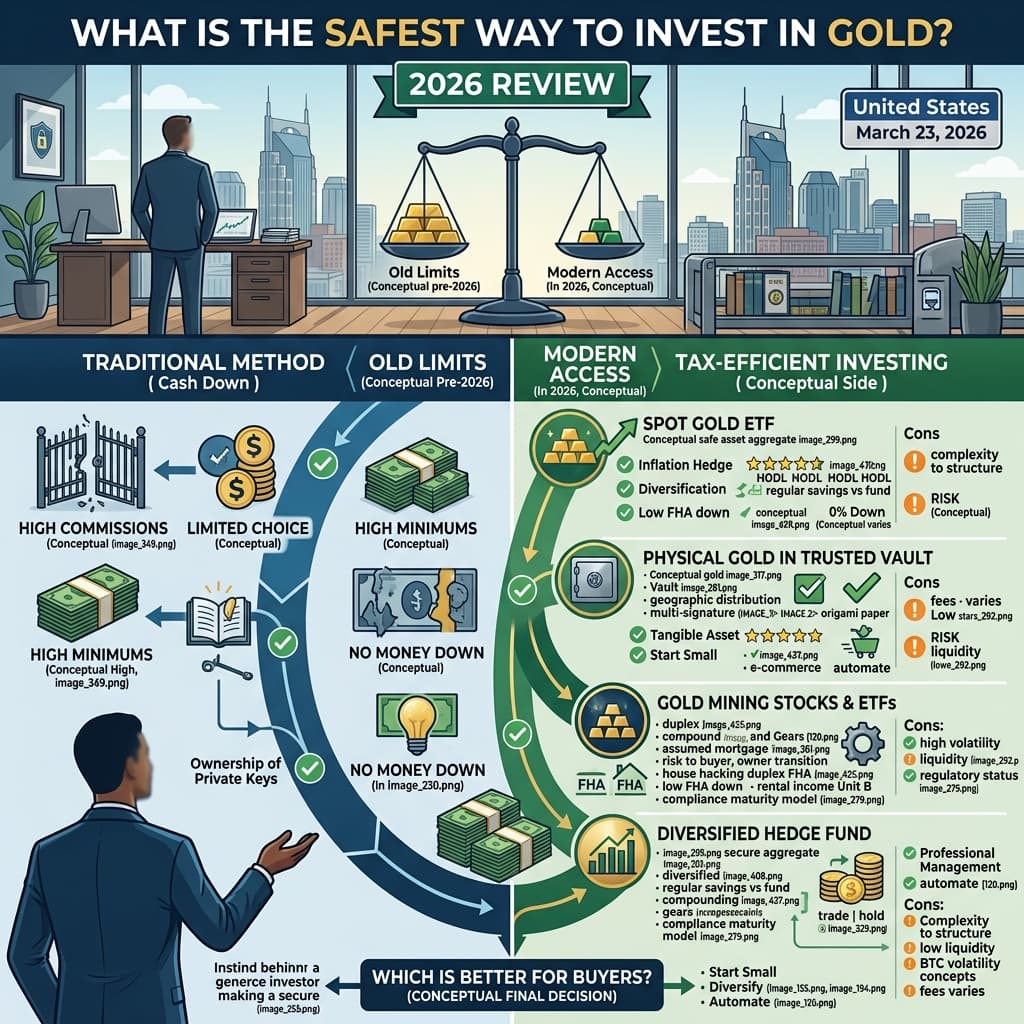
The Short Answer
The safest way to invest in gold is through a combination of physical coins from reputable dealers stored in a home safe or depository, plus a small allocation to gold ETFs like GLD or IAU for liquidity.
What Is the Safest Way to Invest in Gold? (2026 Guide)
By DadAlt Investments | Category: Gold & Precious Metals | Last Updated: March 2026
Gold hit record highs above $5,600 per troy ounce in January 2026 and has never been more widely owned by American individual investors.1 But "investing in gold" means something fundamentally different depending on which vehicle you choose — and the safety profile of each option varies dramatically. A physically-backed gold passive income strategies in a Roth IRA providers costs 0.09%–0.25% per year, is instantly liquid, and requires no insurance, custodian, or storage arrangement. A Gold IRA companies holds allocated physical metal in an IRS-approved vault with meaningful tax advantages but annual fees of $200–$500+ and custodian dependency. Physical coins in your home safe give you direct, counterparty-free ownership but expose you to theft, underinsurance, and the 28% collectibles tax rate. Gold mining stocks can massively outperform in a bull market but carry operational risks that pure gold never does. The right answer for any individual investor depends on which type of risk they are most concerned about — and on the honest recognition that no single gold vehicle is safest across every dimension. This guide breaks down all six ways to own gold, ranks them by safety profile, explains when each one belongs in your portfolio, and flags the scams that have cost thousands of Americans their retirement savings.
Why "Safety" Means Different Things for Gold Investors
Before comparing options, it helps to define what you're trying to be safe from. The same investment that is "safest" against one type of risk may be the worst choice against another.
| Risk You're Protecting Against | Safest Gold Vehicle |
|---|---|
| Inflation and purchasing power loss | All forms of gold provide this — ETFs, physical, IRA, royalties |
| Counterparty risk (custodian/exchange failure) | buying physical gold in your possession; allocated vault storage |
| Theft, loss, or physical damage | Gold ETFs and paper gold — no physical metal to lose |
| Excessive fees eroding returns | Low-cost ETFs (GLDM: 0.10%, IAUM: 0.09%) win clearly |
| Tax drag on long-term gains | Gold ETF or physical gold inside a Roth IRA |
| Price volatility relative to direct gold | Physical gold or a physically-backed ETF (vs. mining stocks) |
| Financial system failure | Physical coins or bars in your direct possession only |
Understanding which risks matter most to your situation is the first step toward choosing the right gold vehicle — or the right combination of vehicles.
The Six Ways to Own Gold
1. Physical Gold Coins and Bars
What it is: Tangible gold — bullion coins (American Gold Eagles, Canadian Maple Leafs, Krugerrands) or bars (PAMP Suisse, Valcambi, Perth Mint) — purchased from a reputable dealer and stored at home or in a private vault.
Best for: Investors who want direct, counterparty-free ownership; crisis-hedge investors; anyone who wants gold that functions when financial systems fail.
Key facts:
- No minimum — you can start with a single 1 oz coin (~$5,100–$5,500 at current prices)
- No annual fees beyond your chosen storage cost
- Long-term gains taxed at the IRS collectibles rate — your marginal rate up to a 28% maximum2
- Immediately accessible — you can sell to a dealer, coin shop, or individual the same day
- Requires secure storage and proper insurance (most homeowner's policies cover only $200–$1,500 in precious metals without a rider)
Suitable dealers: APMEX (largest U.S. selection), JM Bullion (consistently lowest premiums, free shipping over $199), SD Bullion (price-match guarantee). For a full comparison, see Best Places to Buy Gold and Silver Online.
2. Gold ETFs (Exchange-Traded Funds)
What it is: Shares of a fund that holds physical gold or gold-related assets, traded on a stock exchange like any other security. Physically-backed gold ETFs hold allocated gold in vaults; each share represents a fractional interest in actual gold bars.
Best for: Most investors — especially those who want low-cost, liquid gold exposure without the logistical burden of physical ownership.
Key ETFs:
| ETF | Expense Ratio | AUM (Early 2026) | Backing |
|---|---|---|---|
| GLD (SPDR Gold Trust) | 0.40%/yr | ~$176 billion | Physical gold in JPMorgan/HSBC vaults3 |
| IAU (iShares Gold Trust) | 0.25%/yr | ~$81 billion | Physical gold; tracks LBMA Gold Price4 |
| GLDM (SPDR Gold MiniShares) | 0.10%/yr | ~$25 billion+ | Physical gold; lower share price than GLD5 |
| IAUM (iShares Gold Trust Micro) | 0.09%/yr | ~$6 billion | Physical gold; cheapest expense ratio available5 |
| SGOL (abrdn Physical Gold) | 0.17%/yr | ~$9 billion | Physical gold in Swiss vaults; LBMA responsible sourcing3 |
Key facts:
- Available in any brokerage account including Roth and Traditional IRAs
- No minimum above one ETF share
- No storage, no insurance, no custodian, no dealer premium
- Same 28% collectibles tax rate applies in a taxable account — but Roth IRA holding eliminates this permanently
- You do not physically own the gold; you own shares in a fund that owns it
3. Gold IRA
What it is: A self-directed IRA holding IRS-approved physical gold inside a tax-advantaged retirement account. Requires a specialized custodian (not available at standard brokerages) and an IRS-approved depository for storage.
Best for: Retirement investors with $100,000+ who want allocated physical metal with tax-deferred or tax-free growth.
Key facts:
- Tax-deferred growth (Traditional) or tax-free growth (Roth Gold IRA)
- 2026 contribution limits: $7,500/year ($8,600 age 50+); rollovers unlimited
- Setup fees $50–$150; annual custodian + storage fees $200–$500+/year
- Minimum investment: $10,000–$50,000 at most reputable providers
- Gold must be IRS-approved (.995+ purity; American Gold Eagle is the sole 22K exception)
- Cannot take physical possession while the IRA is active
- Traditional Gold IRA requires RMDs at age 73 (Roth is exempt)6
4. Gold Mutual Funds
What it is: Actively managed funds holding a mix of gold-related securities — typically mining stocks, physical gold, and gold-related derivatives. More expensive than ETFs due to active management.
Key facts:
- Expense ratios typically 0.50%–1.50%/year — substantially higher than ETFs
- Active management introduces manager risk (a fund manager's allocation decisions may diverge from gold's actual price movement)
- More suitable for investors who want active oversight of a diversified precious metals exposure
- Generally not recommended for most individual investors when low-cost ETFs are available
- Example: Sprott Gold Equity Fund, Gabelli Gold Fund
5. Gold Mining Stocks
What it is: Shares in companies that mine and produce gold. Mining stocks offer leveraged exposure to gold prices — when gold rises, mining profits often rise faster because operating costs are relatively fixed, amplifying the margin. When gold falls, the reverse is also true.
Key facts:
- In January 2026, gold was up ~6% year-to-date; the Philadelphia Gold and Silver Index of mining companies was up approximately 15% over the same period7
- GDX (VanEck Gold Miners ETF, 0.51% expense ratio) covers large producers including Newmont ($126B+ market cap), Barrick, and Agnico Eagle; $33 billion+ AUM3
- GDXJ (VanEck Junior Gold Miners ETF, 0.51%) focuses on smaller, higher-risk junior miners; $10.5 billion AUM7
- Miners carry risks that pure gold does not: mine production shortfalls, cost overruns, management missteps, political/regulatory risk in mining jurisdictions, and company-specific accounting issues
- Most gold funds pay dividends; physically-backed ETFs like IAU and GLD do not8
Bottom line: Mining stocks are not a substitute for gold — they are equity investments with partial gold exposure. They belong in a different risk category than physical gold or gold ETFs.
6. Gold Royalty and Streaming Companies
What it is: Companies that provide upfront capital to mining operators in exchange for the right to purchase a percentage of future gold production at a predetermined price — usually well below prevailing spot price. They own no mines and carry no operational risk.
The major royalty/streaming companies:
- Franco-Nevada (FNV) — the original gold royalty company; portfolio of royalties and streams on 119+ producing assets globally; 16+ consecutive years of dividend increases9
- Wheaton Precious Metals (WPM) — world's largest precious metals streaming company; 23 operating mines and 25 development projects across five continents; projects ~50% production growth to 1.2 million GEOs by 2030; Q3 2025 net profit margin of 77.1%10
- Royal Gold (RGLD) — diversified royalty portfolio with over 180 properties; steady income stream
Key facts:
- Royalty/streaming companies are not pure gold plays — their stock price reflects gold prices plus company-specific factors including their deal pipeline, management quality, and market sentiment
- They typically outperform physical gold ETFs in bull markets and underperform in bear markets
- They pay dividends, adding an income component that physical gold never provides
- Risk profile sits between pure gold ETFs and direct mining stocks — lower than miners, higher than physical gold or ETFs
Ranked: Safest to Least Safe for Most Investors
This ranking reflects overall safety for a long-term, wealth-preserving American investor — not short-term traders. It weights all risk dimensions including fees, volatility, counterparty exposure, tax efficiency, and accessibility.
#1 — Gold ETF (GLDM, IAU, IAUM) Inside a Roth IRA
Why it ranks first: This is the highest-efficiency, lowest-friction gold investment available to most American investors. You get:
- Direct, physically-backed gold exposure with no storage, no insurance, no custodian
- Tax-free growth and distributions for life (Roth) — the 28% collectibles rate is permanently irrelevant
- Instant liquidity at market prices during any trading day
- Expense ratios as low as 0.09% annually — dramatically lower than any other tax-advantaged gold vehicle
- Available at any brokerage with zero special account setup
Best ETF for cost efficiency: GLDM (0.10%) or IAUM (0.09%) for long-term holders; GLD (0.40%) if you need maximum liquidity for very large positions.5
The one limitation: You do not physically own the gold — you own shares in a fund. In a scenario where the broader financial system collapses and ETF trading is suspended, this vehicle does not function. For most investors, this tail risk is acceptable. For investors who specifically want gold as a financial-system-failure hedge, supplement with physical coins.
#2 — Physical Gold in a Professional Depository
Why it ranks second: Allocated storage at a professional depository (Delaware Depository, Brink's, Loomis) gives you direct title to specific physical gold coins or bars, stored in an institutional-grade insured vault, without the home security risk.
- Your specific allocated coins are identified, segregated, and insured
- Annual costs: typically 0.10%–0.50% of holdings value — more expensive than ETFs but far cheaper than a Gold IRA
- Accessible for withdrawal or sale on your instruction
- No counterparty beyond the vault itself (unlike a Gold IRA, which adds a custodian layer)
- Gains still subject to 28% collectibles rate (unless held in an IRA)
Best for: Investors with $25,000+ in physical gold who want the security of professional storage without the full Gold IRA structure.
#3 — Gold IRA with a Reputable Provider
Why it ranks third: A Roth Gold IRA with a vetted provider like Augusta Precious Metals, Goldco, or Birch Gold Group delivers meaningful tax advantages — permanent exemption from the 28% collectibles rate in the Roth structure — with the security of professional allocated storage. The custodian adds an institutional compliance layer that protects IRA assets in ways a private vault may not. For a head-to-head comparison, see Augusta, Goldco, and Birch Gold Group.
Honest limitations: Annual fees of $200–$500+ make small accounts ($10,000–$25,000) economically suboptimal. The custodian layer adds both cost and dependency. The industry contains documented bad actors (see Scams section below). At account sizes of $100,000+, these limitations become manageable relative to the tax benefit.
#4 — Physical Gold Stored at Home
Why it ranks fourth: Direct physical possession gives you maximum personal control and no counterparty risk whatsoever — but introduces risks that professional storage eliminates:
- Residential burglary (800,000 burglaries annually in the U.S.)
- Homeowner's insurance sublimits of $200–$1,500 without a scheduled rider
- No institutional fire suppression or security infrastructure
- Still subject to the 28% collectibles tax rate
Appropriate scale: $5,000–$20,000 in a quality bolted safe (Liberty, AMSEC, Fort Knox) with proper insurance coverage. The crisis-hedge case for home storage remains valid at any portfolio size, but larger holdings warrant splitting between home and professional storage. For a complete home storage guide, see How to Store Gold at Home Safely.
#5 — Gold Mining Stocks (Individual or GDX/GDXJ)
Why it ranks fifth: Mining stocks can powerfully outperform physical gold in a bull market — but they are equity investments, not gold investments. You are exposed to mine production risk, cost inflation, management decisions, currency risk in foreign mining jurisdictions, and general stock market correlation. The worst years for mining stocks often occur when gold is rising but cost pressures prevent miners from converting higher prices into higher margins.
For investors specifically seeking gold as a portfolio hedge and stability anchor, mining stocks partially undermine that purpose by reintroducing equity risk. GDX and GDXJ are appropriate additions for investors who have already established a physical/ETF gold base and want leveraged upside exposure — not as a substitute for the base.
#6 — Leveraged Gold ETFs (NUGT, JNUG, UGL)
Why it ranks last: Leveraged gold ETFs — such as NUGT (2x daily gold miners) or UGL (2x daily gold price) — are designed for short-term tactical trading, not wealth building. The daily reset mechanism causes a mathematical phenomenon called "volatility decay" that causes these funds to diverge dramatically from their stated leverage over time. NUGT fell approximately 27% over five years ending 2025 despite gold itself rising substantially over that period.8
Never use leveraged gold ETFs for long-term portfolio construction. They are speculation instruments appropriate only for sophisticated traders managing positions on a daily basis.
The Best Starting Point for Most Investors: Gold ETFs
For the large majority of American investors — those who are building a diversified portfolio and want gold exposure as a hedge — a low-cost physically-backed gold ETF inside a Roth IRA is the single most efficient starting point.
Here is why:
- Zero friction: Open an account at Fidelity, Vanguard, and Schwab, Schwab, or Vanguard, fund your Roth IRA, and buy GLDM or IAUM. No custodian application, no dealer negotiation, no minimum beyond what ETF shares cost.
- Lowest total cost: At 0.10% annually (GLDM) or 0.09% (IAUM), you pay $10 per $10,000 per year in fees. Compare this to $200–$500+/year for a Gold IRA or 3–10% dealer premium on physical coins.
- Tax-free growth permanently: Inside a Roth IRA, the IRS collectibles rate on gold is a non-issue. Every dollar of appreciation compounds tax-free.
- Instant liquidity: Sell any time during market hours at the gold spot price minus the ETF's small tracking error.
Recommended starting allocation: Most independent financial planners suggest 5–10% of total portfolio value as a gold hedge position. This is enough to provide meaningful protection during equity drawdowns without over-weighting a non-income-producing asset.7
When to Add Physical Gold
Gold ETFs are the right starting point, but physical gold makes sense as a complement once your portfolio reaches a meaningful size.
Consider adding physical coins when:
- Your total portfolio exceeds $50,000–$100,000. At this scale, a small allocation to 1–5 oz of American Gold Eagles gives you tangible, immediately accessible wealth that does not depend on any financial intermediary.
- You want genuine crisis-hedge exposure. A gold ETF is only accessible while brokerage accounts, internet infrastructure, and financial markets are functioning. Physical gold in your home safe works during power outages, market closures, and financial system disruptions. For this specific risk, ETFs are not a substitute.
- You want to diversify your storage locations. Holding gold in multiple forms (ETF at brokerage + physical at home + depository account) reduces concentration risk across any single institution or vehicle.
For physical purchases: start with 1 oz American Gold Eagles for maximum recognizability and liquidity — every dealer and buyer in the U.S. will immediately price them without hesitation. Add 1 oz Canadian Maple Leafs or bars from PAMP Suisse or Valcambi as your position grows.
Common Gold Scams to Avoid
The gold industry is heavily targeted by fraudulent operators. The CFTC, SEC, FTC, and FINRA have all taken enforcement actions against gold and Gold IRA operators in recent years. These are the specific scam patterns to recognize:
1. Numismatic and "Semi-Numismatic" Coin Pressure Sales
Unscrupulous dealers (particularly in the Gold IRA space) pitch "rare," "collector," or "semi-numismatic" coins with inflated premiums of 40%–200% or more above their gold content value. The CFTC has documented cases where such coins were sold at 300% above spot price. These coins are rarely IRA-eligible, are difficult to resell at a fair price (dealers will typically offer only melt value), and the "rarity" premium is largely manufactured by the seller.11
Protection: Always verify the current spot price before any purchase (Kitco.com, JMBullion.com). Stick to standard IRA-approved bullion coins from authorized mints. If a salesperson is pushing anything described as "rare," "limited," or "collector-grade," walk away.
2. Gold Ownership Certificates With No Verified Allocated Storage
Some operators sell "gold certificates" or "allocated gold accounts" with no independent audit of actual holdings. The gold may not exist. Unlike a publicly-traded ETF like GLD or IAU — whose holdings are independently audited and published — obscure certificate programs have been used to defraud investors.
Protection: Only buy gold through established, independently audited vehicles. If physical metal is involved, verify that it is held at a named, verifiable IRS-approved or LBMA-approved depository and that you can request an independent audit or physical delivery.
3. High-Pressure Gold IRA Rollovers With Undisclosed Fees
In a 2023 SEC enforcement action, Red Rock Secured was sued for marking up gold by as much as 130% on customer IRA rollovers while advertising low markup rates.12 The CFTC has documented a case where a gold dealer and IRA custodian charged nearly $150,000 in commissions and fees on a $300,000 rollover.11
Protection: Demand a complete, written fee schedule before signing anything. The total all-in cost of a Gold IRA includes setup fees, annual custodian fees, annual storage fees, and the dealer's markup above spot. Any company that hedges on disclosing any of these in writing is a red flag. Never make a rollover decision during or immediately following a sales call — take days or weeks to independently research and compare providers.
4. Counterfeit Gold Bars (Tungsten Core)
Tungsten — a metal with a density very close to gold — has been used to produce convincing counterfeit gold bars. A tungsten-core bar coated in gold will pass a basic visual and weight check but fails a proper density test or electromagnetic scan. This risk is concentrated in the secondary market (eBay, private sellers, unverified overseas dealers).
Protection: Buy only from established U.S. dealers with track records (APMEX, JM Bullion, SD Bullion). For any secondary market purchase, use a Sigma Metalytics Precious Metal Verifier ($699+) which measures electromagnetic resistivity through the entire coin or bar — detecting tungsten cores and other substitutions that surface-only tests miss.
FAQ
Should I buy a Gold ETF or physical gold coins?
For most investors, the honest answer is: start with a gold ETF, then add physical coins when your portfolio reaches $50,000–$100,000+. A gold ETF inside a Roth IRA gives you tax-free gold exposure with minimal cost and no friction. Physical coins give you tangible, counterparty-free wealth that works when systems fail. The two serve different purposes and complement each other — the question is sequencing. Most investors are better served establishing an efficient ETF position first before taking on the storage and insurance obligations of physical gold.
How much of my investment portfolio should be in gold?
Most independent financial planners who include gold in portfolio recommendations suggest a 5–15% allocation — enough to provide meaningful diversification and crisis protection without over-weighting a non-income-producing asset. Warren Buffett has famously argued that gold produces no returns beyond price appreciation; Dave Ramsey opposes gold IRAs primarily due to industry fee structures. Both critiques have validity. At 5–10%, gold serves its hedging purpose. At 30–50%, it creates meaningful drag when equities are outperforming (which is most of the time over the long run). A 5–10% position in a diversified retirement account is defensible; a 30–50% position requires a very specific investment thesis to justify.6
Is gold a reliable investment for retirement?
Gold is a reliable hedging and diversification tool within a retirement portfolio — but not a reliable growth engine. Over the 20 years ending February 2026, gold returned approximately 9.4% annualized (550% total), compared to the S&P 500's approximately 10.1% annualized. Gold trailed equities over that full period but held its value during the 2008 financial crisis (+5.5% vs. S&P 500 -37%), the 2020 COVID crash (+25% vs. -34%), and the 2022 simultaneous stock/bond drawdown.6 Gold belongs in a retirement portfolio as an allocation that stabilizes performance during the worst equity environments — not as a replacement for equities.
When is the best time to buy gold?
The most reliable approach is dollar-cost averaging — investing a fixed dollar amount in gold at regular intervals regardless of price level. This removes the pressure of timing and smooths your average purchase price over market cycles. Gold prices are driven by factors including dollar strength, real interest rates, central bank buying, geopolitical stress, and inflation expectations — making short-term prediction unreliable even for professional analysts. The right time to own gold is determined by your portfolio strategy, not by price forecasting. If your portfolio has no gold allocation and you want a 5–10% hedge position, building that position gradually over 6–12 months reduces timing risk while establishing meaningful exposure.
Sources and References
Disclaimer: This article is for informational and educational purposes only and does not constitute financial, legal, or tax advice. Past performance does not guarantee future results. Gold prices are volatile and all investments carry risk of loss. Always consult a qualified, independent financial advisor before making investment or retirement account decisions. DadAlt Investments may earn affiliate commissions from some links in this article at no cost to you.
Recommended Reading
- How to Buy Gold Online Safely
- Gold IRA vs. Physical Gold: Which Is Better?
- How to Store Gold at Home Safely
Footnotes
-
APMEX. "Gold Price Today." https://www.apmex.com/gold-price — Gold record high $5,602.22 on January 28, 2026. ↩
-
Alloy Market. "How Much Gold Can I Sell Without Reporting to the IRS?" https://thealloymarket.com/how-much-gold-can-i-sell-without-reporting/ — 28% collectibles long-term capital gains rate for physical gold. ↩
-
Motley Fool. "Best 7 Gold ETFs for March 2026 & How to Invest." March 2026. https://www.fool.com/investing/stock-market/market-sectors/materials/gold-stocks/gold-etfs/ — GLD $176B AUM; SGOL $9B AUM; GDX $33B AUM. ↩ ↩2 ↩3
-
Kiplinger. "The Cheapest Gold ETFs to Buy Now." https://www.kiplinger.com/investing/commodities/gold/22000/7-gold-etfs-with-low-costs — IAU $81B AUM; 494.56 tonnes held; LBMA Gold Price tracking. ↩
-
Nasdaq/Motley Fool. "3 Best Gold ETF Picks for 2026." https://www.nasdaq.com/articles/3-best-gold-etf-picks-2026 — GLDM 0.10% expense ratio; IAUM 0.09% expense ratio; gold up 62% in 2025. ↩ ↩2 ↩3
-
Bullion ITE Asset Group. "Are Gold IRAs a Good Idea? Pros, Cons and Returns 2026." https://bullioniteassetgroup.com/are-gold-iras-a-good-idea-pros-cons-returns-2026/ — Gold 20-year return ~9.4%; S&P 500 ~10.1%; 2008, 2020, 2022 crisis performance; 10–20% allocation recommendation. ↩ ↩2 ↩3
-
U.S. News. "5 Best Gold ETFs to Buy for 2026." January 16, 2026. https://money.usnews.com/investing/articles/best-gold-etfs-to-hedge-volatility — Philadelphia Gold and Silver Index up ~15% year-to-date; GDX and mining leverage explanation. ↩ ↩2 ↩3
-
LendEDU. "6 Best Gold ETFs to Watch in 2026." January 2026. https://lendedu.com/blog/best-gold-etfs/ — NUGT leveraged ETF fell ~27% over five years; IAU and GLD no dividends; mining ETF dividends. ↩ ↩2
-
XS.com. "19 Best Gold Stocks in the World (2026)." January 13, 2026. https://www.xs.com/en/blog/best-gold-stocks/ — Franco-Nevada 16+ consecutive dividend increases; Royal Gold diversified portfolio overview. ↩
-
Morningstar/Wheaton Precious Metals. "Wheaton Exceeds 2025 Production Guidance." February 2026. https://www.morningstar.com/news/pr-newswire/20260216va88315/wheaton-precious-metals-exceeds-2025-production-guidance — Wheaton WPM 2026 guidance 860,000–940,000 GEOs; 50% growth to 1.2M GEOs by 2030; Q3 2025 net profit margin 77.1%. ↩
-
CFTC. "Precious Metal Frauds." https://www.cftc.gov/LearnAndProtect/metalsfrauds — $150,000 in fees on $300,000 rollover; 300% premiums on numismatic coins. ↩ ↩2
-
ConsumerAffairs. "Gold IRA Scams to Avoid in 2026." https://www.consumeraffairs.com/finance/gold-ira-scams-to-avoid.html — SEC 2023 action against Red Rock Secured; 130% markups on IRA rollovers. ↩
Frequently Asked Questions
Is physical gold safer than gold ETFs?
Physical gold eliminates counterparty risk — you own the actual metal. Gold ETFs are more liquid and convenient but depend on a fund manager. The safest approach combines both for different purposes.
What type of gold is best to buy?
American Gold Eagles and Canadian Gold Maple Leafs are the most recognized and easiest to resell. For pure investment, 1 oz gold bars from PAMP Suisse or Valcambi offer slightly lower premiums.
How much gold should I own?
Most advisors recommend 5–10% of your portfolio in precious metals. Conservative investors might go to 15% during uncertain times. Gold is a hedge, not a growth engine — size it accordingly.

About the Author
Jared DeValk
Founder, DadAlt Investments
Father, alternative investment researcher, and founder of DadAlt Investments. 14+ years turning hard lessons into honest guidance for dads building real wealth.