
How to Buy Physical Gold Online Safely (2026 Guide)
Step-by-step guide to buying physical gold from trusted online dealers.
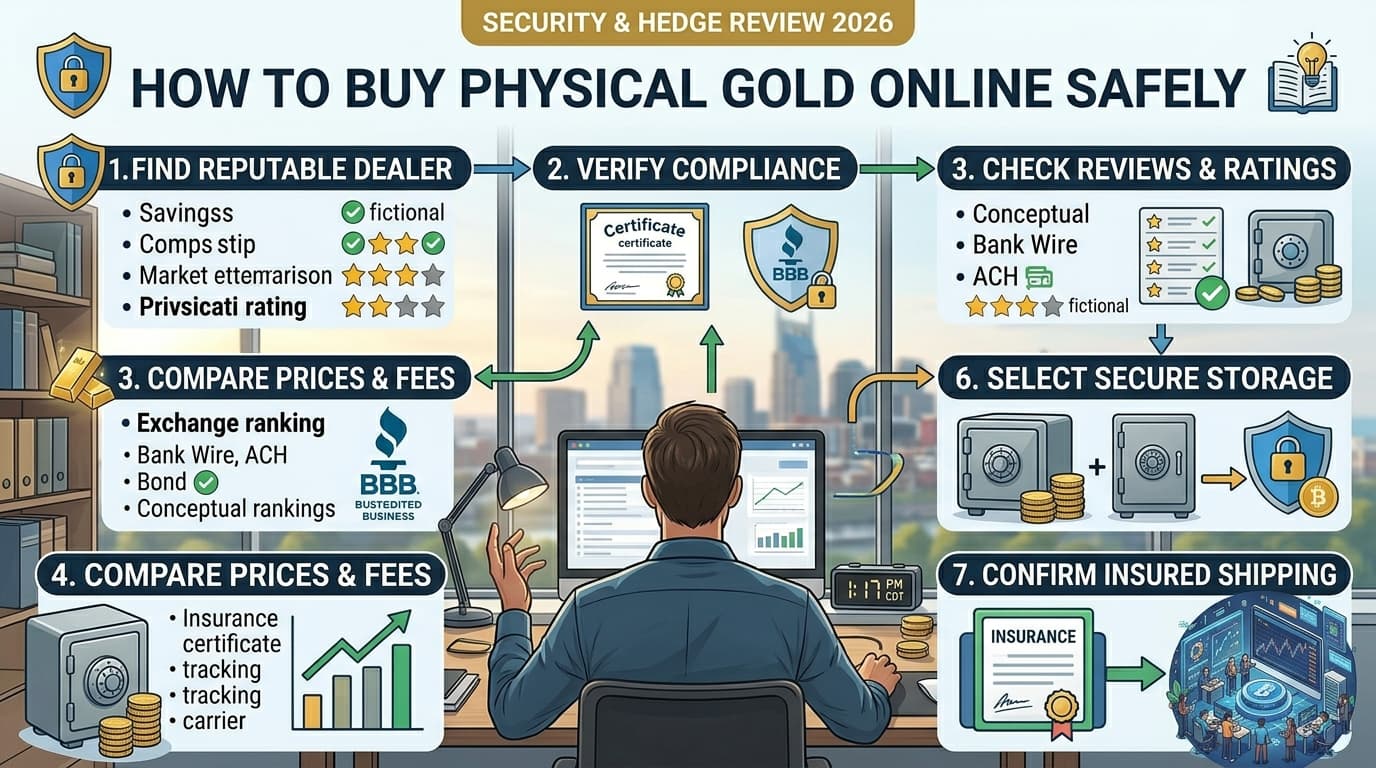
The Short Answer
Buy physical gold online safely by choosing BBB-accredited dealers, paying by bank transfer, starting with recognizable coins like American Gold Eagles, selecting insured shipping, and verifying authenticity upon delivery.
How to Buy Physical Gold Online Safely (2026 Guide)
By DadAlt Investments | Category: Gold & Precious Metals | Last Updated: March 2026
Gold hit a record high of $5,602.22 per troy ounce on January 28, 2026 — more than $2,100 above where it traded just one year earlier — as investors poured into hard assets amid dollar uncertainty, geopolitical stress, and persistent inflation concerns.1 For many American families, physical gold represents something a Gold passive income strategies never can: a tangible asset that requires no counterparty, no custodian, and no brokerage account to hold its value. But buying physical gold online safely requires knowing which dealers to trust, how dealer premiums work, how to place and receive your first order without making costly mistakes, and — critically — how the IRS treats your gains when you eventually sell. This guide walks through every step of the process: what forms of gold to buy, how to read spot prices and compare premiums, which four U.S. online dealers have earned strong reputations, a step-by-step walkthrough of your first purchase, how to verify and store your gold after delivery, and the tax rules that apply to physical gold ownership in the United States.
Why Buy Physical Gold (and When It Makes Sense)
Physical gold fills a specific role in a portfolio that paper gold — ETFs, futures, or mining stocks — does not. Before buying, make sure you understand both the case for it and its real limitations.
The Case for Physical Gold
- Zero counterparty risk. A 1 oz American Gold Eagle in your safe does not depend on a bank, brokerage, fund manager, or exchange staying solvent. No one can freeze it, rehypothecate it, or block your access to it.
- Tangible inflation protection. Gold has preserved purchasing power across centuries. While it can underperform stocks for long stretches, it tends to hold value through periods of currency debasement and high inflation.
- Crisis hedge. Gold historically appreciates during periods of geopolitical uncertainty, banking stress, and dollar weakness — precisely when other assets may be declining.
- True ownership vs. paper. When you buy shares of GLD or IAU (the most popular gold ETFs), you own a fractional claim on a fund that holds gold — but you cannot take delivery, and the fund carries management fees and custodian risk. Physical gold eliminates that layer entirely.
Honest Limitations
- Gold produces no income — no dividends, no interest, no yield. You earn only capital appreciation when you sell.
- Physical gold has storage costs and logistics: you need a secure location, and larger holdings may require a third-party vault.
- Gold is taxed as a collectible by the IRS, meaning long-term gains face up to a 28% rate — higher than the maximum 20% long-term capital gains rate on stocks (more on this in the Tax section below).
- It is a long-term hedge, not a speculation. Daily price swings are common; gold rewards patient, long-term holders who treat it as portfolio insurance.
Recommended Portfolio Allocation
Most building a financial planners who include gold in portfolio recommendations suggest a 5–15% allocation as a hedge — enough to provide meaningful protection during a crisis without over-weighting a non-income-producing asset. This is not a get-rich-quick play; it is an insurance component of a diversified strategy.
What Forms of Physical Gold to Buy
Not all gold is created equal for investment purposes. Here is what matters:
Gold Coins — Best for First-Time Buyers
Coins are the most liquid, most recognizable, and most easily resold form of physical gold for individual investors. They carry slightly higher premiums than bars but are easier to sell quickly at a fair price because dealers and buyers recognize them instantly.
The three most recognized coins for U.S. investors:
- American Gold Eagle — Minted by the U.S. Mint; 22-karat gold (91.67% pure gold, with silver and copper added for durability); the most widely recognized and traded gold coin in the United States. Available in 1 oz, 1/2 oz, 1/4 oz, and 1/10 oz sizes. APMEX has been a U.S. Mint Authorized Purchaser since 2014.1
- Canadian Maple Leaf — Minted by the Royal Canadian Mint; 24-karat gold (.9999 fine purity); anti-counterfeiting features including radial lines and Bullion DNA holographic security. Highly liquid globally.
- South African Krugerrand — One of the oldest bullion coins (first minted 1967); 22-karat gold (same composition as Gold Eagles); remains one of the most widely traded gold coins worldwide. Typically trades at slightly lower premiums than Gold Eagles.
Gold Bars — Best for Lower-Cost Bulk Accumulation
Gold bars carry lower premiums than coins because they have no face value, are not government-minted, and are simpler to produce. The tradeoff is liquidity: bars are slightly harder to sell than coins because buyers must weigh and verify them more carefully.
- Common retail sizes: 1 gram, 5 grams, 10 grams, 1 oz, 10 oz, 1 kilogram
- Best-known producers: PAMP Suisse, Valcambi, Credit Suisse, Perth Mint, Royal Canadian Mint
- Start with 1 oz bars from well-known refineries if you choose bars over coins
What to Avoid: Numismatic and Collectible Coins
Numismatic coins — rare, historically significant, or graded collector coins — carry premiums far above their gold content value. A coin worth $3,000 over spot based on its rarity and condition is only worth its gold melt value if you need to sell it quickly and the buyer doesn't share your assessment of its collectible value. For investment purposes, stick to bullion coins — coins valued primarily for their gold content, not their rarity.
Rule of thumb for first-time buyers: Start with a 1 oz American Gold Eagle from a reputable dealer. It is the most universally recognized, liquid, and easy-to-resell gold coin available in the U.S. market.
Understanding Spot Price and Dealer Premiums
Before placing any order, you need to understand how gold pricing actually works — because the price you pay is never simply the spot price.
What Is Spot Price?
The spot price is the current market price for one troy ounce of pure gold for immediate delivery. It is determined by futures trading on the COMEX exchange and updates continuously during market hours, changing by the second based on global supply, demand, and sentiment. This is the number you see quoted on financial news sites.
Where to check live spot price:
- Kitco.com — widely used real-time gold and silver price charts
- APMEX.com/gold-price — dealer spot price with historical charts
- Goldprice.org — clean live spot price display
- JMBullion.com — live price with interactive historical charts; as of March 15, 2026, gold was trading at approximately $5,032/oz.2
What Is a Dealer Premium?
The premium is the amount above spot price that a dealer charges for a physical product. It covers the cost of manufacturing, minting, distribution, dealer margin, and market conditions. The premium is your true additional cost over the underlying metal value — and it is the key variable to compare across dealers.
Typical premium ranges in 2026:
| Product | Typical Premium Over Spot |
|---|---|
| Gold bars (1 oz, major refineries) | 1–3% |
| Gold bars (smaller/less common) | 3–5% |
| American Gold Eagle (1 oz) | 4–8% |
| Canadian Maple Leaf (1 oz) | 3–6% |
| South African Krugerrand (1 oz) | 3–6% |
| Fractional gold coins (1/4 oz, 1/10 oz) | 10–20%+ |
Note: Fractional coins carry dramatically higher premiums because the fixed manufacturing cost is spread over a smaller amount of gold. For investment purposes, 1 oz coins and bars give you the most gold for your dollar.
How to Compare Premiums
Dealers publish their prices live on their websites, automatically adjusting as spot price moves. When comparing two dealers, look at the dollar amount over spot (not just the total price) — this is an apples-to-apples comparison of true dealer markup. Sites like Bullion.com allow side-by-side premium comparisons across APMEX, JM Bullion, SD Bullion, Money Metals, and Provident Metals in real time.3
Payment Method Affects Your Final Price
Most dealers charge different premiums depending on how you pay:
- ACH bank transfer / eCheck / paper check — lowest premium; dealers pass savings on because there is no payment processing fee and no chargeback risk
- Bank wire transfer — similarly low premium
- Debit card — moderate; some dealers accept at coin price
- Credit card — highest premium; typically adds 2–4% on top of the listed price
- Bitcoin / cryptocurrency — varies by dealer; some accept at the same rate as ACH
Bottom line: Pay by ACH or check whenever possible to minimize your all-in cost per ounce.
Best Reputable Online Gold Dealers
The U.S. online bullion market is competitive and, for the most part, well-regulated. These four dealers have earned strong reputations through years of operation, verified customer reviews, and published buyback programs.
#1 APMEX — Best for Selection and Track Record
Founded in 2000 and headquartered in Oklahoma City, APMEX is the largest U.S. online bullion dealer by inventory, with over 30,000 products available at any given time. APMEX holds an A+ rating from the Better Business Bureau and has been a U.S. Mint Authorized Purchaser since 2014 — a shortlist that also includes Deutsche Bank and Scotia Bank.1
Why APMEX stands out:
- Widest product selection of any U.S. online dealer — standard bullion, government coins, collectibles, fractional sizes, and more
- APMEX Bullion Club loyalty rewards program for repeat buyers
- Live price alerts and spot price tracking tools
- Third-party vault storage (Citadel) available for large holdings
- Multiple payment options; bank wire earns lowest premium
- Instant online buyback quotes with competitive spread
Best for: Investors who want the largest selection and a thoroughly established track record, or who plan to buy across multiple product types.
#2 JM Bullion — Best for Lowest Premiums
Founded in 2011 and based in Dallas, Texas, JM Bullion has built a loyal following by consistently offering some of the most competitive premiums on popular bullion coins and bars in the U.S. market. The company has accumulated over 400,000 customer reviews with a 4.8/5 average rating.4
Why JM Bullion stands out:
- Consistently among the lowest premiums on Gold Eagles, Maple Leafs, and 1 oz bars
- Free insured shipping on all orders over $199 — a meaningful value for smaller buyers
- ACH payment option lowers cost further; detailed payment options displayed on every product page before checkout
- Easy price comparison tools built into the website
- Volume (bulk) discounts for larger purchases
- Published buyback program; minimum "Sell-To-Us" amount of $1,0005
- Accredited by the Better Business Bureau; full U.S. state and federal regulatory compliance
Best for: Cost-conscious buyers focused on minimizing the premium per ounce — especially on common coins and bars.
#3 SD Bullion — Best for Bulk Buyers and Competitive Bar Pricing
Founded in 2012 by two physicians with a mission to offer the lowest gold and silver prices in the industry, SD Bullion has grown into one of the highest-rated major bullion dealers at the Better Business Bureau and has executed over $5 billion in total sales. SD Bullion has appeared on Inc. Magazine's list of 5,000 Fastest Growing Companies four times and was ranked the 76th largest e-tailer in the United States in 2024.6
Why SD Bullion stands out:
- Price-match guarantee — will match any competitor's advertised price
- Best tube and bulk pricing for silver stackers; competitive on gold bars
- A+ BBB rating — highest-rated major bullion dealer at the BBB per the company's own claim
- Strong market analysis content and educational resources
- Sells the Sigma Metalytics Precious Metals Verifier directly, which is the professional-grade authentication tool used by dealers
Best for: Investors purchasing larger quantities (multiple ounces), or anyone who wants to price-match and is focused on absolute lowest cost per ounce.
#4 Money Metals Exchange — Best for Recurring Buyers
Money Metals Exchange, based in Eagle, Idaho, differentiates itself with strong educational resources, market commentary, and — most importantly for systematic investors — a monthly automatic purchase program that allows you to dollar-cost average into gold or silver on a set schedule.7
Why Money Metals Exchange stands out:
- Auto-purchase program: set a monthly dollar amount and automatically receive gold or silver at prevailing premiums
- Strong editorial/educational content — useful for investors still learning
- Competitive premiums on popular products
- Multiple payment methods including check and ACH
Best for: Investors who want to build their gold position systematically over time through dollar-cost averaging rather than lump-sum purchases.
Dealer Vetting Checklist
When evaluating any online precious metals dealer — including dealers not on this list — look for the following before sending money:
- BBB accreditation and rating — A or A+ BBB rating, with a history of resolving complaints
- Years in business — Established dealers (5+ years) with verifiable track records
- Published buyback program — A legitimate dealer publishes their buy prices and spread. If they won't buy back what they sell you, be cautious.
- Transparent premium pricing — Premiums should be visible before checkout, not revealed only at payment
- Industry memberships — Industry Council for Tangible Assets (ICTA), American Numismatic Association (ANA), or Professional Numismatists Guild (PNG) memberships signal professional standards
- Insured, tracked shipping — Every legitimate dealer ships insured with signature confirmation required
Step-by-Step: Placing Your First Gold Purchase Online
Step 1: Check the Live Spot Price
Before opening any dealer website, check the live gold spot price on Kitco.com, Goldprice.org, or APMEX's spot price page. This gives you the baseline number against which you'll evaluate every dealer's premium. Spot prices update every few seconds during market hours.
Step 2: Compare Premiums Across Two or Three Dealers
Open APMEX, JM Bullion, and SD Bullion simultaneously and look up the same product — for example, a 1 oz American Gold Eagle. Compare the dollar amount over spot on each site, not just the total price (which moves with spot). Note the payment method that gives you the lowest premium on each site.
Step 3: Choose Your Product
For your first purchase, a 1 oz American Gold Eagle is the recommended starting point. It is the most recognized, most liquid, and most easily resold gold coin in the United States. One ounce gives you maximum liquidity without the high percentage premiums of fractional sizes.
Step 4: Choose Your Payment Method
Select ACH bank transfer, eCheck, or paper check to receive the lowest premium. Avoid credit card for gold purchases if possible — the 2–4% surcharge can easily eliminate one year's worth of price appreciation. Confirm the exact payment-adjusted price before adding to cart.
Step 5: Place the Order and Confirm Shipping Details
- Verify your shipping address carefully — precious metals are shipped to the verified address only
- Confirm that your order ships fully insured and with adult signature required upon delivery
- Note the estimated ship time — most major dealers ship within 1–3 business days after payment clears; ACH/check orders typically clear in 3–5 business days
- Save your order confirmation email and record your purchase price and date (important for cost basis tracking at tax time)
Step 6: Inspect on Delivery — Before Signing
When your package arrives:
- Inspect the outer packaging before signing — if the package shows obvious signs of tampering, document it with photos before opening and contact the dealer immediately
- Open carefully — do not cut through the contents; gold coins may be in sealed plastic capsules or assay cards
- Verify the product — check that the coin or bar matches what you ordered (markings, weight, size)
- Weigh it (optional but recommended for bars) — a 1 oz gold bar should weigh exactly 31.1 grams on a precision scale
- Sign for the package only after you are satisfied with the exterior condition
How to Verify Gold Authenticity
Buying from a reputable, established U.S. dealer significantly reduces counterfeit risk. Major dealers source directly from government mints and authorized refiners and have established authenticity protocols. However, if you purchase gold on the secondary market (eBay, private sellers, coin shows), additional verification is warranted.
Free / Low-Cost Home Tests
These are first-line checks, not definitive authentication:
- Weight and dimensions — A genuine 1 oz gold coin or bar has precise, published specifications. Weigh it (a digital scale accurate to 0.01 grams costs $15–$25) and measure the diameter with calipers. Any significant deviation is a red flag.
- Magnet test — Gold is not magnetic. Hold a strong neodymium rare-earth magnet near the coin — it should have no attraction. If the coin is attracted to the magnet, it contains iron or steel and is almost certainly fake. Note: tungsten counterfeits (the most sophisticated fakes) also pass the magnet test.
- Visual inspection — Examine the coin under good light for sharp, clearly defined lettering and relief. Counterfeit coins often have softer detail, slightly wrong proportions, or inconsistent edge reeding.
Professional-Grade Verification: Sigma Metalytics PMV
The Sigma Metalytics Precious Metal Verifier (PMV) is the professional authentication tool used by coin dealers and refiners across the United States. It measures the electromagnetic resistivity of the bulk metal inside a coin or bar — penetrating past any surface plating — and compares the result to a calibrated range for the expected alloy. A reading inside the brackets confirms the metal composition is consistent with authentic gold; a reading outside indicates the bulk metal is not what it claims to be.8
Key features:
- Tests in under one second, non-destructively
- Can read through plastic capsules, assay cards, and numismatic slabs without removing the coin
- Tests gold (pure, 22K, 90%), silver, platinum, and palladium
- PMV Original retails around $699; PRO model approximately $1,500+
Note: The Sigma PMV verifies metal composition — it cannot authenticate that a coin is from a specific mint or year, and highly sophisticated counterfeits of the correct alloy could theoretically pass. For the highest certainty, an independent assay (fire assay or XRF gun) at a licensed refinery is the definitive test. For most individual investors buying from reputable dealers, the Sigma PMV provides strong practical reassurance.8
Storing Physical Gold After Purchase
How and where you store your gold is as important as how you buy it. Your storage decision should match the value of what you're protecting.
Home Safe
A quality home safe is the most accessible storage option and costs nothing in ongoing fees.
- UL-rated fireproof safe — look for a safe with a UL fire rating of at least 1 hour at 1,700°F; gold itself won't melt (melting point: 1,948°F) but coins can be damaged if exposed to extreme heat for extended periods
- Bolt it down — a safe that isn't anchored can be carried out of your house entirely. Bolt it to a concrete floor or wall using the mounting hardware most safes include.
- Discrete placement — the best safe in your house is one a burglar never finds. A closet, basement corner, or built-in installation is better than a highly visible placement.
- Recommended for holdings under $10,000–$20,000
Bank Safe Deposit Box
An inexpensive (typically $20–$100/year) option at your local bank branch that provides physical security without home storage risk.
- Limitations: Not FDIC insured — a safe deposit box is not a deposit account. If the bank fails, your contents are generally still recoverable (they are not bank assets), but access may be delayed during bank resolution proceedings.
- The box is also inaccessible outside banking hours — a consideration if you want emergency access.
- Recommended as a secondary location for seed phrase backups and moderate gold holdings
Third-Party Vault (Professional Storage)
For large holdings — particularly anything over $25,000–$50,000 — professional allocated vault storage provides the strongest security infrastructure.
- Major providers: Brink's, Loomis, Delaware Depository (a common Gold IRA companies depository), IDS of Delaware, APMEX's Citadel storage service
- Allocated storage: Your specific coins or bars are segregated and identified as yours — not pooled with other customers' metals
- Annual fees: Typically 0.10%–0.15% of assets per year for allocated storage
- Insurance: Professional vault storage carries institutional-grade all-risk insurance coverage
Related Reading: How to Store Gold at Home Safely — complete guide to home gold storage, safes, insurance, and security.
Tax Implications of Physical Gold
This is the section most first-time gold buyers overlook — and it contains some genuinely important numbers.
Gold Is Taxed as a Collectible: Up to 28% Long-Term Rate
The IRS classifies physical gold (coins, bars, rounds) as a collectible. This means long-term capital gains from selling gold you have held for more than one year are taxed at your marginal income tax rate up to a maximum of 28% — not the 20% maximum that applies to most long-term stock gains.9
For high-income earners (married filing jointly above ~$364,000 in ordinary income), this means gold gains are taxed at 28% long-term, versus 20% for stocks. For most middle-income investors, their marginal rate is below 28%, so they pay their ordinary income rate on long-term gold gains.
Short-term gold gains (gold held one year or less before selling) are taxed at ordinary income rates — the same as stocks held short-term.
Example: You buy 10 oz of gold at $3,000/oz (total cost $30,000). You hold for 3 years and sell at $5,000/oz (total proceeds $50,000). Your gain is $20,000. If you are in the 24% bracket, you owe $4,800 in federal tax. If you are in the 32%+ bracket, you owe $5,600 (capped at 28%). Compare this to selling appreciated stock at the 15% long-term rate, where you would owe $3,000 on the same gain. The collectible classification is a real cost to model into your after-tax return expectations.
Gold in an IRA Avoids the Collectible Rate (With Important Conditions)
Gold held inside a Gold IRA:
- Traditional Gold IRA: Gains are deferred and taxed as ordinary income on distribution — not at the collectible rate
- Roth Gold IRA: Qualified distributions are entirely tax-free
However, Gold IRA accounts have strict IRS rules on eligible gold purity (.995+ fineness), approved coin types, and required use of IRS-approved custodians and depositories. See our article Top Gold IRA Companies for full details on Gold IRA structure.
Dealer Reporting Requirements
Dealers are required to file Form 1099-B with the IRS when customers sell certain quantities of specific gold products. Key thresholds to know:10
- Gold bars of .995+ fineness at 1 kilogram (32.15 oz) or more in a single transaction → reportable
- Gold Krugerrands (1 oz): Sales of 25 or more coins in a 24-hour period → reportable
- Canadian Gold Maple Leaf (1 oz): Sales of 25 or more coins → reportable
- American Gold Eagles: Generally not reportable under the 1099-B rules regardless of quantity — one of several IRS exemptions for U.S.-minted coins10
Dealers must also file Form 8300 for any cash payment of $10,000 or more in a single transaction or related transactions — an anti-money laundering requirement unrelated to your capital gains obligations.11
Important: The dealer's 1099-B reporting thresholds are not your personal tax threshold. You are legally required to report and pay tax on any gain from selling gold — even a single coin — regardless of whether the dealer files a 1099-B. Your obligation to report gains exists independently of dealer reporting.9
Keep Records From Day One
Record the following for every gold purchase, and keep these records indefinitely:
- Date of purchase
- Number of coins/bars purchased
- Exact amount paid (including premium and shipping)
- Name of the dealer
- Order confirmation or receipt
This documentation establishes your cost basis — the number used to calculate your taxable gain when you eventually sell. Without it, the IRS can treat your entire sale proceeds as taxable gain.
FAQ
Is it legal to buy gold online safely in the United States?
Yes, absolutely. U.S. citizens and residents have the legal right to own, buy, and sell gold bullion in any quantity. There is no federal restriction on gold ownership. Executive Order 6102 (which required Americans to turn in their gold in 1933) was repealed by President Ford in 1974. Some states have no sales tax on gold bullion; others do. Check your state's tax rules before purchasing, as some states exempt investment-grade bullion from sales tax while others tax it at the standard rate.
How do I verify a gold coin is authentic?
When buying from a major established dealer (APMEX, JM Bullion, SD Bullion, Money Metals), authenticity risk is very low — these dealers source directly from authorized mints and have rigorous internal verification protocols. For secondary market purchases, use a combination of: (1) weight and dimension verification against published specifications, (2) a neodymium magnet test (gold is non-magnetic), (3) visual inspection of detail and edge reeding, and (4) a Sigma Metalytics Precious Metal Verifier for professional-grade electromagnetic composition testing. Note that no single test is 100% definitive — the combination of checks provides strong practical confidence.8
Should I buy gold coins or gold bars for my first purchase?
Coins for your first purchase — specifically a 1 oz American Gold Eagle or Canadian Maple Leaf. Coins carry slightly higher premiums than bars, but they are vastly more liquid: every coin dealer, pawn shop, and gold buyer in the country will immediately recognize and price them. Bars require more verification effort from buyers and may be harder to sell quickly at full value, particularly from lesser-known refineries. Start with coins; add bars once you understand the market better and are buying in larger quantities where the lower bar premium begins to matter meaningfully.
Do I have to report gold purchases to the IRS?
Buying gold does not trigger any IRS reporting obligation on your part. However, if you pay $10,000 or more in cash for a single purchase, the dealer is required to file Form 8300 with the IRS as an anti-money laundering measure. This is the dealer's obligation, not yours, though it does create an IRS record of the transaction. When you eventually sell gold at a profit, you must report the capital gain on your federal tax return — on Form 8949 and Schedule D — regardless of whether the dealer filed a 1099-B.9
Sources and References
Disclaimer: This article is for informational and educational purposes only and does not constitute financial, legal, or tax advice. Gold prices fluctuate and past performance does not guarantee future results. Tax rules are complex and individually variable — always consult a qualified CPA or tax professional for your specific situation. DadAlt Investments may earn affiliate commissions from some links in this article at no cost to you.
Recommended Reading
- How to Buy Gold Online Safely
- Best Places to Buy Gold and Silver Online
- How to Store Gold at Home Safely
Footnotes
-
APMEX. "Gold Price Today." https://www.apmex.com/gold-price — Record high of $5,602.22 on January 28, 2026; U.S. Mint Authorized Purchaser status since 2014. ↩ ↩2 ↩3
-
JM Bullion. "Gold Price Today — Live Gold Spot Price Charts." March 15, 2026. https://www.jmbullion.com/charts/gold-price/ — Live spot price $5,032.82 as of March 15, 2026 at 2:11 PM ET. ↩
-
Bullion.com. "Compare Gold, Silver, Platinum Bullion Prices." https://www.bullion.com/compare-bullion-prices — Real-time premium comparison across APMEX, JM Bullion, SD Bullion, Money Metals, and Provident Metals. ↩
-
Summit Metals. "Finding the Most Reputable Online Silver Coin Dealers." October 2025. https://summitmetals.com/blogs/bald-guy-money-articles/dont-get-fleeced-finding-the-most-reputable-online-silver-coin-dealers — JM Bullion: 400,000+ reviews, 4.8/5 average rating. ↩
-
Money.com. "5 Best Online Gold Dealers of March 2026." March 2026. https://money.com/best-online-gold-dealers/ — JM Bullion free shipping on orders over $199; $1,000 minimum buyback. ↩
-
SD Bullion. "About SD Bullion." https://sdbullion.com/ — $5B+ in total sales; Inc. Magazine 5000 Fastest Growing Companies four times; 76th largest U.S. e-tailer in 2024. ↩
-
Money Metals Exchange. https://www.moneymetals.com — Automatic purchase/DCA program for gold and silver. ↩
-
Sigma Metalytics. "Precious Metal Verifier." https://www.sigmametalytics.com/ — Electromagnetic PMV technology; non-destructive; tests through packaging; used by coin dealers and refiners. ↩ ↩2 ↩3
-
Alloy Market. "How Much Gold Can I Sell Without Reporting to the IRS?" July 2025. https://thealloymarket.com/how-much-gold-can-i-sell-without-reporting/ — 28% collectible capital gains rate; personal reporting obligation independent of dealer 1099-B thresholds. ↩ ↩2 ↩3
-
JM Bullion. "Bullion Transactions That Require a 1099-B Form." https://www.jmbullion.com/investing-guide/taxes-reporting-iras/1099b-forms/ — IRS Form 1099-B reportable thresholds for gold bars (1 kilo+), Krugerrands (25+), Maple Leafs (25+); American Gold Eagles generally exempt. ↩ ↩2
-
U.S. Gold Bureau. "Tax Reporting and Precious Metals." https://www.usgoldbureau.com/news/post/tax-reporting-and-precious-metals — Form 8300 requirement for cash purchases over $10,000. ↩
Frequently Asked Questions
How do I know if online gold is real?
Buy from established dealers with verified reviews. When you receive gold, check weight and dimensions against official specs. A simple magnet test (gold is not magnetic) and a sigma metalytics verifier provide additional confirmation.
What's the cheapest way to buy physical gold?
Pay by bank transfer (avoid 3% credit card premiums), buy 1 oz bars instead of coins (lower premiums), and compare prices across 3–4 dealers. Larger orders often qualify for free shipping.
Should I buy gold coins or gold bars?
Coins (like American Gold Eagles) are easier to sell and more recognizable. Bars have lower premiums per ounce. For most dads, start with coins for flexibility and add bars as your holdings grow.

About the Author
Jared DeValk
Founder, DadAlt Investments
Father, alternative investment researcher, and founder of DadAlt Investments. 14+ years turning hard lessons into honest guidance for dads building real wealth.