
Gold IRA vs. Physical Gold: Which Is Better? (2026 Guide)
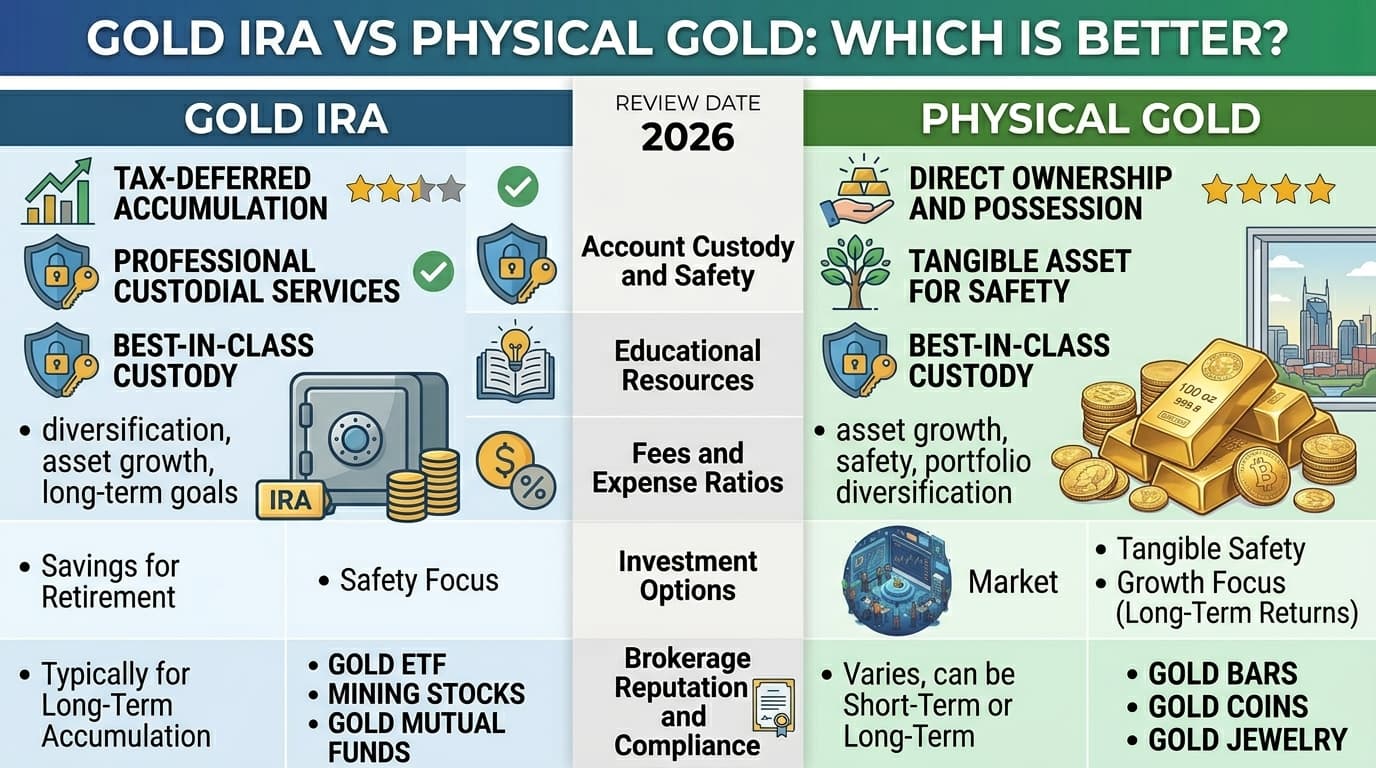
Side-by-side comparison of Gold IRAs and physical gold ownership.
The Short Answer
Physical gold gives you direct ownership and no ongoing fees, while a Gold IRA offers tax advantages but costs more annually — most dads benefit from having some of each depending on their retirement timeline.
top Gold IRA companies vs. buy physical gold safely: Which Is Better? (2026 Guide)
By DadAlt Investments | Category: Gold & Precious Metals | Last Updated: March 2026
When most Americans decide to add gold to their financial plan, they quickly discover there are two very different ways to do it: buy physical gold coins and bars you hold in your possession, or open a Gold IRA that holds IRS-approved gold inside a tax-advantaged retirement account. These two approaches use the same underlying asset — physical gold — but they differ fundamentally in how they're taxed, how accessible they are, what they cost to maintain, and what role they play in your overall strategy. Physical gold gives you direct, immediate, custody-free ownership with no minimums, no custodian, and no annual fees — but your gains face the IRS collectibles rate of up to 28%, and you handle storage yourself. A Gold IRA puts that same gold inside a retirement account with tax-deferred or tax-free growth — but it requires high minimums, annual fees of $200–$500+, and prohibits you from touching your coins while the account is active. For most investors, the honest answer is not "one or the other" — it's a deliberate combination of both, sized for where you are in life and what you're trying to accomplish. This guide breaks down every dimension of the comparison so you can make that decision with clarity.
Two Ways to Own the Same Metal: Key Differences Upfront
Both options result in the same real asset — physical gold in an IRS-approved vault, or gold in your own hands. But the legal, financial, and practical wrapper around that asset determines everything that matters: how it's taxed when you sell, how quickly you can access it, how much it costs to hold annually, and what role it plays in a crisis scenario.
The four key difference drivers:
- Tax treatment — Physical gold gains face up to 28% (collectibles rate). Gold IRA gains grow tax-deferred (Traditional) or tax-free (Roth) until distribution.
- Control — Physical gold is in your possession or a vault of your choosing, fully accessible at any time. Gold IRA gold is held by a custodian in an IRS-approved depository; you cannot touch it without triggering a taxable distribution.
- Liquidity — Physical gold can be sold directly to a dealer the same day. A Gold IRA sale requires instructing your custodian, which may take several days.
- Minimum investment required — Physical gold starts with a single 1 oz coin (currently ~$5,000–$5,500 at spot + premium). Most reputable Gold IRA providers require $10,000–$50,000 to open.
Quick Comparison Table
| Factor | Physical Gold | Gold IRA (Traditional) | Gold IRA (Roth) |
|---|---|---|---|
| Tax on growth | Long-term gains taxed at your marginal rate up to 28% collectibles cap | Tax-deferred; taxed as ordinary income on distribution | Tax-free growth; qualified distributions tax-free |
| Tax deductibility | None — purchased with after-tax dollars | Contributions may be tax-deductible (income limits apply) | No deduction; contributions are after-tax |
| Annual fees | None (excluding storage costs you choose) | $200–$500+/year (custodian + storage) | $200–$500+/year (custodian + storage) |
| Minimum to start | ~$5,000 (1 oz coin at current prices); no regulatory minimum | $10,000–$50,000 at most reputable providers | $10,000–$50,000 at most reputable providers |
| Storage | Your choice: home safe, bank safe deposit box, private vault | IRS-approved depository only — no exceptions | IRS-approved depository only — no exceptions |
| Who controls access | You, directly, at any time | IRS-approved custodian; you instruct, they execute | IRS-approved custodian; you instruct, they execute |
| Liquidation process | Sell directly to a dealer; same-day settlement possible | Instruct custodian to sell; typically 3–7 business days | Instruct custodian to sell; typically 3–7 business days |
| Early withdrawal penalty | None — you can sell any time | 10% penalty + income tax if withdrawn before age 59½ | 10% penalty on earnings withdrawn before 59½/5-year rule |
| Required Minimum Distributions | None — no mandatory withdrawal at any age | Required at age 73 (SECURE 2.0 Act) | None during account holder's lifetime |
| IRS coin restrictions | Any legal gold product | Only IRS-approved bullion meeting .995+ purity (with exceptions) | Only IRS-approved bullion meeting .995+ purity (with exceptions) |
| Contribution limits | None | $7,500/year ($8,600 if age 50+) for 2026; rollovers unlimited | $7,500/year ($8,600 if age 50+) for 2026; rollovers unlimited |
Physical Gold — The Full Picture
Pros of Physical Gold
1. Direct ownership — you hold the actual metal. A 1 oz American Gold Eagle sitting in your home safe is owned by you, free and clear. No custodian, no third party, no account agreement that can be frozen, amended, or suspended. In a genuine financial or systemic crisis — the exact scenario many gold buyers are hedging against — physical gold in your possession is fully accessible regardless of what happens to financial institutions, brokerage firms, or retirement account administrators.
2. No minimum investment required. You can start with a single 1 oz American Gold Eagle for approximately $5,100–$5,500 at current prices (spot + premium). There is no regulatory floor. This makes physical gold accessible to anyone who can afford a single coin — unlike most Gold IRA providers, which require $10,000–$50,000 to open an account.1
3. No annual fees. Once you buy physical gold, you own it. There is no ongoing custodian fee, no annual administration charge, and no storage fee unless you choose to pay for a third-party vault. The only "fee" is the one-time dealer premium at purchase and the cost of whatever storage solution you select.
4. No contribution limits. Unlike an IRA, which caps annual contributions at $7,500 ($8,600 age 50+) in 2026, you can buy as much physical gold as you want, whenever you want, at any income level.2
5. Immediate liquidity. You can walk into any coin dealer, pawn shop, or gold buyer in America with a recognized bullion coin and receive cash the same day. Online dealers like APMEX and JM Bullion publish live buyback prices and will purchase your gold with wire transfer settlement typically within 1–3 business days.
Cons of Physical Gold
1. The 28% collectibles capital gains tax rate. This is the most significant financial drawback of physical gold. The IRS classifies gold as a collectible, meaning long-term capital gains (held more than one year) are taxed at your marginal income tax rate up to a maximum of 28% — compared to the 20% maximum long-term rate on stocks and passive income strategies.3 For most middle-income investors, this means paying their ordinary income rate on gold profits. For higher earners, the 28% cap still exceeds the 20% stock rate by 8 percentage points.
2. Storage and security are your responsibility. A home safe, a bank safe deposit box, or a private vault all cost money and require active management. Standard homeowner's insurance typically covers only $200–$2,500 in precious metals — you'll need to schedule your gold as a separate rider to be properly covered. Larger holdings warrant third-party vault storage, which typically runs 0.10%–0.50% of holdings value annually.
3. No tax-deferred growth mechanism. Every year your physical gold appreciates is a year you are accumulating an unrealized taxable liability. There is no account structure that lets your gold compound tax-free over decades the way a Roth IRA providers does.
Gold IRA — The Full Picture
A Gold IRA is a self-directed Individual Retirement Account (SDIRA) that holds IRS-approved physical gold inside a tax-advantaged retirement structure. It operates under the same legal framework as a Traditional or Roth IRA, with the same contribution limits, distribution rules, and account mechanics — the difference is what lives inside: physical gold coins and bars instead of stocks and mutual funds.
Pros of a Gold IRA
1. Tax-deferred growth (Traditional) or tax-free growth (Roth). This is the core financial advantage. A Traditional Gold IRA grows tax-deferred — you pay no tax on appreciation while the gold is inside the account; tax is only owed when you take distributions in retirement. If you are in a higher tax bracket now than you expect to be in retirement, this defers tax to a lower-rate period. A Roth Gold IRA grows entirely tax-free — contributions are after-tax, but all appreciation and qualified withdrawals in retirement are completely free of federal tax. Neither option exposes your gains to the 28% collectibles rate while gold remains inside the account.4
2. Eliminates the collectibles tax rate for long-term holders. Inside a Roth Gold IRA, the 28% collectibles rate is irrelevant permanently. You buy gold, it appreciates over decades, and you take it out tax-free in retirement. This is the single most powerful tax argument for the Gold IRA structure, especially for investors with long time horizons.
3. Portfolio diversification within your retirement account. Most Americans hold 100% of their retirement savings in stocks and bonds through a 401(k) or traditional IRA. A Gold IRA introduces a non-correlated asset — one that historically rises when equities fall — directly inside the tax-advantaged retirement structure. During 2022's inflation spike, gold rose roughly 6% while the S&P 500 fell approximately 18%.5
4. Rollover-eligible from a 401(k) or existing IRA. You can fund a Gold IRA by rolling over an existing 401(k), Traditional IRA, SEP IRA, or 403(b) without triggering taxes or penalties — the rolled-over amount does not count against annual contribution limits. This allows investors with significant existing retirement savings to add gold exposure without requiring new after-tax dollars.6
5. Beneficiary designation and estate planning. A Gold IRA, like any IRA, allows you to designate beneficiaries who can inherit the account and continue distributions according to their own life expectancy rules — a structured estate transfer mechanism that physical gold does not automatically provide.
Cons of a Gold IRA
1. High minimum investment requirements. Most reputable Gold IRA providers require $10,000–$50,000 to open an account. Augusta Precious Metals requires $50,000. Goldco starts at $25,000. Birch Gold Group is among the most accessible at $10,000. The premium dealers exist at these minimums for regulatory and operational reasons — but it creates a meaningful barrier to entry for investors who are just beginning.7 For a detailed comparison of these providers, see Augusta, Goldco, and Birch Gold Group.
2. Annual fees reduce your net return. Every Gold IRA carries ongoing costs that physical gold does not:
- Setup fee: $50–$150 (one-time)
- Annual custodian/administration fee: $100–$200/year
- Annual storage and insurance fee: $100–$300/year depending on segregated vs. commingled vault storage
Total annual carrying cost typically runs $200–$500/year depending on the provider.7 On a $25,000 account, $300 in annual fees represents 1.2% drag per year — a real return headwind that compounds over time. On a $100,000 account, the same $300 is only 0.30%, which is much easier to absorb.
Critical math check: A $5,000 Gold IRA paying $225/year in fees is losing 4.5% of its value annually to fees alone — before accounting for any market movement. Gold IRA economics only make strong sense at account sizes where the fee drag is manageable, generally $25,000+.6
3. You cannot take physical possession while the IRA is active. This is an absolute IRS rule. While your gold is inside a Gold IRA, it must remain in an IRS-approved depository. You cannot take delivery, store it at home, or put it in your bank safe deposit box. Violating this rule — even briefly — is treated as a distribution: the full fair market value of the metals becomes immediately taxable, and if you are under 59½, a 10% early withdrawal penalty applies on top of ordinary income tax. The entire IRA can be disqualified.8
4. Required Minimum Distributions (RMDs) at age 73 create logistical complexity. Under the SECURE 2.0 Act, Traditional Gold IRA holders must begin taking Required Minimum Distributions at age 73. Unlike a stock-based IRA where your custodian simply sells shares and wires cash, a Gold IRA RMD requires either:
- Cash distribution: Your custodian sells a portion of your gold holdings and distributes the proceeds — but this requires coordination with a dealer, adds transaction time, and may force you to sell at an inopportune price.
- In-kind distribution: Your custodian ships you physical coins or bars equal in value to your RMD amount — you receive the gold, pay ordinary income tax on its market value, and then own it outright.9
Roth Gold IRAs are NOT subject to RMDs during the account holder's lifetime — a meaningful advantage for estate planning and long-term wealth accumulation.
5. IRS rules restrict which gold products are eligible. Not every gold product qualifies for IRA inclusion. Under Internal Revenue Code Section 408(m)(3), IRA-eligible gold must meet a minimum fineness of .995 (99.5% pure). The only exception is the American Gold Eagle, which at 91.67% purity (22-karat) was specifically authorized by Congress via the Bullion Coin Act of 1986.8
IRS-approved gold coins for IRAs include:
- American Gold Eagle (bullion and proof versions — the sole .9167 fine exception)
- Canadian Gold Maple Leaf (.9999 fine)
- Australian Gold Kangaroo/Nugget (.9999 fine)
- Austrian Gold Philharmonic (.9999 fine)
- American Gold Buffalo (.9999 fine)
- Gold bars from NYMEX/COMEX-approved refiners meeting .995 fineness
Strictly prohibited in Gold IRAs:
- Pre-1933 U.S. gold coins (collectibles under IRS rules)
- South African Krugerrands (note: Krugerrands are .9167 fine but were NOT granted the specific Congressional exemption that Gold Eagles received — they are ineligible)9
- Any coin graded or certified by a third-party grading service (PCGS, NGC) — grading transforms a bullion coin into a "collectible" under IRS rules
- Numismatic or rare coins of any kind
- Private mint rounds not meeting fineness and accreditation standards
The Tax Math: When a Gold IRA Wins
The tax advantage of a Gold IRA is most powerful in two scenarios: long time horizons and large position sizes.
The Roth Gold IRA Advantage — Permanent and Compounding
Assume you invest $50,000 in gold, hold it for 20 years, and it grows to $150,000 — a $100,000 gain.
| Scenario | Tax Owed at Sale | After-Tax Proceeds |
|---|---|---|
| Physical gold (28% collectibles rate, top bracket) | $28,000 | $122,000 |
| Physical gold (22% bracket, middle income) | $22,000 | $128,000 |
| Traditional Gold IRA (22% ordinary income in retirement) | $33,000 on full $150K distribution | ~$117,000 |
| Roth Gold IRA | $0 | $150,000 |
The Roth Gold IRA eliminates the collectibles rate entirely and permanently. Over multi-decade holding periods, this gap compounds substantially — and it is the reason the Roth structure is the recommended first choice for most investors opening a Gold IRA.3
The Traditional Gold IRA Advantage — Tax Bracket Arbitrage
A Traditional Gold IRA makes the most sense when you are in a higher tax bracket now than you expect to be in retirement. If you are currently in the 32% bracket and expect to be in the 22% bracket in retirement, every dollar you put into a Traditional Gold IRA saves you 10 percentage points of tax on the front end — a genuine, quantifiable return improvement.
The Tax Math: When Physical Gold Wins
Despite the powerful tax case for a Gold IRA, physical gold is the superior choice in specific situations:
1. Small account sizes — when IRA fees negate the tax benefit. On a $10,000–$20,000 gold position, annual fees of $250–$400 can represent 1.5%–4% annual drag. If gold appreciates 5% in a given year, fees have consumed 30%–80% of your gross gain before taxes even enter the picture. For smaller positions, holding physical gold outright and paying the collectibles tax on eventual profit may produce better net results than dragging the account down with high fixed fees.
2. When you need immediate, unconditional access. A Gold IRA requires your custodian to execute any sale or distribution. In a genuine emergency — a financial crisis, a health emergency, a situation where you need cash within 24 hours — physical gold in your possession or a nearby vault can be monetized same-day. A Gold IRA adds a custodian-dependent process, potential delays, and a possible 10% penalty if you are under 59½.
3. For the portion that serves as a crisis hedge. The philosophical premise of physical gold ownership — tangible, counterparty-free wealth outside the financial system — is fundamentally incompatible with a custodial account structure. If your gold allocation is partly intended as a last-resort hedge against extreme systemic disruption, that portion should be physical gold in your direct possession, not held by a depository and custodian.
4. For investors over the IRA contribution limit. If you have already maximized your IRA contributions for the year and want additional gold exposure, physical gold has no contribution ceiling. You can buy any amount at any time regardless of income or existing retirement account balances.
IRS Rules Every Gold IRA Investor Must Know
These are the non-negotiable rules that govern Gold IRA accounts. Violations can disqualify the entire account, triggering immediate taxation of all holdings.
- Gold purity standard: .995 minimum fineness (99.5%) under IRC Section 408(m)(3); American Gold Eagles are the sole statutory exception at .9167 fine8
- No home storage: IRA-owned gold must remain in an IRS-approved depository at all times. "Home storage Gold IRA" promotions claiming this is legal are misrepresenting IRS rules — home storage of IRA gold constitutes a prohibited transaction and a taxable distribution.8
- IRS-approved custodian required: Gold IRAs require a self-directed IRA custodian — Fidelity, Vanguard, and Schwab, Vanguard, and Charles Schwab do not offer physical precious metals IRAs. You need a specialized custodian such as Equity Trust Company, STRATA Trust, or Midland IRA.6
- No collectibles or numismatic coins: The collectibles prohibition under IRC Section 408(m)(2) is absolute. Placing a collectible in an IRA is treated as a distribution the year of acquisition — full taxes and potential penalties apply immediately.9
- 2026 contribution limits: $7,500/year ($8,600 age 50+) — rollovers and transfers do not count against this limit2
- Penalty-free withdrawals: Age 59½ for distributions without the 10% early withdrawal penalty
- RMD age: 73 for Traditional Gold IRAs (SECURE 2.0 Act); no RMDs for Roth Gold IRAs during account holder's lifetime
The Right Answer for Most Investors: Both
Rather than choosing one or the other, most serious investors benefit from using both strategies in combination — sized to their specific financial situation.
A practical framework:
| Gold Allocation | Recommended Structure |
|---|---|
| First $5,000–$25,000 | Physical gold coins (1 oz American Gold Eagles or Maple Leafs) — immediate access, no fees, no minimums |
| $25,000+ with a long time horizon | Open a Roth Gold IRA — tax-free growth permanently eliminates the collectibles rate gap |
| Existing 401(k) with $25,000+ to diversify | Roll a portion into a Traditional Gold IRA — no new out-of-pocket dollars required; existing pre-tax retirement dollars gain gold exposure |
| Gold intended as crisis hedge | Physical gold only — outside the financial system, in your possession |
Why prioritize the Roth Gold IRA if you are opening an IRA: The Roth structure permanently eliminates the 28% collectibles rate that otherwise applies to all physical gold gains. Over 20+ year holding periods at today's gold price levels, this tax-free status compounds into a very large dollar difference. For younger investors (under 50) who have decades for their gold to appreciate, a Roth Gold IRA is among the most structurally advantageous ways to own gold.4
FAQ
Can I hold physical gold coins in a Roth IRA?
Yes — with strict conditions. A Roth Gold IRA allows you to hold IRS-approved physical gold coins and bars inside a tax-advantaged Roth structure. The key requirements: gold must meet the .995 fineness standard (or be an American Gold Eagle, the sole Congressional exception), it must be purchased through your custodian (you cannot contribute coins you already own), and it must be stored in an IRS-approved depository — not at home. Numismatic, collectible, and graded coins are prohibited regardless of gold content.8
What is the minimum investment to open a Gold IRA?
Most reputable Gold IRA companies set minimums in the $10,000–$50,000 range:
- Birch Gold Group: $10,000
- Goldco: $25,000
- Augusta Precious Metals: $50,000
- Noble Gold Investments: $20,000
These minimums exist because the fixed annual fee structure (custodian + storage = $200–$400/year) makes very small accounts economically unworkable. A $5,000 Gold IRA paying $250/year loses 5% annually to fees — that has to be compared against the tax benefit of the IRA structure to determine whether it makes financial sense.7
Can I take physical delivery of my Gold IRA coins?
Not while the IRA is active without triggering a taxable event. Taking physical possession of IRA-owned gold is treated as a distribution — the fair market value of the coins becomes ordinary taxable income in the year of distribution, and if you are under 59½, a 10% early withdrawal penalty applies. However, once you reach age 59½ and begin taking distributions, you can elect an in-kind distribution — your custodian ships the actual physical coins or bars to you, you pay ordinary income tax on the fair market value at the time of distribution, and you then own the gold outright with no further IRA restrictions.9
How do I roll over a 401(k) into a Gold IRA?
A direct rollover is the safest and most common method. The process:6
- Select your Gold IRA custodian — choose a reputable SDIRA custodian specializing in precious metals (Equity Trust, STRATA Trust, Midland IRA, etc.)
- Open your Gold IRA account — complete the custodian's application, submit a government-issued ID, designate beneficiaries
- Contact your 401(k) plan administrator — request a direct rollover to your new Gold IRA custodian; provide the custodian's account details
- Funds transfer directly — in a direct rollover, money moves from your 401(k) to your Gold IRA without passing through your hands; no taxes are withheld, no 60-day deadline applies
- Select your IRS-approved gold — work with your custodian or a preferred dealer to choose eligible coins and bars; gold is purchased and shipped directly to the IRS-approved depository
- Receive confirmation — your custodian confirms receipt and provides account documentation
Critical warning on indirect rollovers: If you receive a check from your 401(k) instead of a direct transfer, your plan administrator is required to withhold 20% for taxes. You then have 60 days to deposit the full original amount (including the withheld 20% from your own funds) into your Gold IRA — or the shortfall is treated as a taxable distribution with a potential 10% penalty. Always use a direct rollover to avoid this trap.9
Sources and References
Disclaimer: This article is for informational and educational purposes only and does not constitute financial, legal, or tax advice. Gold IRA rules are complex and individually variable — account minimums, fees, and eligible products vary by provider. Always consult a qualified CPA, tax attorney, or financial advisor before making retirement account decisions. DadAlt Investments may earn affiliate commissions from some links in this article at no cost to you.
Recommended Reading
- Is a Gold IRA Worth It? Pros & Cons
- Top Gold IRA Companies Reviewed
- How to Store Gold at Home Safely
Footnotes
-
JM Bullion. "Gold IRA vs. Physical Gold." https://www.jmbullion.com/investing-guide/taxes-reporting-iras/gold-ira-vs-physical-gold/ ↩
-
Scottsdale Bullion & Coin. "Gold IRA pros and cons and Cons: 2026 Guide." January 5, 2026. https://www.sbcgold.com/blog/gold-ira-pros-and-cons/ — 2026 IRA contribution limits: $7,500 ($8,600 age 50+) ↩ ↩2
-
Alloy Market. "How Much Gold Can I Sell Without Reporting to the IRS?" — 28% collectibles long-term capital gains rate for physical gold. ↩ ↩2
-
Retirement Living. "Gold IRA vs. Physical Gold (2026)." February 9, 2026. https://www.retirementliving.com/best-gold-ira-accounts/gold-ira-vs-physical-gold ↩ ↩2
-
Summit Metals. "IRA Investing in Gold." January 27, 2026. https://summitmetals.com/blogs/dollar-cost-averaging-dca/ira-investing-in-gold — Gold rose ~6% during 2022 inflation spike vs. S&P 500 –18%. ↩
-
Bullion ITE Asset Group. "How to Roll Over Your 401k to a Gold IRA in 2026." March 10, 2026. https://bullioniteassetgroup.com/401k-to-gold-ira-rollover/ — Direct rollover steps; fee drag math at small account sizes. ↩ ↩2 ↩3 ↩4
-
Retirement Living. "Gold IRA Pros and Cons (2026)." February 9, 2026. https://www.retirementliving.com/best-gold-ira-accounts/gold-ira-pros-and-cons — Setup fees $50–$150; custodian fees $100–$200/year; storage $150–$300/year; minimums $10,000–$25,000. ↩ ↩2 ↩3
-
American Standard Gold. "Gold IRA Rules and Regulations." https://www.americanstandardgold.com/blog/gold-ira-rules-and-regulations.cfm — .995 purity requirement; American Gold Eagle exception; home storage prohibition; IRC Section 408(m)(3). ↩ ↩2 ↩3 ↩4 ↩5
-
Precious Metals Report. "Gold IRA Rollover Rules: IRS Requirements Explained." February 2026. https://www.preciousmetalsreport.com/gold/gold-ira-rollover-rules-and-regulations — RMD age 73 (SECURE 2.0); Krugerrand ineligibility; indirect rollover 20% withholding trap; in-kind distributions. ↩ ↩2 ↩3 ↩4 ↩5
Frequently Asked Questions
What's cheaper — a Gold IRA or buying physical gold?
Physical gold is cheaper long-term because you avoid annual custodian and storage fees ($150–$300/year). A Gold IRA's tax advantages can offset those fees if you're in a high tax bracket.
Can I take physical delivery of my Gold IRA gold?
Yes, but it's treated as a distribution — you'll owe income taxes and potentially a 10% early withdrawal penalty if you're under 59½. It's generally better to sell within the IRA and withdraw cash.
Which is better for passing wealth to my kids?
Physical gold can be gifted directly and may avoid probate. Gold IRA assets pass through beneficiary designations and may carry required distribution rules. Consider your estate plan when choosing.

About the Author
Jared DeValk
Founder, DadAlt Investments
Father, alternative investment researcher, and founder of DadAlt Investments. 14+ years turning hard lessons into honest guidance for dads building real wealth.