
How to Finance a Business Purchase Without Savings
SBA loans, seller financing, creative funding.
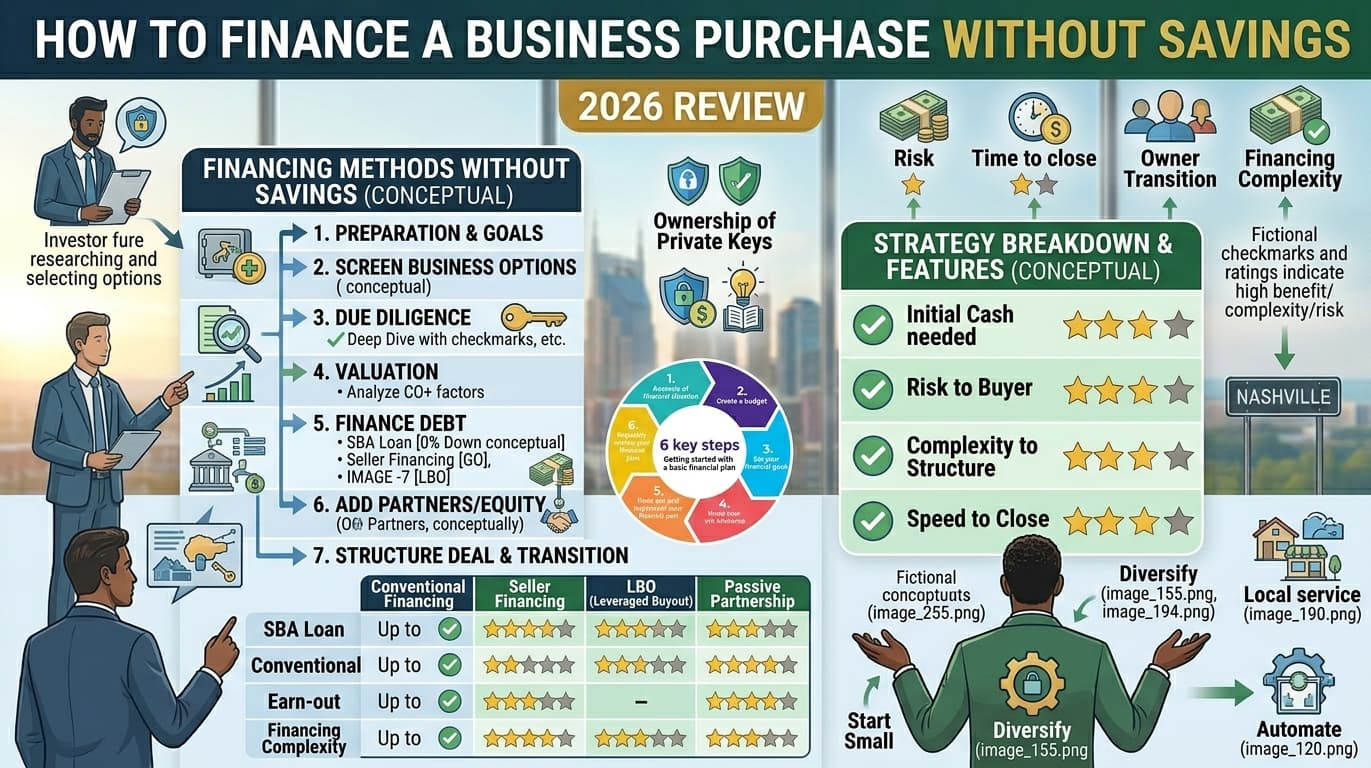
The Short Answer
You can finance a business purchase without savings using SBA 7(a) loans, seller financing, earn-outs, or partner equity — most small business acquisitions don't require all cash at closing.
How to Finance a Business Purchase Without Savings
Category: Buying Businesses | Tags: Creative Financing · Beginner Guides · Guides & How-To's · Small Business Loans
Target Keywords: finance a business purchase without savings, how to buying a small business with no money, business acquisition financing
Summary
The single biggest lie in entrepreneurship is that you need a pile of cash to buy a business. You don't. While the most successful deals involve at least some buyer equity, a growing number of Americans are acquiring profitable, cash-flowing businesses using creative financing structures that require little to no personal savings. The tools exist: SBA loans that cover up to 90% of a purchase price, financing a business purchase that lets the current owner act as your bank, retirement fund rollovers that tap your 401(k) tax-free, earn-out agreements that tie part of the price to future performance, and equity partnerships that trade a slice of ownership for capital. This article breaks down every major financing path available to US buyers in 2025—how each works, what it costs, what it requires, and critically, the real risks you need to understand before you sign anything. If you've been putting off business ownership because you assume you need $100,000 in the bank first, this guide was written for you.
The Truth About Buying a Business Without Savings
Let's start with an honest reality check, because most content on this topic oversells the "zero money down" concept without giving you the full picture.
Buying a business with absolutely no personal capital on the table is possible, but it's rare, and it almost always involves one of these scenarios:
- The seller is highly motivated (retiring, health issue, the business has been sitting unsold for months)
- The business is underperforming and the seller is relieved to transfer it
- You're buying from a family member or long-time employer
- You're bringing extraordinary non-financial value to the table (an audience, a brand, industry expertise that the seller is desperate for)
In most other situations, "financing without savings" means minimizing your out-of-pocket cash—not eliminating it. With the right combination of strategies, you can realistically get into a business for 0%–10% of the purchase price in personal funds, with the rest coming from loans, seller financing, retirement accounts, or investor capital.
That's still transformative. A $400,000 business at 5% down is $20,000 of your own money—a number that's achievable for many families without wiping out savings or borrowing from retirement.
Here's how each financing path works.
Strategy 1: SBA 7(a) Loan — The Foundation of Most Deals
If you only learn one financing tool in this article, make it the SBA 7(a) loan. It is the most widely used financing mechanism for small business acquisitions in the United States, and it's specifically designed to help buyers with limited capital get into established businesses.
How It Works
The SBA 7(a) loan is not issued by the SBA directly. Instead, the US Small Business Administration guarantees a portion of a loan made by an approved bank, credit union, or non-bank lender. That guarantee—typically 75%–85% of the loan amount—reduces the lender's risk and allows them to offer terms that wouldn't otherwise exist in the private market.
Key terms for business acquisitions (as of 2025):
- Maximum loan amount: $5 million
- Down payment (equity injection): The SBA requires at least 10% for change-of-ownership transactions. Many lenders accept seller financing as part of that equity injection
- Repayment term: Up to 10 years for business acquisitions; up to 25 years if real estate is included
- Interest rates: Negotiated between borrower and lender, but capped by the SBA. Current rates typically range from approximately 10.50%–15.50% for 7(a) loans
- SBA guarantee: 75%–85% of most loans
- Credit score: Most lenders recommend a minimum personal FICO score of 680, though some lenders work with borrowers at 650+
- Debt Service Coverage Ratio (DSCR): Lenders typically require the business to generate at least 1.25x the annual debt service—meaning if your loan payment is $60,000/year, the business should generate at least $75,000 in annual cash flow available to cover it
The Down Payment Math
The SBA's minimum equity injection for an acquisition is 10%. For a $400,000 business, that's $40,000. But here's the crucial detail: the SBA allows seller financing to count toward a portion of that equity injection. Under current 2025 rules (SBA SOP 50.10.8, effective June 1, 2025), seller notes on standby can cover up to 50% of the required equity injection—effectively meaning seller financing can represent about 5% of the transaction value, with the buyer contributing the other 5%.
Example:
- Purchase price: $400,000
- SBA 7(a) loan: $360,000 (90%)
- Seller standby note: $20,000 (5%) — on full standby for the SBA loan term
- Buyer cash: $20,000 (5%)
- Total out of pocket: $20,000
Important 2025 SBA Changes
In April 2025, the SBA implemented sweeping changes through its updated Standard Operating Procedure (SOP 50.10.8), effective June 1, 2025. Key changes affecting buyers:
- Seller notes used toward equity injection must now remain on "full standby" for the entire SBA loan term—often 10 years—receiving no principal or interest payments during that period
- This change makes seller financing less attractive to sellers and creates tighter deal structures
- The SBA eliminated prescreening requirements for loans under $350,000, making smaller loans more accessible
- As of June 2025, SBA loans may only be made to US citizens, lawful permanent residents, naturalized citizens, or US nationals
Bottom line: The SBA 7(a) loan is powerful, but 2025's rule changes mean you need a lender who understands the updated SOP. Get pre-qualified before you start searching for businesses.
How to Apply for an SBA 7(a) Loan
- Check your credit. Pull your personal credit report. Aim for 680+ before applying.
- Calculate your DSCR. Use the target business's financials to verify the deal generates enough cash flow to cover the debt.
- Use SBA Lender Match. The SBA's free online tool at lendermatch.sba.gov connects you with approved lenders in your area.
- Get pre-qualified. Many lenders will give you a letter of indication or pre-qualification based on your financial profile before you identify a specific business.
- Submit your application. You'll need personal financial statements, three years of the business's tax returns, and a business plan explaining how you'll run the acquisition.
Strategy 2: Seller Financing — Your Most Powerful Negotiating Tool
Seller financing (also called owner financing) is when the current business owner agrees to act as your lender for part of the purchase price. Instead of receiving 100% of the sale proceeds at closing, they accept a promissory note from you and receive payments over time—with interest.
Seller financing is involved in 60%–80% of small business acquisitions. Nearly 80% of small business purchases include at least some form of it. And it's often the only way to bridge the gap between what a lender will fund and the full purchase price.
Why Sellers Agree to It
Sellers aren't doing you a favor by offering financing—there's something in it for them too:
- Expands the buyer pool to include qualified people who don't have all-cash offers
- Can result in a higher total sale price (buyers can afford to pay more when they're not constrained by upfront cash)
- Generates interest income—seller notes typically carry 6%–10% interest
- May offer favorable installment sale tax treatment, spreading capital gains taxes over time
- Seller stays financially motivated for the business to succeed under new ownership
Typical Seller Financing Terms
- Loan amount: Typically 5%–40% of the purchase price (note: the 2025 SBA rule changes limit standby seller notes in SBA deals to ~5% of the transaction value)
- Interest rate: 6%–10%, negotiated between buyer and seller
- Repayment term: 3–7 years, sometimes up to 10 years
- Security: Seller typically files a UCC lien against business assets and requires a personal guarantee
How to Find Motivated Sellers
Not every seller will accept financing—most would prefer all cash. Motivated sellers are your target:
- Business owners nearing retirement who don't need all the proceeds immediately
- Businesses that have been listed for months without selling (listed businesses have a median days-on-market of 168–198 days, according to BizBuySell's 2024–2025 data)
- Business owners with health challenges or major life events driving the sale
- Sellers with significant goodwill value in the business (high intangibles, low hard assets) who understand buyers will need financing support
- Long-tenured owners who want a smooth transition and trust you can run the business
Negotiation tip: If a seller is resistant to financing, offer a slightly higher total purchase price in exchange for their willingness to carry a note. A seller who gets $410,000 via seller financing is often happier than one who gets $390,000 cash—and you get to conserve capital.
Strategy 3: ROBS (Rollover for Business Startups) — Use Your 401(k) Without Penalties
If you have a 401(k), 403(b), traditional IRA, or other eligible retirement account with at least $50,000 in it, ROBS may be your most powerful and least-discussed financing tool.
ROBS—Rollover for Business Startups—is a legal structure authorized under the Employee Retirement Income Security Act (ERISA) of 1974 and sections of the Internal Revenue Code that allows you to invest your investing by age into your own business without paying early withdrawal penalties or income taxes.
In 2024, over half of the business owners surveyed in Guidant Financial's Small Business Trends study reported using ROBS to finance their ventures.
How ROBS Works: The Five Steps
- Create a C Corporation. ROBS only works with C corporations—the business must be structured this way. Other entity types (LLC, S Corp, sole proprietorship) cannot issue the Qualified Employer Securities (QES) required by ROBS.
- Establish a 401(k) plan for the new C Corp. This becomes your new retirement plan as the business owner.
- Roll your existing retirement funds into the new C Corp's 401(k) plan—tax-free, penalty-free.
- The 401(k) plan purchases stock in your C Corp. This transfers the retirement funds to the corporation in exchange for company stock.
- The C Corp uses those funds to buy the business, cover startup costs, or serve as a down payment on an SBA loan.
ROBS Costs
- Setup fee: Approximately $5,000 one-time cost (most ROBS providers charge in this range)
- Ongoing administration: Approximately $100–$150/month for annual IRS Form 5500 filings and plan compliance
- Minimum recommended account balance: Most providers require at least $50,000 in eligible retirement funds
The Critical ROBS Risks (Read This Before Proceeding)
The IRS has studied ROBS arrangements and found that, while not considered an illegal or abusive tax avoidance scheme, they are "questionable" because they may solely benefit one individual. More importantly: the IRS's ROBS Compliance Project found that most ROBS-funded businesses either failed or were on the road to failure, with high rates of bankruptcy, business and personal liens, and corporate dissolutions.
Key risks you must understand:
- Your entire retirement nest egg is at risk. If the business fails, you lose both the business and those retirement savings. There is no FDIC insurance, no backstop.
- Compliance complexity is real. ROBS requires ongoing maintenance: annual Form 5500 filings, shareholder meetings, accurate corporate records, and active participation as an employee of the business. Miss a filing or violate a rule and you face tax penalties.
- C Corp structure has tax implications. C corporations are subject to double taxation (corporate tax on profits + personal tax on dividends). This is different from the pass-through taxation of an LLC or S Corp.
- You must be an active employee. ROBS is not for passive investors. You must work in the business—the IRS recommends at least 1,000 hours per year (approximately 20 hours per week).
Who ROBS is right for: Buyers with $50,000+ in retirement accounts who have limited liquid savings, who can't qualify for or don't want a traditional loan, who are buying a business where they'll be actively involved, and who have worked with a qualified ROBS provider to set up the structure correctly.
Who should avoid ROBS: Anyone near retirement age whose retirement savings represent their primary financial security. The risk of total loss is too severe.
Recommended providers: Guidant Financial and Benetrends are two of the most established ROBS providers in the US. Always work with a provider that includes IRS audit protection.
Strategy 4: Earn-Out Agreement — Pay for the Business With Its Own Profits
An earn-out is a deal structure where you pay a portion of the purchase price upfront and the remainder only if the business hits specific financial targets after closing. It's essentially a way to say to the seller: "I believe this business is worth what you're asking—but let's let the numbers prove it."
Earn-outs were included in approximately 22%–26% of private company acquisitions in 2024, according to data from SRS Acquiom and the American Bar Association's Private Target M&A Deal Points Study.
How Earn-Outs Work in Small Business Deals
A typical small business earn-out might look like this:
Example:
- Business asking price: $500,000
- Upfront payment at closing: $300,000 (60%)
- Earn-out: Up to $200,000 additional, paid over 24 months if the business maintains current revenue levels
In this structure, you put up $300,000 at closing (potentially through an SBA loan + small equity injection) and owe the remaining $200,000 only if the business performs. The seller is protected by measurable targets; you're protected from paying full price for a business that was presented with inflated projections.
Common Earn-Out Metrics
- Revenue targets — Most common, easiest to measure (used in approximately 62% of 2024 earn-outs per SRS Acquiom)
- EBITDA or net profit targets — More complex but more meaningful for cash-flow businesses
- Customer retention milestones — Common for service businesses with long-term clients
- Operational milestones — New contracts signed, specific certifications achieved, etc.
Earn-Out Pros and Cons for Buyers
Pros:
- Reduces upfront capital requirement significantly
- Protects you from paying full price for overstated financials
- Seller stays engaged and motivated post-sale (they're still owed money)
- Can be combined with seller financing for a hybrid structure
Cons:
- Complex to negotiate and document—requires a good business attorney
- Potential for post-closing disputes over how metrics are calculated
- Seller may feel you're not fully committed if upfront payment is too low
- You're managing the business under the shadow of ongoing obligations
Key rule: Any earn-out agreement must be drafted by a business attorney who understands M&A deal structures. Ambiguous earn-out language is the most common source of post-acquisition lawsuits.
Strategy 5: Equity Partnership — Use Someone Else's Capital
If you have the skills to run a business but not the capital to buy one, an equity partnership lets you trade ownership for cash. A silent investor or equity partner provides the purchase capital in exchange for a percentage of the business going forward.
This is sometimes called a "search fund" structure or Entrepreneurship Through Acquisition (ETA)—a model that has grown popular among experienced professionals, MBA graduates, and industry operators who want to own and operate a business without having the personal capital to fund it themselves.
How an Equity Partnership Works
- You identify a business and negotiate the deal
- An investor or group of investors provides the acquisition capital
- In exchange, they receive an ownership percentage (often 20%–49% for a silent partner role)
- You run the business day-to-day and receive a salary plus your ownership stake
- Both parties profit when the business generates dividends or is eventually sold
Where to Find Equity Partners
- Search fund networks: Stanford and Harvard Business School both maintain search fund databases and alumni networks
- Local angel investor networks: Many cities have organized angel investor groups focused on small business acquisition
- Family and high-net-worth individuals: If you have a strong track record and a compelling business opportunity, personal networks can be surprisingly effective
- Small business investment companies (SBICs): SBA-licensed investment funds that can provide equity capital to acquisition targets
The Trade-Off: Shared Upside
The downside of equity partnerships is obvious—you're giving up a piece of the business you're working hard to build. Before taking on an equity partner, understand:
- What percentage are they requesting?
- What decision-making rights do they retain?
- What happens if you want to buy them out later?
- What are the conditions for distributions and profit sharing?
An equity partnership with the wrong partner can be worse than buying with personal debt. Get everything in writing, have an attorney review the operating agreement, and make sure you trust the person as much as you trust the numbers.
Strategy 6: Asset-Based Financing — Use the Business's Own Collateral
Some businesses come with significant hard assets: commercial equipment, vehicles, inventory, accounts receivable, or real estate. These assets can be used as collateral for financing that doesn't rely on your personal savings at all.
Equipment Financing
If the business you're buying has valuable equipment (a commercial kitchen, industrial machinery, service vehicles), equipment lenders can finance 80%–100% of that equipment's value. This frees up other financing for the purchase price itself.
- Loan amounts: Typically up to the appraised value of the equipment
- Terms: Usually 3–7 years, matching the equipment's useful life
- Credit requirements: Often more flexible than unsecured business loans, since the equipment itself is collateral
Accounts Receivable Financing (Invoice Factoring)
For businesses with strong existing receivables (B2B service companies, staffing firms, trucking companies), the receivables themselves can be used to generate immediate cash. This is more useful for post-acquisition working capital than acquisition financing itself, but can free up other capital for the deal.
Asset-Based Lending (ABL)
Some lenders will make a loan based on the value of inventory, equipment, and receivables combined. This is common in manufacturing, distribution, and certain retail businesses where asset values are substantial and verifiable.
Strategy 7: Home Equity (HELOC or Home Equity Loan)
If you own a home with meaningful equity, a Home Equity Line of Credit (HELOC) or a lump-sum home equity loan can serve as a source of capital for a down payment or gap financing.
Current HELOC characteristics:
- Rates are typically tied to the prime rate (currently 7.00% as of late 2025)
- Most lenders will allow you to borrow up to 80%–85% of your home's equity
- Interest-only payment options are common during the draw period
- Approval based on home equity + personal income and credit
The significant risk: A HELOC or home equity loan puts your house at risk. If the business fails and you can't make payments, you could lose your family's home. This is the highest-stakes form of business financing available to most individuals, and should only be used when:
- You have high confidence in the deal based on thorough evaluating a business
- The business has a verifiable track record of consistent cash flow
- The HELOC represents a manageable portion of your total household risk
Never use a HELOC to finance a startup or turnaround situation. Reserve it for established, cash-flowing businesses where the numbers have been verified.
Strategy 8: Seller Transition Arrangements — Work Before You Buy
One underutilized creative approach is negotiating a management buyout (MBO) or employee purchase agreement with a current business owner. If you're already working in an industry or have a relationship with the seller, you may be able to:
- Work in the business for a period of time, drawing salary while learning operations
- Apply a portion of your earnings or a deferred compensation arrangement toward the eventual purchase price
- Negotiate 100% seller financing in exchange for your demonstrated operational competence
This strategy works particularly well for:
- Employees looking to buy the business from a retiring owner
- Industry operators approaching owners in their sector
- Buyers who lack savings but have clear operational expertise the seller can verify
Stacking Strategies: How Most Real-World Deals Get Done
The most successful "no savings" acquisitions typically combine two or three of these tools rather than relying on any single strategy. Here's how a realistic deal might stack:
Real-World Deal Example: Service Business, $350,000 Purchase Price
| Funding Source | Amount | % of Purchase Price |
|---|---|---|
| SBA 7(a) Loan | $297,500 | 85% |
| Seller Standby Note | $17,500 | 5% |
| ROBS (Buyer's 401k) | $35,000 | 10% |
| Buyer's Personal Cash | $0 | 0% |
In this structure, the buyer uses their 401(k) retirement savings through a ROBS arrangement to fund the SBA equity injection requirement—paying zero out of personal checking or savings. The seller carries a standby note for 5% of the deal that requires no payments for the length of the SBA loan (per 2025 SBA rules). The buyer's actual monthly budget is never touched.
Is this zero-risk? No. The ROBS puts retirement assets at stake. But for a buyer who has $35,000 in a 401(k) from a former employer and no liquid savings, this structure makes business ownership achievable.
Critical Questions to Answer Before Pursuing Any Financing
Before you approach a single lender or contact a single seller, work through these questions:
1. Can the business actually support the debt?
Any financing you take on must be serviced by the business's cash flow. As a basic rule of thumb, lenders want to see a DSCR (Debt Service Coverage Ratio) of at least 1.25x—meaning the business generates at least $1.25 for every $1.00 in debt payments. Calculate this before you get emotionally attached to a deal.
Formula: Annual Net Operating Income ÷ Annual Debt Service = DSCR
If a business generates $90,000/year in owner's discretionary earnings and your annual debt service is $60,000/year, your DSCR is 1.5x—a comfortable margin.
2. What's your personal liability exposure?
Almost all SBA loans and seller notes require a personal guarantee. This means if the business fails, you're personally liable for the debt. Understand this going in. Buying a business isn't like buying a stock—there's no exit button.
3. Do you have working capital reserved?
Whatever you spend to acquire the business, plan to have an additional 3–6 months of operating expenses set aside. Post-acquisition cash flow can be unpredictable, especially in the transition period when you're learning the business. Many business buyers fund the acquisition successfully but run into trouble because they have no working capital buffer.
4. Have you hired the right team?
For any deal over $100,000, you should not be navigating this alone. At minimum:
- A business attorney who handles acquisitions (not a general practice attorney)
- A CPA familiar with business acquisition tax treatment
- A financial advisor or SBA loan specialist
These professionals typically cost $5,000–$15,000 for a transaction, which is trivial relative to the size of the deal—and essential to protecting yourself.
The Honest Risk Breakdown
| Strategy | Out-of-Pocket | Main Risk | Best For |
|---|---|---|---|
| SBA 7(a) Loan | 5%–10% of purchase price | Personal guarantee; business failure | Most buyers with decent credit |
| Seller Financing | 0%–30% | Seller reclaims business if you default | Deals with motivated sellers |
| ROBS (401k) | Setup costs (~$5,000) | Total loss of retirement savings if business fails | Buyers with 401(k) assets, no liquid savings |
| Earn-Out | Varies (partial upfront) | Disputes over metrics; ongoing obligations | Buyers who can negotiate well |
| Equity Partnership | Operational effort | Giving up ownership; wrong partner | Buyers with skills but no capital |
| Asset-Based Financing | Low/none | Business asset liquidation if default | Asset-heavy businesses |
| HELOC | Low to none | Losing your home if business fails | High-confidence, vetted deals only |
Frequently Asked Questions
Q: What credit score do I need to finance a business purchase?
Most SBA lenders recommend a personal FICO score of 680 or higher. Some lenders will work with scores down to 650, but expect higher rates and stricter terms. Scores below 650 significantly limit your options. If your credit needs work, focus on improving it before approaching lenders.
Q: Can I buy a business while still employed full-time?
Yes, and many buyers do—especially with service businesses or How to Spot a Good Online Business Deales that can be semi-managed with hired staff. However, some SBA lenders prefer buyers who will be full-time operators. ROBS requires you to be an active employee of the business. Clarify the time commitment expectation before you approach financing.
Q: How long does it take to secure financing?
SBA 7(a) loans typically take 60–90 days from application to close. Seller financing can close faster, sometimes in 30–45 days if the deal structure is straightforward. ROBS setup takes approximately 3–4 weeks with a dedicated provider.
Q: What if I have no credit history or a past bankruptcy?
A past bankruptcy significantly limits SBA options for a period of years. Non-bank lenders may still work with you, but at much higher rates. Seller financing remains the most accessible option for buyers with damaged credit, since sellers evaluate you based on personal judgment, business plan, and character—not just a credit score.
Q: Do I need industry experience to qualify for financing?
SBA lenders and sellers both give significant weight to relevant experience. You don't need to have run an identical business, but being able to demonstrate transferable skills—management experience, financial literacy, industry knowledge—substantially improves your chances of securing financing and negotiating favorable terms.
Key Takeaways
- Buying a business without savings is possible, but "no money down" usually means minimizing personal cash—not eliminating risk
- SBA 7(a) loans are the most common acquisition financing tool, covering up to 90% of the purchase price with a 10% equity injection required
- Seller financing is involved in 60%–80% of small business acquisitions and is your most powerful negotiating lever
- ROBS lets you invest 401(k) or IRA funds tax- and penalty-free, but the risk of total retirement savings loss is real and must be taken seriously
- Earn-outs (found in ~22%–26% of 2024 private deals) reduce upfront cost but require careful legal documentation
- Most real-world no-savings deals stack two or three strategies—SBA loan + seller note + ROBS is a common winning combination
- The business must generate enough cash flow to cover debt service (target DSCR of 1.25x or better)
- Never skip working capital reserves, and always retain a business attorney, CPA, and SBA lender before closing any deal
Next Steps and Related Articles
- How to Buy a Small Local Business for Under $100k Down — Full acquisition playbook with real deal examples
- [Flippa vs Flippa vs Empire Flippers: Which Is Better?](#) — For buyers interested in online business acquisitions
- How to Evaluate a Business Before Buying — The due diligence checklist for first-time buyers
- Recession-Proof Assets Every Dad Should Own — Diversification strategies beyond business ownership
Sources and References
-
US Small Business Administration — SBA 7(a) Loan Terms, Conditions, and Eligibility — Official SBA program terms, guarantee percentages, and loan amount limits. sba.gov
-
US Small Business Administration — 7(a) Loans Program Page — Eligibility requirements, lender match tool, and program overview. sba.gov
-
Nav — SBA 7(a) Loans: Rates, Terms, and Requirements — 2025 SOP 50.10.8 changes, equity injection requirements, and citizenship requirements effective June 2025. nav.com
-
LendingTree — SBA Loan Down Payment: How Much Is Required? — Down payment requirements by loan type, lender comparisons. lendingtree.com
-
Pioneer Capital Advisory — SBA 7(a) Loan Step-by-Step Guide — DSCR requirements, 2025 SBA rule changes, and lender guidance for business acquisitions. pioneercapitaladvisory.com
-
Sunbelt Atlanta / Morgan & Westfield — Seller Finance in M&A — Seller financing prevalence (60%–80% of small business sales), typical terms, and structure. sunbeltatlanta.com
-
Jackim Woods & Co. — The New SBA Landscape in 2025 — Comprehensive analysis of SBA SOP 50.10.8 changes, standby seller note restrictions, and buyer equity requirements. jackimwoods.com
-
Guidant Financial — ROBS 401(k) Financing Guide — How ROBS works, the five structural steps, legal basis under ERISA. guidantfinancial.com
-
Guidant Financial — ROBS FAQ — 2024 Small Business Trends survey: over half of business owners surveyed reported using ROBS to finance ventures. guidantfinancial.com
-
Internal Revenue Service — Rollovers as Business Start-Ups Compliance Project — IRS findings on ROBS: high rates of business failure, bankruptcy, liens, and corporate dissolutions among ROBS-funded businesses. irs.gov
-
Nav — ROBS (Rollover as Business Startups): Pros, Cons, Risks — ROBS risks, setup costs, and IRS compliance requirements. nav.com
-
FitSmallBusiness — Rollover for Business Startups (ROBS): Ultimate Guide — ROBS setup costs (~$5,000 one-time, $100–$150/month ongoing), 2024 Guidant survey data. fitsmallbusiness.com
-
SRS Acquiom — Managing M&A Earnouts — 2024 data: earnouts in approximately 1 in 5 M&A transactions tracked by SRS Acquiom; median earn-out length of 24 months. srsacquiom.com
-
Kroll — Earn-Outs in M&A: Key Deal Tool — 2023 ABA and 2024 SRS Acquiom earn-out deal term data; median earn-out potential of 32% of closing payment; 62% use revenue as metric. kroll.com
-
White & Case — Building Better Earnouts in the Current M&A Climate — 2024 earnout data: 22% of M&A deals included earn-outs; 62% used revenue as metric; 22% used EBITDA. whitecase.com
-
DueDilio — Buying a Business With No Money — Overview of creative financing strategies; BizBuySell 2024 data on seller financing involvement. duedilio.com
-
UpFlip — How to Buy a Business With No Money (2025) — Seller financing terms, structured financing combinations, and acquisition strategies. upflip.com
-
BizBuySell Insight Report — Q4 2024 Year-End Data — Median days on market for small businesses (168–198 days in 2024–2025). smallbiztrends.com
-
Ice Miller LLP — ROBS: What to Know When Financing a Business — ROBS structure requirements, IRS and DOL compliance framework, C-corp requirements. icemiller.com
Disclaimer: This article is for educational purposes only and does not constitute financial, legal, investment, or tax advice. Business acquisition financing involves significant risk, including the potential loss of invested capital. Always consult a qualified attorney, CPA, and SBA-approved lender before making any business acquisition or financing decision. ROBS structures in particular carry substantial risk of retirement savings loss and require specialized legal and tax guidance. DadAlt Investments may receive compensation from affiliate partners referenced in this article. See our Affiliate Disclaimer for full details.
Recommended Reading
Frequently Asked Questions
Can I get an SBA loan to buy a business?
Yes. SBA 7(a) loans are specifically designed for business acquisitions, offering up to $5 million with as little as 10–20% down, competitive rates, and terms up to 10 years.
What is seller financing and how does it work?
Seller financing means the seller acts as your lender — you pay them in installments after closing instead of a bank. It's common in small business deals and often requires 10–30% down.
How much down payment do I need to buy a business?
Most business acquisitions require 10–20% down. SBA loans typically require 10%, while seller-financed deals vary. Creative structures like earn-outs can reduce upfront cash even further.

About the Author
Jared DeValk
Founder, DadAlt Investments
Father, alternative investment researcher, and founder of DadAlt Investments. 14+ years turning hard lessons into honest guidance for dads building real wealth.