
How to Finance Buying a Small Business (2026 Guide)
Five financing options for small business acquisitions with real deal structures.
The Short Answer
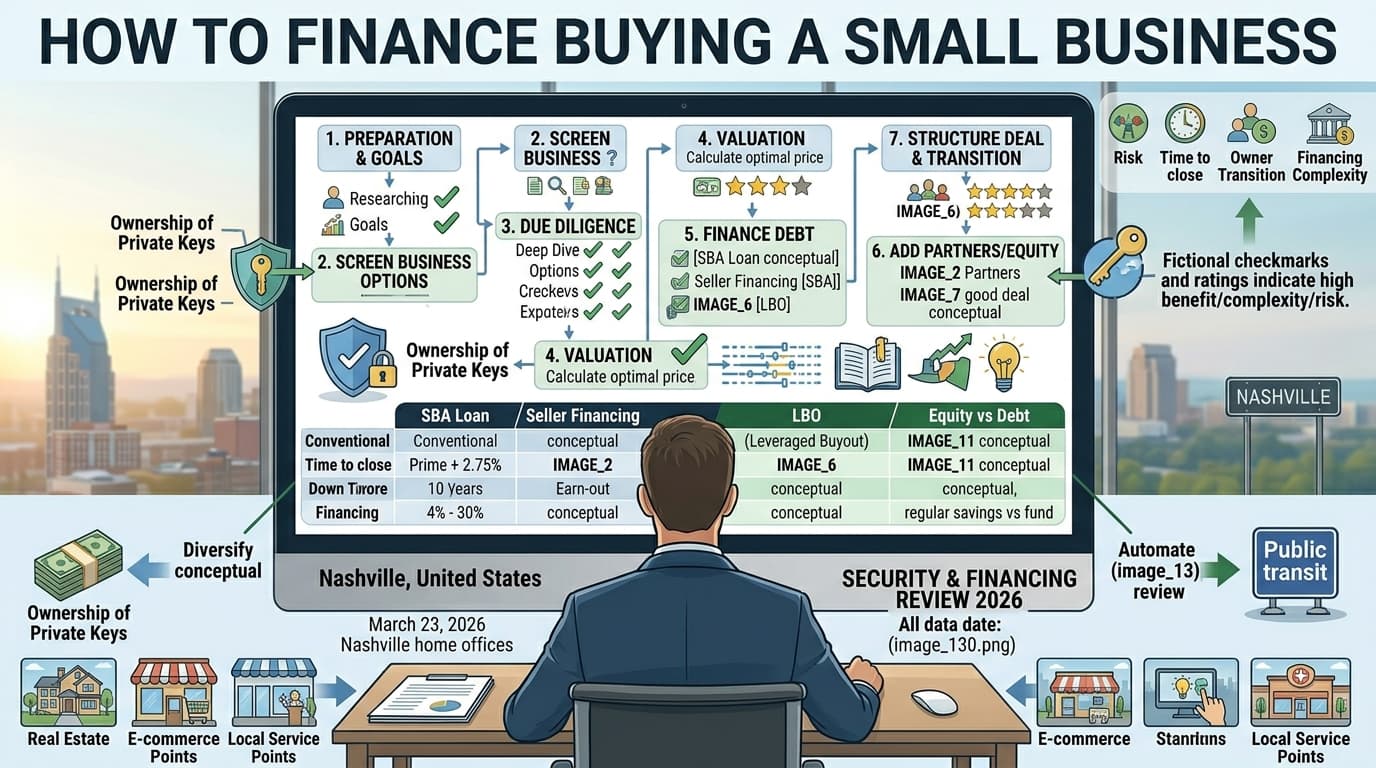
Finance a small business purchase using SBA 7(a) loans (10% down), seller financing (negotiable terms), ROBS (using retirement funds), conventional bank loans, or investor partnerships — most buyers combine two or more methods.
How to Finance Buying a Small Business (2026 Guide)
By DadAlt Investments | Category: Buying Businesses | Last Updated: March 2026
Buying a small business is one of the most effective paths to building significant income and long-term wealth — but the financing question stops most buyers before they ever make an offer. The reality in 2026 is more accessible than most people realize: the majority of small business acquisitions under $500,000 are completed using personal savings, How to Finance a Business Purchase Without Savings, or a combination of both — the SBA loan is not always required, and it is far from the only option. Five primary financing structures dominate small business acquisitions: personal savings, SBA 7(a) loans, seller financing, ROBS (Rollover for Business Startups), and conventional bank loans or home equity lines of credit. Each has specific use cases, costs, and risk profiles. The Federal Reserve's rate cuts in the second half of 2025 reduced the WSJ Prime Rate to 6.75% as of early 2026, meaningfully improving the acquisition math for leveraged buyers compared to the 2022–2024 high-rate environment. The core principle that runs through all five options: use the lowest-cost financing available, minimize interest drag, and structure the deal so the business's own cash flow services any debt — not your personal income.
The Financing Landscape for Small Business Acquisition in 2026
Understanding the full menu of financing options before you make an offer separates buyers who close deals from buyers who spend months in dead-end conversations with banks.
The Five Primary Financing Sources
- Personal savings / self-funding — cleanest structure, no lender approval, zero interest drag
- SBA 7(a) loan — government-backed, up to $5 million, 10-year repayment, 10%–20% down
- Seller financing — seller carries a portion of the purchase price as a note you repay over time
- ROBS (Rollover for Business Startups) — use existing 401(k)/IRA funds to fund the purchase without early withdrawal penalties
- Conventional bank loans / HELOC — harder to qualify, faster to close, appropriate for specific situations
The Capital Stack Principle
Most sophisticated acquisitions use a layered capital stack — multiple financing sources combined to minimize out-of-pocket cost while keeping debt service manageable relative to business cash flow. A typical structure for a $300,000 acquisition:
- $210,000 (70%) — SBA 7(a) loan
- $60,000 (20%) — 5-year seller note at 7%
- $30,000 (10%) — buyer cash down payment
The seller note in this example satisfies a portion of the equity injection requirement under current SBA guidelines, potentially allowing the buyer to close with only $30,000 of personal capital on a $300,000 business.
The Current Rate Environment (March 2026)
The WSJ Prime Rate sits at 6.75% as of early 2026, following rate cuts by the Federal Reserve in the second half of 2025. SBA 7(a) loan rates for business acquisitions over $350,000 are currently capped at Prime + 3.0%, equaling a maximum of 9.75% — the most favorable acquisition loan environment in nearly three years.1
The SBA closed fiscal year 2025 with a record $44.8 billion in guaranteed loans, with the 7(a) program accounting for the majority — demonstrating ongoing lender appetite for SBA-backed acquisitions even in a higher-rate environment.2
Option 1: Personal Savings / Self-Funding
Self-funding is the cleanest financing structure available for small business acquisition. No lender approval process, no debt service eating into early cash flow, no personal guarantee on a commercial loan, maximum flexibility in negotiating deal terms with a seller.
When Self-Funding Makes Sense
- Acquisitions under $100,000 — at this price range, debt service on a leveraged acquisition can consume a disproportionate share of business cash flow; self-funding often produces better returns
- Investors with 6+ months of personal living expenses covered after purchase — the liquidity reserve after closing matters as much as the purchase itself; a business acquisition followed by immediate personal financial pressure is a high-risk combination
- Deals with seller financing available — even self-funded buyers can use seller notes for a portion of the price, reducing upfront cash required without adding a third-party lender
The Concentration Risk
Self-funding a business acquisition concentrates personal capital in a single illiquid asset. Unlike a stock portfolio where a bad position can be sold in seconds, a business acquisition cannot be unwound quickly. If the business underperforms post-acquisition, the capital is locked.
The rule of thumb most experienced acquisition entrepreneurs use: Do not invest more than 20%–30% of liquid net worth in a single business acquisition. Investing more means a single deal gone wrong meaningfully impairs your overall financial position.
Self-Funding Works Best When Combined With a Seller Note
Even buyers who could pay 100% cash often negotiate a seller note for 15%–30% of the purchase price — not because they need the financing, but because the seller note keeps the seller financially motivated to ensure a successful transition. More on seller financing in Option 3.
Option 2: SBA 7(a) Loan — The Most Common Acquisition Loan
The SBA 7(a) loan is the gold standard of small business acquisition financing. Backed by the U.S. Small Business Administration, it offers lower interest rates, longer repayment terms, and smaller down payments than conventional bank financing — making it accessible to buyers who cannot put 30%–40% down.
Current SBA 7(a) Rates (March 2026)
As of March 2026, with the WSJ Prime Rate at 6.75%, the SBA caps maximum rates on 7(a) loans by loan size:1
| Loan Amount | Maximum Rate | Effective Rate Cap |
|---|---|---|
| $50,000 or less | Prime + 6.5% | 13.25% |
| $50,001 – $250,000 | Prime + 6.0% | 12.75% |
| $250,001 – $350,000 | Prime + 4.5% | 11.25% |
| Over $350,000 | Prime + 3.0% | 9.75% |
These are ceilings, not floors. A borrower with a 750+ credit score, strong cash flow documentation, and an existing lender relationship can negotiate rates meaningfully below these maximums. Most business acquisition loans exceed $350,000 and are capped at Prime + 3.0% = 9.75% maximum.1
Important: Effective March 1, 2026, the SBA now permits lenders to use alternative base rates including 30-Day SOFR, 5-year Treasury notes, or 10-year Treasury notes in addition to the WSJ Prime Rate — though the Prime Rate remains the most commonly used benchmark.1
Key SBA 7(a) Terms for Business Acquisitions
- Maximum loan amount: $5 million (for acquisitions exceeding this, pari passu structures combining SBA and conventional financing are available for deals up to $10–12 million)
- SBA guarantee: Up to 85% on loans of $150,000 or less; up to 75% on loans above $150,000
- Repayment term: 10 years for business acquisitions; up to 25 years for real estate components
- Down payment: Typically 10%–20% of purchase price
- Rate type: Variable (adjusts quarterly with Prime Rate changes); fixed-rate options available, locked at closing
The Seller Standby Note: How to Reduce Your Down Payment
A significant SBA guideline update effective in 2025 expanded the ability of buyers to satisfy equity injection requirements using seller financing on standby. Under current SBA rules:
- A seller note structured as a standby note (no payments for the first 24 months following closing) can count toward the equity injection requirement
- This potentially allows a buyer to acquire a business with 5% cash down combined with a seller standby note covering the remaining equity requirement
- This structure requires lender approval and specific documentation, but it meaningfully reduces cash required at closing for qualified transactions3
SBA 7(a) Requirements for Acquisition Buyers
To qualify for an SBA 7(a) loan in 2026:
- Credit score: 650+ minimum; 700+ preferred for competitive rates; 720+ for best-available terms
- Personal financial documents: Two years personal tax returns; personal financial statement (SBA Form 413)
- Business documents: Three years of business tax returns from the acquisition target; trailing-twelve-month profit and loss statement; balance sheet
- Debt service coverage ratio (DSCR): Lenders require the business to generate sufficient cash flow to service the debt — minimum 1.15x DSCR (for every $1.00 in debt service, the business must generate $1.15 in adjusted cash flow)
- Business plan / management experience: Evidence that the buyer has relevant industry experience or a credible management transition plan
- Collateral: SBA requires collateral when available; for acquisitions, the business assets and goodwill often serve as primary collateral; personal guarantees are standard
SBA 7(a) Fees (Fiscal Year 2026)
The SBA charges guarantee fees that are typically rolled into the loan amount:2
- Loans up to $150,000: 0.25% of the guaranteed portion (upfront) + 0.55% annual servicing fee
- Loans $150,001–$700,000: 3.0% of the guaranteed portion
- Loans $700,001–$5 million: 3.5% on the guaranteed portion up to $1 million; 3.75% on the guaranteed portion above $1 million
- Annual servicing fee: 0.55% of the outstanding guaranteed balance
Timeline and Process
Most SBA 7(a) acquisition loans close in 45–90 days from complete application submission. SBA Express loans (up to $500,000) can close in 30–45 days. The most common delays are incomplete documentation — assembling financials, business valuations, and purchase agreements in advance significantly accelerates the process.3
Option 3: Seller Financing — Often the Best Deal Structure
Seller financing is frequently the most advantageous financing option available in small business acquisitions — yet it is the least understood by buyers entering the market for the first time. In a seller-financed deal, the seller accepts a portion of the purchase price as a promissory note rather than cash at closing, effectively becoming the buyer's lender for that portion.
Why Sellers Agree to Finance
Sellers are often willing to carry a note because:
- Capital gains tax deferral: Under installment sale rules (IRS Section 453), a seller receiving payments over multiple years defers capital gains recognition to each year payments are received, rather than recognizing the entire gain in the year of sale. This can meaningfully reduce the seller's total tax burden.
- Ongoing income stream: A seller note at 6%–8% on a portion of the sale price generates income for the seller in retirement — often better than rates available on certificates of deposit or bonds
- Demonstrates confidence in the transition: A seller who believes the business will thrive post-transition accepts a note without concern; a seller demanding 100% cash at close may be signaling hidden risk
Why Buyers Prefer Seller Financing
- Lower upfront capital requirement: A 30% seller note on a $250,000 acquisition saves $75,000 of cash at closing
- The seller has skin in the game: When a portion of the seller's proceeds depends on the business remaining viable post-transition, the seller is financially motivated to assist with customer retention, employee introductions, and operational knowledge transfer
- No bank approval required: The negotiation is directly between buyer and seller; no third-party lender underwriting process, no guarantee fees, faster closing
- Flexible structure: Interest rate, repayment period, amortization schedule, and subordination terms are all negotiable between buyer and seller
Standard Seller Note Structures
The most common seller financing structures in sub-$500K small business acquisitions:
Structure A — Standard Split Close
- 70%–80% cash or SBA financing at close
- 20%–30% seller note at 6%–8% interest, amortized over 3–5 years
- Seller payments begin 30–60 days post-close
Structure B — SBA + Seller Standby Note
- 80%–85% SBA 7(a) loan
- 10%–15% seller standby note (no payments for 24 months per SBA requirements)
- 5%–10% buyer cash down payment
- This structure can reduce buyer cash at closing to 5%–10% of purchase price3
Structure C — Pure Seller Financing
- Seller carries 100% of purchase price; buyer pays nothing at close
- Less common; typically requires a well-documented relationship between buyer and seller, strong business cash flow, or seller urgency
- Effectively a business loan from the seller at agreed terms
Option 4: ROBS — Using Retirement Funds to Buy a Business
ROBS (Rollover for Business Startups) is a legal financing structure established under ERISA that allows prospective business buyers to use their existing 401(k), 403(b), or traditional IRA funds to purchase a business without triggering early withdrawal penalties or immediate tax liability. It is not a loan — there are no monthly payments, no interest charges, and no personal guarantee.
How ROBS Works: The Five Steps
- Form a C Corporation — The business must be structured as a C-Corp (not an LLC or S-Corp); only C-Corps can issue employer stock, which is central to the ROBS mechanism
- The C-Corp sponsors a new 401(k) plan — The corporation establishes a qualified retirement plan that permits investment in employer stock
- Roll retirement funds into the new plan — Existing retirement account funds are rolled over tax-free into the new C-Corp's 401(k) plan
- The 401(k) plan purchases C-Corp stock — The plan uses rolled-over funds to buy stock in the new corporation, transferring capital from the retirement account to the business
- The corporation uses the proceeds — The C-Corp receives the capital from the stock sale and uses it to fund the business acquisition
Because the funds are rolled over (not withdrawn), no taxable distribution event occurs. No early withdrawal penalty applies. The business buyer gains access to retirement capital without debt or tax cost — at the time of the transaction.4
ROBS Costs
- Setup fees: $1,000–$5,000 with a ROBS provider (Guidant Financial, FranFund, Benetrends are common providers); some providers quote higher setup costs in the $5,000–$15,000 range depending on complexity
- Monthly administration fees: $100–$200/month for ongoing compliance administration (Form 5500 filing, plan administration, annual audits)
- Minimum retirement account balance: Typically $50,000 or more to justify the ROBS structure and associated costs4
ROBS Ongoing Compliance Requirements
ROBS is not a "set it and forget it" structure. Ongoing annual requirements include:
- File IRS Form 5500 annually (Annual Return/Report of Employee Benefit Plan)
- File corporate tax returns (C-Corp Form 1120) annually
- Offer eligible employees the opportunity to participate in the 401(k) plan
- Pay yourself a fair market salary as an active employee of the C-Corp
- Purchase C-Corp stock at fair market value only
- Maintain an ERISA fidelity bond covering at least 10% of the plan's value (minimum $500,000 maximum)
Failure to meet these requirements can result in plan disqualification, triggering retroactive taxes and penalties on the original rollover amount — effectively converting the tax-free rollover into a taxable distribution.4
The IRS's Official Position on ROBS
The IRS does not classify ROBS as an abusive tax avoidance transaction — but it does classify them as "questionable" because they typically benefit only one individual (the business owner) and may not satisfy anti-discrimination provisions in the tax code. The IRS's ROBS compliance project found that a significant portion of ROBS-funded businesses either failed or were on the road to failure, with high rates of bankruptcy, business and personal liens, and corporate dissolutions. Some business owners lost not only their retirement savings but also faced personal financial ruin.5
The bottom line on ROBS: It is a legal structure with real utility — particularly for buyers who cannot qualify for bank financing, have substantial retirement savings, and are purchasing a proven, cash-flowing business. But it is categorically not appropriate for a speculative or unproven acquisition. A failed ROBS-funded business means permanently lost retirement funds with no ability to recover them.
If you are seriously considering ROBS, consult both a ROBS specialist provider and an independent tax attorney or CPA before proceeding. Do not rely solely on the ROBS provider's guidance — they earn fees from completing the transaction.
Option 5: Conventional Bank Loans and HELOC
Conventional financing options exist outside the SBA framework and are worth understanding, particularly for buyers who do not want to navigate the SBA's documentation requirements or who need faster closing timelines.
Conventional Bank Loans
A conventional bank business loan for an acquisition operates without SBA backing — the lender bears the full credit risk and structures terms accordingly:
- Down payment: Typically 30%–40% of purchase price (versus 10%–20% for SBA)
- Interest rates: Generally 7%–20%+ depending on creditworthiness, business collateral, and lender risk appetite; no SBA rate caps apply
- Qualification: Harder to qualify without significant business collateral; underwriting focused heavily on the business's tangible asset value rather than goodwill and cash flow
- Closing speed: Potentially faster than SBA (30–45 days versus 45–90 days); no SBA processing queue
- Best for: Asset-heavy businesses (equipment, real estate) where tangible collateral supports the loan without SBA guarantees; buyers who can put 30%–40% down and want simpler documentation1
HELOC (Home Equity Line of Credit)
A HELOC uses the equity in your home as collateral to fund a business acquisition. This is a legitimate and commonly used financing tool for smaller acquisitions in the $50,000–$200,000 range.
HELOC advantages:
- Fast approval and access to funds (often 2–4 weeks from application to funding)
- Variable or fixed rates typically lower than SBA rates — HELOC rates in early 2026 range from approximately 7%–10% depending on credit and loan-to-value ratio
- Flexible draw — you access only what you need, when you need it
- No SBA fees, no guarantee fees, no complex business documentation required for approval
HELOC risks — read carefully:
- Your home secures the loan. A failed business acquisition does not just lose capital — it can result in the lender foreclosing on your residence if you cannot service the HELOC payments
- HELOC rates are typically variable; if rates rise post-closing, your debt service cost increases without any corresponding increase in the business's income
- HELOC draws reduce the equity buffer in your home — relevant if you need to refinance your mortgage or sell the property
Who should use a HELOC for a business acquisition:
- Buyers with substantial home equity (50%+ loan-to-value remaining after the HELOC draw)
- Acquisitions with strong, documented cash flow that clearly covers HELOC payments
- Buyers purchasing a low-risk, owner-operated service business with predictable revenue
- Supplementary financing alongside cash or a small seller note — not as the sole funding source for a large acquisition
Structuring the Deal: Asset Purchase vs. Stock Purchase
The financing discussion is incomplete without understanding how the deal structure affects what you are actually buying — and how lenders view the transaction.
Asset Purchase: The Most Common Structure for Small Businesses
In an asset purchase, the buyer acquires specific assets and goodwill of the business — equipment, inventory, customer lists, contracts, intellectual property, the trade name — while the seller retains the legal entity (LLC or corporation) and its liabilities.
- Liability protection: The buyer generally does not inherit the seller's historical liabilities, undisclosed debts, lawsuits, or tax obligations
- Tax advantage: The buyer gets a stepped-up basis in the acquired assets, allowing accelerated depreciation deductions
- Most common structure for acquisitions under $5 million — preferred by buyers, brokers, and most SBA lenders
- SBA lender preference: Asset purchases are more lender-friendly because collateral identification is cleaner and liability exposure is limited
Stock Purchase: Required in Specific Circumstances
In a stock purchase, the buyer acquires the entire legal entity — including all of its assets, contracts, and liabilities (including unknown or undisclosed ones). Sellers often prefer stock purchases because they receive capital gains treatment on the entire sale price; buyers generally do not.
Stock purchases are sometimes necessary when:
- The business holds licenses or permits that cannot be transferred to a new entity (contractor licenses, certain health care or financial licenses, liquor licenses in some states)
- Key contracts with customers or suppliers have change-of-control clauses that would trigger termination in an asset sale
- The business is a franchise where the franchisor requires continuity of the entity
If a stock purchase is required, enhanced due diligence is essential — the buyer inherits all liabilities, including those not visible on the balance sheet. A quality of earnings (QofE) report and legal review of contracts, pending litigation, and tax filings is standard practice for any stock acquisition.
Impact on SBA Financing
SBA 7(a) loans are available for both asset purchases and stock purchases. For stock purchases, the SBA requires additional documentation including a corporate resolution authorizing the sale and evidence that the acquired entity has no outstanding SBA loans. Asset purchases typically receive faster lender approval due to cleaner documentation and liability separation.3
FAQ
How Much of My Own Money Do I Need to Buy a Business?
The minimum varies significantly by deal structure:
- SBA 7(a) loan only: Typically 10%–20% of the purchase price in cash equity injection. On a $300,000 acquisition, that is $30,000–$60,000 out of pocket.
- SBA + seller standby note: Under current SBA guidelines, a seller standby note can satisfy a portion of the equity injection requirement, potentially reducing cash at close to 5% of the purchase price for qualifying transactions — $15,000 on a $300,000 acquisition.
- Pure seller financing: In deals where the seller carries 100% of the purchase price, it is theoretically possible to close with minimal or no cash — though these structures require strong seller motivation and are less common.
- Self-funded acquisitions under $50,000: Online businesses (content sites, newsletters, SaaS tools) in this range are frequently acquired with cash from personal savings, no bank financing required.
The practical floor for most acquisitions with bank financing: 10% cash of the purchase price, plus closing costs (legal, accounting, due diligence) typically running 2%–5% of deal value.
Can I Get an SBA Loan for an Online Business Acquisition?
Yes — the SBA 7(a) program covers online business acquisitions including content sites, SaaS businesses, e-commerce stores, and digital service businesses. The key requirement is that the business must demonstrate consistent, documentable revenue and cash flow sufficient to service the debt (minimum 1.15x DSCR).
The practical challenge with online business acquisitions: lenders require 2–3 years of consistent business tax returns to underwrite the loan. Many online businesses are newer or have inconsistent revenue histories that do not meet SBA documentation thresholds. For online businesses without a clean multi-year financial record, seller financing is typically the more viable path.
Additionally, SBA lenders assess collateral — and online businesses often have limited tangible assets. Some SBA Preferred Lenders (PLP lenders) have developed programs specifically for digital asset acquisitions; working with a specialist lender rather than a local bank significantly improves approval odds for online business acquisitions.3
Is Seller Financing Better Than a Bank Loan?
In most sub-$500K acquisitions, seller financing for a portion of the purchase price is better than a bank-only structure — for both the buyer and the seller. The combined SBA + seller note structure gives the buyer lower cash at close, gives the seller tax-advantaged installment sale treatment, and aligns both parties' incentives around a successful transition.
Seller financing alone (without any bank component) can work but has a meaningful limitation: most sellers do not want to finance 100% of a sale unless they have strong confidence in the buyer and the business. Asking a seller to be your bank for the entire purchase price is a substantial ask that requires clear creditworthiness and business quality documentation.
The most efficient structure for most acquisitions: SBA 7(a) for 70%–80% of the purchase price, seller note on standby for 10%–20%, buyer cash for the remaining 5%–10%. This spreads risk, reduces closing costs versus pure seller financing (no ROBS fees, no personal guarantee on a HELOC), and gives the buyer a clear 10-year amortization schedule for the SBA portion.
What Credit Score Do I Need for an SBA 7(a) Loan?
The SBA does not mandate a specific minimum credit score — individual lenders set their own floors within SBA guidelines. In practice for 2026:
- 620–649: Some lenders will consider this range with compensating factors (strong business financials, significant collateral, or a large down payment), but approval is challenging
- 650–679: The realistic minimum for most SBA lenders; expect higher rates and stricter collateral requirements
- 680–719: Competitive; access to most SBA lenders; rates negotiable below maximum caps
- 720+: Best-available terms; lenders compete for these borrowers; rates significantly below the SBA cap
Before applying, pull your personal credit report from all three bureaus (Equifax, Experian, TransUnion) and resolve any inaccuracies. Collections, tax liens, and recent late payments are the most common causes of SBA loan denials. Address these at least 6–12 months before pursuing acquisition financing.1 2
Sources and References
Disclaimer: This article is for informational and educational purposes only and does not constitute financial, legal, or investment advice. SBA loan rates, program terms, and IRS regulations are subject to change. ROBS structures involve complex legal and tax considerations — consult a qualified attorney and CPA before proceeding. All figures reflect early 2026 data. DadAlt Investments may earn affiliate commissions from some links in this article at no cost to you.
Recommended Reading
- How to Finance a Business Purchase Without Savings
- How to Buy a Small Business With No Money Down
- How to Evaluate a Business Before Buying It
Footnotes
-
GoSBA Loans / PrimeRates / Lendio. "SBA 7(a) Loan Interest Rates — March 2026." https://gosbaloans.com/blog/sba-loan-interest-rates/ and https://primerates.com/sba-7a-loans-explained-rates-requirements-2026/ and https://www.lendio.com/blog/sba-loan-interest-rates — WSJ Prime Rate 6.75% as of March 2026; SBA 7(a) rate caps by loan size: $50K or less Prime + 6.5% = 13.25%; $50,001–$250K Prime + 6.0% = 12.75%; $250,001–$350K Prime + 4.5% = 11.25%; over $350K Prime + 3.0% = 9.75% maximum; effective March 1, 2026 SBA permits alternative base rates including SOFR and 5/10-year Treasury notes; most business acquisition loans exceed $350,000 and are capped at 9.75% maximum; variable rates adjust quarterly; fixed-rate options available; credit scores: 680+ for competitive rates, 720+ for best terms; lenders prefer 650+ minimum; 10-year repayment term for acquisitions; SBA guarantees 75%–85% depending on loan size; maximum loan amount $5 million. ↩ ↩2 ↩3 ↩4 ↩5 ↩6
-
NerdWallet / Fundwell / SBA.gov. "SBA Loan Rates 2026 and Program Details." https://www.nerdwallet.com/business/loans/learn/sba-loan-rates and https://www.fundwell.com/blog/sba-loan-interest-rates-2026 — SBA 7(a) loan rates range 9.75%–14.75% maximum as of March 2026; SBA FY2026 guarantee fees: 0.25% on loans up to $700K; 3.5% on guaranteed portion up to $1M; 3.75% on guaranteed portion over $1M; annual servicing fee 0.55% on guaranteed outstanding balance; SBA closed FY2025 with record $44.8 billion in guaranteed loans; 50%+ of 7(a) loans under $150,000 in FY2025; SBA Express loans up to $500K with faster decisions (30–45 days close); standard 7(a) closes in 45–90 days from complete application. ↩ ↩2 ↩3
-
GoSBA Loans. "Ultimate Guide to SBA 7(a) Loans in 2026: Requirements, Rates and How to Qualify." February 2026. https://gosbaloans.com/guide/the-ultimate-guide-to-sba-7-a-loans-in-2026-requirements-rates-and-how-to-qualify/ — SBA maximum loan $5 million; pari passu structures for deals up to $10–12M; standard 10% equity injection requirement; seller standby note structure approved under 2025 SOP update — seller note on standby for 24 months counts toward equity injection; minimum 10% equity injection with seller standby note can reduce cash at close to 5% for qualifying transactions; minimum DSCR 1.15x required by lenders; 45–90 day standard close; SBA Express up to $500K can close 30–45 days; asset purchases more lender-friendly; stock purchases require corporate resolution and additional documentation; online business acquisitions viable with documented 2–3 year revenue history. ↩ ↩2 ↩3 ↩4 ↩5
-
Guidant Financial / FitSmallBusiness / NerdWallet. "ROBS (Rollover for Business Startups) — How It Works and What It Costs." https://www.guidantfinancial.com/401k-business-financing-robs-guide/how-rollovers-for-business-startups-work/ and https://fitsmallbusiness.com/rollover-business-startups-robs/ and https://www.nerdwallet.com/business/loans/learn/rollovers-as-business-startups-robs — ROBS setup fees $1,000–$5,000 (providers quote higher range $5,000–$15,000 for complex transactions); monthly administration fees $100–$200/month; minimum $50,000 retirement account balance typically required; eligible accounts include 401(k), 403(b), traditional IRA; C-Corp required (S-Corp and LLC ineligible); steps: form C-Corp → sponsor 401(k) plan → rollover retirement funds → 401(k) buys C-Corp stock → corporation receives proceeds; ongoing requirements: Form 5500 annually, Form 1120 corporate tax return, ERISA fidelity bond (lesser of $500,000 or 10% of plan value), fair market salary for owner, fair market value stock purchase; ROBS is not a loan — no payments, no interest, no personal guarantee; takes approximately 3–4 weeks with ROBS provider. ↩ ↩2 ↩3
-
IRS.gov / Nav / NAPA-NET. "ROBS Compliance Project and IRS Official Position." https://www.irs.gov/retirement-plans/rollovers-as-business-start-ups-compliance-project — IRS Employee Plans ROBS Compliance Project findings: most ROBS-funded businesses either failed or were on the road to failure; high rates of bankruptcy (personal and business), liens (personal and business), corporate dissolutions; IRS classifies ROBS as "questionable" (not abusive, but subject to scrutiny) because they primarily benefit one individual; concerns about anti-discrimination provisions, exclusive benefit rule, inactive CODAs; plan disqualification can trigger retroactive taxes and 10% early withdrawal penalty on original rollover amount; IRS recommends consulting tax and legal advisors before proceeding; ROBS promoters cited for high fees, aggressive marketing, failure to file or issue required forms; Form 5500 filing failures are the most common compliance violation found by IRS. ↩
Frequently Asked Questions
What's the easiest way to finance a business purchase?
Seller financing is the easiest — it doesn't require bank approval, terms are negotiable, and motivated sellers may accept 10–20% down. About 60–90% of small business sales involve some form of seller financing.
Can I use my 401(k) to buy a business?
Yes — ROBS (Rollover for Business Startups) lets you use retirement funds to buy a business without early withdrawal penalties. It's complex and requires proper setup, but it's a legitimate, IRS-approved strategy.
How much does an SBA loan cover for a business purchase?
SBA 7(a) loans cover up to 90% of the purchase price (you put 10% down), up to $5 million. Terms are typically 10 years with competitive interest rates. The process takes 45–90 days.

About the Author
Jared DeValk
Founder, DadAlt Investments
Father, alternative investment researcher, and founder of DadAlt Investments. 14+ years turning hard lessons into honest guidance for dads building real wealth.