
Should I Buy Crypto? The Case for Crypto in a Family Portfolio
Why crypto belongs in a long-term portfolio.
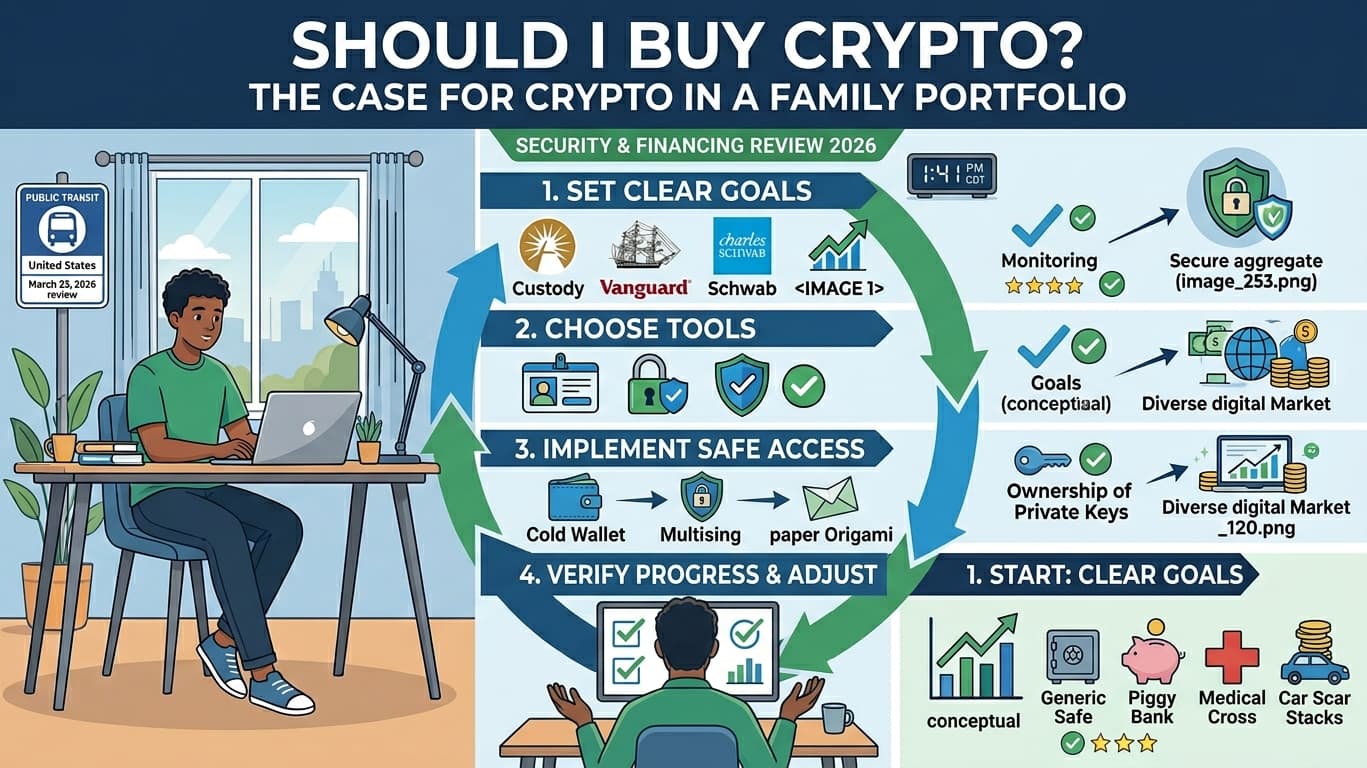
The Short Answer
A 5–10% crypto allocation can strengthen a family portfolio through diversification and asymmetric upside potential — but only after you've secured an emergency fund and traditional investments first.
Should I Buy Crypto? The Case for Crypto in a Family Portfolio
Category: Crypto & Digital Assets | Tags: Beginner Guides · Investment Strategy · Bitcoin · Portfolio Building
Target Keywords: should I buy crypto, Bitcoin in a portfolio, crypto for families, Bitcoin investment 2025, how much Bitcoin to buy, is crypto a good investment, Bitcoin vs stocks
Summary
Crypto has gone from a fringe experiment to a legitimate question on the family financial planning agenda — and in 2025, more American households are asking it seriously than ever before. Roughly 21% of U.S. adults, approximately 55 million people, now own at least some cryptocurrency, according to the largest survey ever conducted of U.S. crypto holders. Behind that number is a real investment debate: not whether crypto is "real," but whether it belongs in the kind of diversified portfolio a working dad is building for his family's future. This article makes the case for why a modest, intentional crypto allocation — centered on Bitcoin — deserves a place in most family portfolios, while being completely honest about the volatility, tax complexity, and risks that come with it. You won't find a get-rich-quick pitch here. What you'll find is the same framework you'd apply to evaluating any asset class: historical returns, risk profile, correlation to the rest of your portfolio, what serious institutional investors are actually doing with it, and how to size a position that lets you participate in the upside without putting your family's financial security at risk.
Part 1: The Foundation — What Is Crypto, and Why Does It Matter Now?
Cryptocurrency is digital money built on blockchain technology — a decentralized public ledger that records every transaction without relying on a bank, government, or central authority. The most important cryptocurrency by far is Bitcoin (BTC), the original, which accounts for over 50% of the entire crypto market by value as of late 2025, according to BlackRock's iShares Bitcoin Trust data. Bitcoin was created in 2009 in the wake of the global financial crisis specifically as an alternative to the centralized monetary system — a currency whose supply is controlled by math and code rather than central bank policy.
For most of its history, Bitcoin was treated as either a curiosity or a purely speculative asset. That characterization has become increasingly difficult to maintain. By 2025, the conversation has shifted at every level of finance:
- BlackRock, the world's largest asset manager, launched a spot Bitcoin passive income strategies in January 2024 that grew to over $70 billion in assets under management in 341 days — a pace five times faster than gold ETFs took to reach the same milestone
- Harvard University's endowment allocated $443 million to BlackRock's Bitcoin ETF by September 2025
- Corporate treasuries including Strategy (formerly MicroStrategy), which holds 671,000+ Bitcoin on its balance sheet, have treated Bitcoin as a long-term hedge against dollar debasement
- BlackRock CEO Larry Fink called Bitcoin an "asset of fear" in December 2025 — meaning investors turn to it during periods of inflation, geopolitical instability, or weakening confidence in traditional markets
- The U.S. government passed the GENIUS Act in July 2025, representing a major step toward regulatory clarity for the crypto industry
None of this makes Bitcoin a safe investment. What it does mean is that when an institution like BlackRock — which manages $10+ trillion in assets — builds and aggressively markets a Bitcoin product, the asset has crossed a threshold from speculative fringe into mainstream financial instrument. That changes the conversation for every investor, including you.
Part 2: The Historical Performance Case
Before evaluating whether crypto belongs in your portfolio, you need to understand what the data actually shows about its track record. The numbers are extraordinary — and the risks are equally extraordinary.
Bitcoin's Long-Run Return Record
According to BlackRock's analysis (based on Bloomberg data through June 30, 2025):
From 2014 to 2024, Bitcoin was the best-performing asset class in eight of those eleven years — but also the worst-performing asset in the other three years. Over the full period, Bitcoin averaged a 54% annualized return, outperforming every major asset class by a wide margin.
To put that in concrete terms, from research by Good Financial Cents:
- 2011 to 2023: The Vanguard S&P 500 ETF (VOO) delivered a 15.74% average annual return and 173% total return. Bitcoin's average annual return over the same period was approximately 819%, with a total return of roughly 9,012%.
- 2010 to 2021: Bitcoin delivered approximately a 1,576% average annual return and 18,912% total return, compared to roughly 13.5% and 162% for the Vanguard Real Estate ETF over the same period.
The Down Years Are Real — And They Are Brutal
Those numbers come with a critical caveat: the down years for Bitcoin are not ordinary declines.
- 2014: Bitcoin fell approximately 58% for the year
- 2018: Bitcoin fell approximately 73% for the year
- 2022: Bitcoin fell approximately 65%, from a high of $69,000 in November 2021 to a low of $15,476 by November 2022 — a 78% peak-to-trough collapse triggered by the FTX bankruptcy and broader macro conditions
In 2022, Bitcoin fell much harder than both stocks (the S&P 500 fell ~25%) and gold (which fell ~20%). Anyone who had a large Bitcoin allocation during that period took severe losses. This is not a footnote — it is the central risk that every investor needs to internalize before putting a dollar into crypto.
What Happened After the Crashes?
Equally important is what happened after each major drawdown. Between Bitcoin's 2022 low of $15,476 and its October 2025 peak of $126,271, according to data from TradeThatSwing.com, Bitcoin rallied 716%. By Bitcoin's own historical pattern — as tracked by ARK Invest — the post-crash recovery reliably dwarfs prior peaks before the next correction begins.
As of early 2026, Bitcoin has corrected significantly from its October 2025 all-time high, trading in the mid-to-low $60,000s range. Whether this represents the beginning of another bear market or a mid-cycle pullback is a matter of active debate among analysts.
The Supply Story: Why Bitcoin Is Structurally Different from Dollars
One of the most important investment arguments for Bitcoin is not about price history — it's about supply design. Unlike the U.S. dollar, which can be printed in unlimited quantities by the Federal Reserve, Bitcoin has a hard-coded maximum supply of 21 million coins that can never be changed.
According to The Block, approximately 19.97 million Bitcoin had already been mined by January 2026 — about 95% of the total that will ever exist. After the fourth Bitcoin halving in April 2024, Bitcoin's annual supply growth rate fell below 1% — lower than gold's estimated supply growth rate of 1.5–2% per year, according to Coinpaprika.
This matters because of a basic economic principle: when supply is fixed or declining and demand increases, prices tend to rise. Bitcoin's halvings — which cut miner rewards in half approximately every four years — are encoded directly into Bitcoin's protocol, making them predictable and immutable. The next halving is projected for April 2028.
Why does this matter for a dad building a family portfolio?
Every year, the U.S. dollar loses purchasing power to inflation. According to Winthrop Wealth, the investor thesis for Bitcoin as a hedge is straightforward: if the government continues to expand the money supply and the dollar continues to lose value, an asset with a mathematically guaranteed fixed supply becomes more appealing — the same way gold has functioned as a monetary hedge for centuries, but with digital scarcity that is verifiable and absolute.
Part 3: The Portfolio Case — What Does Crypto Actually Do to a Diversified Portfolio?
Historical returns tell you what an asset did in isolation. Portfolio construction tells you what it does when it's added to the mix of things you already own. The research here is nuanced and worth understanding.
Low Correlation: Bitcoin's Key Portfolio Benefit
The core argument for adding any new asset to a portfolio is diversification — specifically, whether the asset moves differently from everything else you already own. If it does, adding it can actually reduce your portfolio's overall risk even if the asset itself is more volatile than what you already hold.
From 2022 to mid-2025, Bitcoin maintained consistently low correlations with traditional asset classes including equities, treasuries, and even gold, according to research by 21Shares using Bloomberg and Yahoo Finance data. BlackRock's research supports this, noting that because Bitcoin has been relatively uncorrelated to traditional assets like stocks and bonds over long time horizons, a modest bitcoin allocation may actually have a smaller impact on portfolio volatility than a similar-sized position in certain individual stocks.
However, there's an important caveat from Morningstar: "It was once thought that crypto could offer returns uncorrelated to both stocks and bonds. So far, that hasn't been the case, especially for equities." Correlation between Bitcoin and the stock market tends to increase during periods of market stress — exactly when investors most want diversification. This is a genuine limitation of Bitcoin's diversification argument.
What the Numbers Show on Risk Contribution
According to J.P. Morgan Private Bank analysis (data as of January 2025), using a classic 60% stocks / 40% bonds portfolio as the baseline:
- The entire 40% bond allocation in a 60/40 portfolio accounted for only about 9% of the portfolio's total risk
- A 3.5% Bitcoin allocation introduced approximately the same level of risk as that entire 40% bond allocation
This means that even what sounds like a small Bitcoin allocation has an outsized impact on total portfolio risk. According to Morningstar's December 2025 analysis:
- A 1%–2% crypto allocation may not noticeably impact overall portfolio volatility, though it still contributes disproportionately to total risk at 3%–5% of total risk
- At a 5% allocation (a 50/50 Bitcoin/Ethereum split), crypto contributes approximately 27% of the portfolio's total risk and overall portfolio volatility rises to 1.3 times that of the baseline 60/40 portfolio
- At a 10% allocation, Bitcoin alone accounts for 32% of portfolio risk according to J.P. Morgan
This is not a reason to avoid crypto — it is a reason to be precise about how much you own.
The 21Shares Backtesting Analysis
21Shares conducted a portfolio allocation analysis testing what happens when 5% of a multi-asset portfolio is allocated to Bitcoin (sourced from 2% U.S. equities, 2% gold, and 1% real estate, reflecting Bitcoin's hybrid characteristics). Key findings:
- Downside risk stayed well-contained: Even at 5%, maximum drawdown increased by only 0.52 percentage points (from -14.91% to -15.43%) compared to the benchmark
- Returns improved meaningfully: The Bitcoin allocation boosted overall portfolio returns while keeping drawdown within the safety limits of a typical investment strategy
- Rebalancing matters: Semiannual and quarterly rebalancing produced the best risk-adjusted returns; investors who never rebalanced achieved higher returns but experienced a maximum drawdown of 59.5% — demonstrating that crypto without discipline creates serious risk
Part 4: What Serious Institutional Investors Are Actually Doing
The institutional investor response to Bitcoin in 2024–2025 is the strongest signal yet that Bitcoin has crossed the threshold from speculative fringe to legitimate asset class. Here's what the data shows:
Spot Bitcoin ETFs: A New Benchmark for Access
The SEC's approval of spot Bitcoin ETFs in January 2024 was a turning point. For the first time, traditional investors could gain regulated, exchange-traded exposure to Bitcoin without needing a wallet, private keys, or a crypto exchange account. The results have been remarkable:
- BlackRock's iShares Bitcoin Trust (IBIT): Over $70 billion in AUM as of Q4 2025, making it the world's largest Bitcoin ETF and the fastest ETF in history to reach that milestone
- Fidelity, Vanguard, and Schwab's FBTC: Over $21 billion in AUM
- Grayscale's GBTC: Over $19 billion in AUM
- Combined spot Bitcoin ETF assets: Over $115 billion by late 2025, according to B2Broker analysis
- IBIT ranked 6th globally in ETF net inflows for all of 2025, attracting $25 billion despite Bitcoin's 30%+ decline from its October high — a remarkable sign of institutional conviction
Who Is Buying?
According to data from AInvest and PowerDrill research:
- 86% of institutional investors now have exposure to digital assets or plan to allocate capital in 2025, with 68% specifically targeting Bitcoin ETPs
- 24.5% of the U.S. Bitcoin ETF market is held by institutional investors
- Harvard University's endowment, pension funds, and family offices all filed IBIT holdings in 2025 regulatory filings
- Over 8.4% of total BTC supply is held by corporate treasuries as of February 2026
BlackRock positions Bitcoin as one of its top three investment themes for 2025 alongside U.S. Treasury bills and mega-cap technology stocks — a characterization that would have seemed absurd five years ago.
The Regulatory Tailwind
One of the key remaining risks for Bitcoin — regulatory crackdown — has meaningfully diminished in 2025. The Trump administration's January 2025 executive order on digital assets signaled a pro-innovation stance. The U.S. passed the GENIUS Act on stablecoins in July 2025. The SEC dismissed its enforcement action against Coinbase Wallet in February 2025. According to Grayscale's 2026 Digital Asset Outlook, the regulatory environment has shifted from adversarial to broadly constructive for the first time in the industry's history.
Part 5: The Honest Risk Assessment
This article exists to make the case for crypto in a family portfolio — but only an incomplete case would skip the risks. Here is an honest accounting of what you're taking on when you buy Bitcoin.
1. Extreme Volatility — This Is Structural, Not Temporary
Bitcoin's volatility is not a bug that will be fixed with more adoption. It is an inherent feature of an asset with thin liquidity relative to global capital markets, emotionally driven retail participation, and speculative positioning. According to J.P. Morgan, even since the SEC approved spot Bitcoin ETFs in January 2024, Bitcoin's annualized volatility has been approximately 45% — down from prior decades, but still dramatically higher than stocks (~15–20% annualized volatility) or gold (~15%).
What this means in practice: In any given year, your Bitcoin position could be worth 50–80% less than you paid for it. If you can't psychologically or financially absorb that possibility, Bitcoin is not right for you.
2. Correlation Risk Increases in Downturns
As noted above, Bitcoin's correlation with equities increases during periods of market stress — which is when you most need your portfolio to be diversified. In 2022, Bitcoin fell 65% at the same time stocks fell 25% and bonds fell 13%. All three of your asset classes moved in the same direction at once. There is no guarantee this pattern won't repeat.
3. No FDIC or SIPC Insurance
Crypto held directly on an exchange or in a wallet is not insured by the FDIC or SIPC. If your exchange collapses (as FTX did in 2022), your funds may be inaccessible or lost entirely. Self-custody through best crypto walletss solves this problem but introduces the risk of losing your recovery phrase. There is no equivalent of the protections that exist for bank deposits and open a brokerage accounts.
4. Regulatory Risk Remains Real
While the regulatory environment has improved significantly, J.P. Morgan's analysis notes that the current accommodative stance is not guaranteed. A future administration could take a more adversarial approach. International regulatory divergence means that a crackdown in a major economy could meaningfully affect Bitcoin's price and adoption trajectory.
5. Tax Complexity Is Significant
The IRS treats cryptocurrency as property for tax purposes — meaning every sale, trade, or use of crypto is a taxable event. The rules are complex and increasingly enforced:
- Short-term capital gains (held less than 1 year): Taxed as ordinary income at rates from 10%–37%
- Long-term capital gains (held more than 1 year): Taxed at preferential rates of 0%, 15%, or 20% depending on your income
- Swapping one crypto for another (e.g., trading Bitcoin for Ethereum) is a taxable event
- Spending crypto to buy goods or services is a taxable event
- Staking rewards are taxed as ordinary income when received
- Beginning with the 2025 tax year, the IRS requires Form 1099-DA to be sent by brokers for all digital asset sale and exchange transactions — significantly increasing enforcement visibility
This means you need to track every transaction, every cost basis, and every gain or loss. Crypto tax software (Koinly, TaxBit, Awaken.tax) can help, but the complexity is real and the stakes are high. The IRS has confirmed it is actively increasing enforcement of crypto tax reporting. Consult a qualified tax professional before making significant crypto investments.
6. Scams, Hacks, and Human Error
The crypto space has a genuine fraud problem. From phishing attacks and exchange hacks to outright scams targeting new investors, the risks of losing funds to bad actors are real and not adequately covered by investor protection frameworks. See our related article on how to buy Bitcoin safely for a full breakdown.
Part 6: How Much Should a Family Portfolio Allocate to Crypto?
This is where most of the disagreement among serious analysts lives. Here is the range of views from credible institutions:
| Source | Recommended Range | Key Reasoning |
|---|---|---|
| BlackRock | 1%–2% | Optimal risk-adjusted benefit; 4%+ dramatically increases risk contribution |
| Ray Dalio (Bridgewater) | ~1% | Hedge against economic instability; diversification benefit |
| 21Shares | 5% | Well-contained drawdown; meaningful return improvement |
| Morningstar | 1%–5% | Personal and depends on risk tolerance; 5% is a critical risk inflection point |
| Ric Edelman (Barron's Hall of Fame advisor) | 10%–40% | Based on extended life expectancies and long investing horizons |
| J.P. Morgan | Satellite/speculative allocation | Not recommended for core portfolio; suits aggressive investors |
| Grayscale | Rising valuations expected | Structural shift; Bitcoin approaching reserve asset status |
The consensus range for most investors is 1%–5%, with the allocation calibrated to:
- How long you have until you need the money — crypto rewards very long time horizons and punishes investors who are forced to sell during a down cycle
- Your actual risk tolerance — not what you think your risk tolerance is, but how you would actually behave if your Bitcoin position dropped 60% over 12 months
- The rest of your portfolio — a heavily equity-weighted portfolio may want a smaller crypto allocation given elevated correlation; a conservative investor may want even less or none
A Practical Sizing Framework for Families
| Situation | Suggested Crypto Allocation | Rationale |
|---|---|---|
| Early-stage family, tight cash flow, high debt | 0%–1% | Preserve liquidity; crypto's volatility could disrupt financial stability |
| Established income, 15+ years to retirement, emergency fund fully funded | 1%–3% | Modest participation in upside; manageable risk at this scale |
| Strong income, fully funded retirement accounts, 10+ year time horizon | 3%–5% | More meaningful exposure; still within prudent bounds per BlackRock and Morningstar |
| High income, high risk tolerance, very long time horizon | Up to 10% | Aggressive; approach with explicit understanding of J.P. Morgan's risk contribution data |
The most important rule: Never invest more in crypto than you could afford to lose entirely and still meet your family's financial goals.
Part 7: ETFs vs. Direct Ownership — Which Is Right for Families?
One of the most important practical questions for any investor considering crypto in 2025 is whether to buy Bitcoin directly or through an ETF. Both approaches are legitimate; the right answer depends on your goals.
Bitcoin ETFs (IBIT, FBTC, GBTC, and others)
Best for: Investors who want Bitcoin exposure through familiar, tax-advantaged investment accounts (IRAs, 401(k)s where available, brokerage accounts) without managing wallets or private keys.
Advantages:
- Buy through your existing brokerage account (Fidelity, Schwab, Vanguard, etc.)
- No wallet management, no seed phrases, no custody risk
- Can be held in traditional IRAs for tax-deferred growth
- Regulated product with institutional-grade custody (primarily Coinbase Custody for most ETFs)
- Fidelity has introduced Bitcoin ETF options in select 401(k) plans
Disadvantages:
- Expense ratios (BlackRock's IBIT charges 0.25% annually)
- You do not own Bitcoin directly — you own shares in a fund
- Cannot be transferred or used in self-custody; purely a financial instrument
- If the custodian faces a catastrophic failure (low but non-zero risk), your exposure is to the ETF's recovery process
Direct Bitcoin Ownership
Best for: Investors who want to hold Bitcoin in self-custody as a true alternative asset — outside of the traditional financial system.
Advantages:
- Direct ownership of the asset with no counterparty risk beyond your own security practices
- Can be transferred to hardware wallets for maximum long-term security
- No annual fees beyond transaction costs
- Philosophically aligned with Bitcoin's original design as a self-sovereign asset
Disadvantages:
- Requires more technical setup and ongoing responsibility
- Self-custody carries the risk of losing access if you lose your seed phrase
- Cannot easily be held in tax-advantaged accounts (though Bitcoin IRA providers like iTrustCapital and Bitcoin IRA exist)
For most families just getting started: A Bitcoin ETF through your existing brokerage is the simplest, most accessible path. As your position and knowledge grow, direct ownership through a hardware wallet for long-term storage makes sense as an addition.
Part 8: Building Crypto Into a Family Financial Plan — Step by Step
If you've decided a crypto allocation makes sense for your situation, here's how to approach it:
Step 1: Make Sure the Financial Foundation Is in Place First
Before adding any speculative asset, confirm you have:
- Emergency fund: 3–6 months of expenses in liquid savings
- High-interest debt eliminated: No credit card or high-rate debt
- 401(k) or IRA contributions active: Take full advantage of tax-advantaged retirement accounts before adding crypto
- Appropriate life and disability insurance: Protect your family's income before taking speculative risk
Crypto is an addition to a strong financial plan, not a substitute for one.
Step 2: Decide on Your Allocation and Stick to It
Choose a percentage that reflects your situation from the framework above. Write it down. The purpose of this decision is to prevent yourself from panic-selling during a 50% drawdown or euphoria-buying after a 200% rally.
Step 3: Choose Your Access Method
- ETF in a brokerage or IRA: IBIT (BlackRock), FBTC (Fidelity), or GBTC (Grayscale) through any major brokerage
- Direct purchase on a regulated US exchange: Coinbase, Kraken, or Gemini are the leading regulated options for US buyers
- For a step-by-step guide to buying Bitcoin directly, see our article: How to Buy Bitcoin Safely Without Getting Scammed
Step 4: Use Dollar-Cost Averaging (DCA)
Rather than investing your entire allocation at once — which exposes you to the risk of buying at a market peak — invest a fixed dollar amount on a regular schedule (monthly, biweekly, etc.) regardless of the current price. This approach:
- Eliminates the psychological pressure of trying to time the market
- Automatically buys more Bitcoin when prices are lower and less when prices are higher
- Is the same strategy recommended by every traditional financial planner for platforms for index funds investing
Step 5: Rebalance Regularly
Bitcoin's volatility means your allocation will drift significantly over time. If you start with 5% and Bitcoin doubles, you may now have 10% — a very different risk profile. According to Morningstar's December 2025 analysis, semiannual or quarterly rebalancing produces the best risk-adjusted outcomes and is essential to managing crypto's outsized impact on portfolio volatility.
Step 6: Get Your Tax Situation in Order
- Use a regulated exchange that generates year-end tax forms
- Keep records of every purchase: date, amount in USD, number of coins, and any fees
- If you use a Bitcoin ETF through a standard brokerage, your 1099 will handle most of the tracking automatically
- Starting in 2025, your broker is required to issue Form 1099-DA for all digital asset transactions — but this doesn't replace your responsibility to report accurately
- If your position is significant, consult a CPA with crypto experience before filing
The Bottom Line: Should You Buy Crypto?
There is no universal answer — but there is a framework for finding your answer.
The case for a modest crypto allocation is real and well-supported: The historical return record is extraordinary, institutional adoption is at an inflection point, the supply dynamics are structurally different from any fiat currency, the regulatory environment has improved significantly, and a 1%–5% allocation has demonstrated meaningful return improvement in backtested portfolios with manageable additional risk.
The risks are equally real and should not be minimized: Extreme volatility, potential for 50–80% drawdowns in any given year, limited (though improving) correlation benefits during market stress, no FDIC or SIPC protection, complex tax reporting, and regulatory uncertainty that could still shift.
For most American families with a stable financial foundation, a time horizon of 10+ years, and a genuine ability to tolerate volatility without panic-selling — a 1%–5% allocation to Bitcoin, acquired through either a regulated ETF or a regulated U.S. exchange and stored securely, is a reasonable and defensible addition to a diversified portfolio. For families without that foundation, or those who cannot psychologically tolerate the volatility, it is not.
What crypto is definitely not: a shortcut to wealth, a replacement for your retirement savings, or a reason to delay building the financial fundamentals of a strong family balance sheet. It is one tool among many — a high-risk, high-potential-reward one — that belongs in the alternative investments slice of a portfolio constructed with discipline, patience, and a clear-eyed understanding of what you're actually buying.
Related Articles on DadAlt Investments
- How to Buy Bitcoin Safely Without Getting Scammed — Step-by-step guide to purchasing Bitcoin on a regulated US exchange, avoiding the top 5 scam types, and choosing between Coinbase, Kraken, and Gemini
- 5 Crypto Wallets Every Dad Should Know — Coinbase Wallet, MetaMask, Ledger Nano X, and Trezor Safe 3 compared for beginners through experienced holders
- Top 5 Crypto ETFs — For investors who want Bitcoin exposure through a traditional brokerage account without managing wallets
- Gold vs. Crypto: Which Is the Better Hedge? — Comparing Bitcoin and precious metals as inflation protection and portfolio diversifiers
- Crypto Staking Explained for Beginners — How to earn passive income on crypto holdings safely, and what the IRS wants you to know about it
Sources and References
-
National Cryptocurrency Association / Harris Poll — 2025 State of the Crypto Holders Report — 21% of American adults (roughly 55 million people) own at least some cryptocurrency. businesswire.com
-
BlackRock iShares Bitcoin Trust (IBIT) — Product and Insights Pages, 2025 — IBIT reached $70B+ AUM in 341 days (five times faster than gold ETFs); Bitcoin accounts for over 50% of crypto market cap; Bitcoin's 1-year trailing volatility of 43% as of Dec. 31, 2025; institutional adoption framing. blackrock.com/us/financial-professionals/investments/products/bitcoin-investing
-
BlackRock iShares — "Bitcoin Volatility Trends" (2025) — From 2014 to 2024, Bitcoin was the best-performing asset in 8 of 11 years and worst-performing in 3 of 11 years; averaged 54% annualized return over that period; Bitcoin's rolling 1-year volatility has converged toward mega-cap tech stocks. ishares.com/us/insights/bitcoin-volatility-trends
-
BlackRock — "Exploring Crypto Volatility" (November 2025) — Bitcoin reached all-time high of $126K in early October 2025 before falling ~33%; analysis of four contributing factors including Fed outlook shift, unwinding leverage, and whale rebalancing. blackrock.com/us/financial-professionals/insights/exploring-crypto-volatility
-
BlackRock — "Four Factors Behind Bitcoin's Recent Volatility" (2025) — Bitcoin's $100K milestone triggered rebalancing among long-time holders; institutional buying patterns distinguish the 2024–2025 cycle from previous retail-driven cycles. blackrock.com
-
iShares — 2025 ETF & ETP Market Trends — Spot Bitcoin ETFs added $17.4B in H1 2025; IBIT saw $2.3B in outflows in November 2025 (its first month of outflows); Ethereum ETPs nearly quadrupled their 2024 inflows to $10.3B. ishares.com/us/insights/2025-etf-market-trends-record-flows
-
Morningstar — "How to Use Bitcoin in Your Portfolio" (Amy C. Arnott, CFA — August 2025) — Bitcoin created 2009; represents ~50%+ of $3.78 trillion crypto market cap as of July 2025; since September 2015, Bitcoin has been more than 4 times as volatile as U.S. stocks; recommend small slice of diversified portfolio with minimum 10-year holding horizon. morningstar.com/portfolios/how-use-bitcoin-your-portfolio
-
Morningstar — "Should You Add Crypto to Your 60/40 Portfolio?" (December 2025) — 1%–2% crypto allocations contribute disproportionately 3%–13% of total portfolio risk; at 5% allocation (50/50 BTC/ETH), portfolio volatility rises to 1.3x the baseline 60/40; semiannual/quarterly rebalancing scores best risk-adjusted returns; unrebalanced 5% allocation would have experienced 59.5% max drawdown. morningstar.com/portfolios/is-crypto-good-gift-your-6040-portfolio
-
J.P. Morgan Private Bank — "Bitcoin's Role in Investing: What You Need to Know" (2025) — A 3.5% Bitcoin allocation introduces the same level of portfolio risk as the entire 40% bond allocation in a 60/40 portfolio; 1% allocation = 2% risk contribution; 5% allocation = 13% risk contribution; 10% allocation = 32% risk contribution; Bitcoin volatility since spot ETF approval ~45% annualized. privatebank.jpmorgan.com
-
21Shares — "A Slice of Bitcoin Gives a Big Portfolio Boost" (2025) — Bitcoin maintained consistently low correlations with equities, treasuries, and gold from July 2022–June 2025; 5% BTC allocation increased max drawdown by only 0.52 percentage points; return improvement meaningful. 21shares.com/en-us/research/a-slice-of-bitcoin-gives-a-big-portfolio-boost
-
CNBC — "To Lower Crypto Investment Risk, the Market Is Starting to Diversify Its Digital Asset Bets" (December 21, 2025) — Most financial advisors recommend no more than 5% crypto allocation; 1%–3% range common; Bitcoin climbing above $125,000 in October 2025 before sharp drops; Thryve Wealth Management uses Bitcoin as a hedge against the U.S. dollar. cnbc.com/2025/12/21/crypto-investment-risk-market-diversification.html
-
The Motley Fool — "How Much Bitcoin Should Be in Your Portfolio?" (July 8, 2025) — BlackRock found optimal allocation is 1%–2%; at 4%, Bitcoin accounts for 14% of total portfolio risk; financial advisor Ric Edelman recommends 10%–40% allocation based on extended life expectancies; 60/40 portfolio may no longer be appropriate. fool.com/investing/2025/07/08/how-much-bitcoin-should-be-in-your-portfolio/
-
The Motley Fool — "1% of Your Total Portfolio Should Be Allocated to Bitcoin, According to Billionaire Investor Ray Dalio" (December 2025) — Ray Dalio recommends 1% allocation as hedge against economic instability; Bitcoin has been uncorrelated to major asset classes for much of its history; 21-million-coin fixed supply means no inflation risk. fool.com/investing/2025/12/03/1-of-your-total-portfolio-should-be-allocated-to-b/
-
The Motley Fool — "Is Bitcoin a Buy, Sell, or Hold in 2026?" (December 25, 2025) — ETFs, corporate treasuries, and sovereign governments absorbed more than the total number of mined Bitcoin in 2025; Bitcoin's volatility compressing (recent drawdowns stopped at 30% vs. 60%+ in prior cycles); Strategy holds 671,268 Bitcoin; 11 other companies hold $1B+ in BTC on balance sheets. fool.com/investing/2025/12/25/is-bitcoin-a-buy-sell-or-hold-in-2026/
-
Good Financial Cents — "Bitcoin Annual Returns" (2024) — Bitcoin averaged 1,576% annual return from 2010–2021 vs. 13.49% for Vanguard REIT; from 2011–2023, Bitcoin averaged 819% annual return vs. 15.74% for Vanguard S&P 500 ETF; $1,000 invested at 10-year horizons dramatically outperformed other asset classes. goodfinancialcents.com/bitcoin-annual-returns/
-
ARK Invest — "Bitcoin Cycles, Entering 2025" (November 2025) — Bitcoin's 2022 maximum drawdown was 76.9%, less than -86.3% in 2018, -85.1% in 2015, -93.5% in 2011; since 2024 halving, Bitcoin up 114.1% YTD by November 2024 (2.14x performance multiple). ark-invest.com/articles/analyst-research/bitcoin-cycles-entering-2025
-
TradeThatSwing.com — "Statistics on How Bitcoin Moves" (2026) — From 2022 bottom ($15,479) to October 2025 peak ($126,271): 716% rally; Bitcoin's 2022 decline was 78%; six 70%+ declines since 2013, each followed by a larger rally; median bull-market pullback 27%, median rally 75%. tradethatswing.com/statistics-on-how-bitcoin-moves
-
BestBrokers.com — "Bitcoin Price History and CAGR: Trends, Data & Forecast" — Bitcoin CAGR of 102.79% in historical backtest; Bitcoin hit new ATH of $123,015 in July 2025 per Reuters; SEC's approval of Bitcoin ETFs in 2024 caused price surge to over $100,000; FTX collapse in November 2022 caused drop from $20,000 to $16,000. bestbrokers.com/bitcoin-trading/bitcoin-price-history/
-
Bankrate — "Bitcoin's Price History With Charts From 2009 to 2025" — Comprehensive Bitcoin price history; in December 2024, Bitcoin surpassed $100,000 for the first time amid market enthusiasm after Trump election victory; January 2025, Trump signed executive order on digital assets establishing working group. bankrate.com/investing/bitcoin-price-history/
-
Caleb and Brown — "Bitcoin's Market Cycle & Crypto Cycles Chart" — Bitcoin reached $126,296 on October 6, 2025 (new ATH); declined 46.7% to ~$67,550 by mid-February 2026; corporate treasuries held over 8.4% of total BTC supply by February 2026; Strategy holds 717,000 BTC at average purchase price of $76,027. calebandbrown.com/blog/bitcoins-market-cycle/
-
AInvest — "Institutional Bitcoin Adoption 2025: BlackRock's Strategic Shift and the Rise of IBIT" — 86% of institutional investors have or plan exposure to digital assets; 68% specifically targeting Bitcoin ETPs; institutional share of U.S. Bitcoin ETF market reached 24.5%; Harvard University allocated $443 million to IBIT by September 2025. ainvest.com
-
AInvest — "Bitcoin ETF Inflows Signal Institutional Shift: BlackRock's Dominance and Market Momentum" (January 2026) — IBIT ranked 6th in global ETF net inflows for 2025 with $25 billion in inflows despite negative returns; BlackRock's crypto portfolio grew by $22.52 billion in 2025; IBIT launched physical Bitcoin ETP in Europe in March 2025. ainvest.com
-
CCN.com — "Why BlackRock's Larry Fink Now Sees Bitcoin as an 'Asset of Fear'" (December 2025) — Larry Fink described Bitcoin as an "asset of fear" at NYT DealBook Summit December 2025; IBIT briefly surpassed $90 billion in AUM during mid-2025 Bitcoin rally; Harvard University and pension funds filed IBIT holdings in 2025 regulatory filings. ccn.com/education/crypto/blackrock-ceo-larry-fink-bitcoin-asset-of-fear/
-
Grayscale — "2026 Digital Asset Outlook: Dawn of the Institutional Era" (December 2025) — Bitcoin expected to reach new ATH in H1 2026; bipartisan crypto market structure legislation expected to become U.S. law in 2026; fiat currency debasement risk continues to drive demand for alternative stores of value; Federal Reserve cut rates three times in 2025. research.grayscale.com/reports/2026-digital-asset-outlook-dawn-of-the-institutional-era
-
Datos Insights — "Bitcoin Institutional Adoption: How U.S. Regulatory Clarity Unlocks $3 Trillion in Financial Services Capital" (July 2025) — 401(k) adoption already underway via Fidelity; institutional investors view Bitcoin as "store of value in a rapidly evolving financial landscape"; U.S. GENIUS Act passed July 2025; Trump executive order January 2025 rescinded restrictive crypto policies. datos-insights.com/blog/bitcoin-etf-institutional-adoption/
-
The Block — "Bitcoin's Mined Supply Crosses 95% of 21 Million Cap" (November 2025) — Bitcoin mined supply surpassed 19.95 million BTC (95% of hard cap); fourth halving on April 20, 2024 reduced block rewards from 6.25 to 3.125 BTC; Bitcoin's annualized supply growth fell below 1% after 2024 halving; next halving projected April 10, 2028. theblock.co/post/379061
-
Coinpaprika — "Bitcoin Halving: How Reward Cuts Shape Supply, Price Cycles and Miners" (January 2026) — After 2024 halving, Bitcoin's annual inflation rate fell below 1%, lower than gold's estimated 1.5–2% annual supply growth; approximately 20 million BTC in circulation by January 2026 (95% of total); next halving projected April 2028. coinpaprika.com/education/bitcoin-halving
-
CME Group OpenMarkets — "Five Reasons the 2024 Bitcoin Halving Is Different" (2024) — Fourth halving reduced block rewards from 6.25 to 3.125 BTC; halvings scheduled every 210,000 blocks (~4 years) until all 21 million Bitcoin are mined; regulated derivatives market reduces selling pressure from miners post-halving. cmegroup.com/openmarkets
-
TurboTax / Intuit — "Your Cryptocurrency Tax Guide" (Updated for Tax Year 2025) — IRS treats crypto as property; short-term capital gains taxed at ordinary income rates 10%–37%; long-term gains taxed at 0%, 15%, or 20%; beginning 2025 tax year, IRS requires Form 1099-DA; tax-deferred accounts (IRA) avoid taxable events. turbotax.intuit.com/tax-tips/investments-and-taxes/your-cryptocurrency-tax-guide/
-
IRS.gov — "Digital Assets" (2025 guidance) — Final regulations require brokers to report dispositions of digital assets on Form 1099-DA beginning January 1, 2025; crypto-to-crypto trades are taxable events; Form 8949 required for capital gains/losses; Schedule D for summarizing gains. irs.gov/filing/digital-assets
-
CNBC — "New IRS Requirements Make Crypto Tax 'Cheat' Risky This Filing Year" (November 22, 2025) — IRS cracking down with new 1099-DA reporting beginning with 2025 tax year; short-term gains taxed at ordinary rates (10%–37%), long-term at 0%, 15%, or 20%; Grayscale's head of research suggests tax-loss harvesting opportunity during Bitcoin's 2025 pullback. cnbc.com/2025/11/22/new-irs-requirements-crypto-tax-cheat-risky-this-year-filing.html
-
Winthrop Wealth — "Bitcoin: Volatility, Regulation, and What Investors Should Know in 2025" (November 24, 2025) — For those who find equity market volatility unnerving, crypto is likely not appropriate; risks include price volatility, regulatory uncertainty, limited historical data, custody concerns; price exploded from $200 in 2015 to over $100,000 by 2025. winthropwealth.com/commentary/bitcoin-volatility-regulation-and-what-investors-should-know-in-2025/
-
B2Broker — "Institutional Adoption of Crypto: 2026 Trends & Analysis" — Combined spot Bitcoin ETFs managed over $115 billion by late 2025; BlackRock IBIT at $75B, Fidelity FBTC at $20B+; digital assets now serve as tactical instruments for diversification, liquidity management, and macro hedging in institutional portfolios. b2broker.com/news/institutional-adoption-of-crypto/
Disclaimer: This article is for educational and informational purposes only and does not constitute financial, investment, legal, or tax advice. Cryptocurrency is a highly volatile and speculative asset class. Past performance does not guarantee future results. Always conduct your own research and consult a qualified financial advisor and tax professional before making investment decisions. DadAlt Investments may receive compensation from affiliate partners. See our Affiliate Disclaimer for full details.
Recommended Reading
Frequently Asked Questions
How much of my portfolio should be in crypto?
Most financial experts suggest 5–10% for moderate risk tolerance. Conservative dads might start at 2–3%. The key is investing only what you can afford to hold through volatility without panic selling.
Is crypto too risky for a family portfolio?
Not if sized appropriately. A small allocation to Bitcoin and Ethereum provides diversification benefits without jeopardizing your family's financial stability. The risk comes from over-allocation, not the asset itself.
Should I buy crypto before or after maxing out my 401(k)?
Max out employer-matched contributions first — that's guaranteed return. After that, a small crypto allocation alongside your other investments is reasonable for dads with a 10+ year time horizon.

About the Author
Jared DeValk
Founder, DadAlt Investments
Father, alternative investment researcher, and founder of DadAlt Investments. 14+ years turning hard lessons into honest guidance for dads building real wealth.