
Gold vs Crypto: Which Is the Better Hedge?
Compare inflation protection between assets.
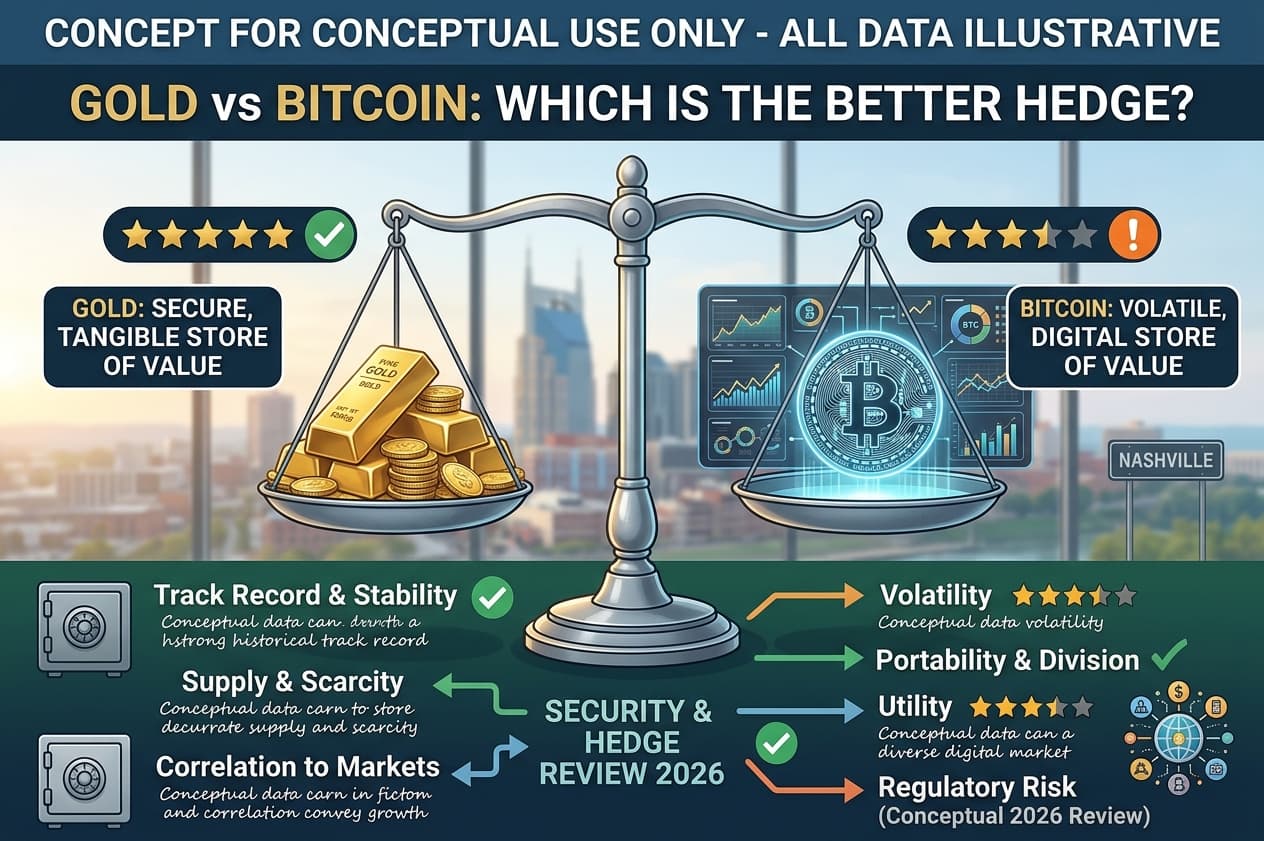
The Short Answer
Gold is the more proven inflation hedge with 5,000 years of track record, while crypto offers higher growth potential with significantly more volatility — most dads benefit from holding both in small allocations.
Gold vs. Crypto: Which Is the Better Hedge?
Category: Gold & Precious Metals / Crypto & Digital Assets Tags: Recession-Proofing · Investment Mindset · Guides & How-To's Target Keywords: gold vs crypto, inflation hedge, gold or bitcoin, gold vs bitcoin comparison
Summary
Gold and Bitcoin both claim the title of "ultimate hedge" — but the 2025 data delivered one of the clearest verdicts in the history of this debate. Gold closed 2025 with a full-year return of +67%, reaching $4,368 per ounce on December 31 and setting 53 new all-time highs along the way, per the World Gold Council's December 2025 Gold Market Commentary. Bitcoin, by contrast, peaked at an all-time high of $126,000 in October 2025 before a sharp correction sent it closing the year at roughly $87,500 — down approximately 7% from where it opened the year near $94,444, per StatMuse price data. For the 2025 calendar year, gold was the decisive winner.
That single year doesn't tell the whole story, though. Zoom out to five years, and Bitcoin has produced dramatically superior total returns — averaging approximately 155% per year from 2020 through 2024 compared to gold's roughly 30% per year over the same window, per casebitcoin.com macro charts. Both assets deserve space in a diversified family portfolio, but they do fundamentally different jobs. This article compares gold and Bitcoin across six dimensions — supply scarcity, volatility, liquidity, historical returns, inflation protection, and crisis behavior — with real numbers and sourced data, so the American dad investor can make a clear-eyed allocation decision.
What Makes a Good Inflation Hedge?
Before putting gold and Bitcoin head to head, it helps to agree on what a quality hedge actually does. A useful inflation hedge should:
- Hold purchasing power when the dollar loses value — if everything costs 8% more, your hedge should gain at least that much to preserve your real wealth
- Maintain low or negative correlation with stocks — if it falls when the S&P 500 falls, it isn't hedging much
- Be a recognized, globally accepted store of value — perceived scarcity and legitimacy matter as much as pure fundamentals
- Be liquid in a crisis — if you can't convert it to cash quickly when markets are falling, it fails you at the worst moment
- Exist outside the counterparty risk of the financial system — the best hedges don't depend on any bank, company, or government remaining solvent
Gold has passed all five of these tests repeatedly across centuries. Bitcoin has passed most of them in its 16-year history — but with important exceptions, particularly during acute market stress events. The honest story is more nuanced than either gold bulls or Bitcoin maximalists will admit.
The Case for Gold
Gold has been used as money, a store of value, and a hedge against uncertainty for over 5,000 years. That track record isn't marketing language — it's the closest thing to empirical proof that any financial asset can offer.
2025: Gold's Historic Year
Gold's 2025 performance was extraordinary by any measure. Per the World Gold Council's December 2025 Gold Market Commentary and Full Year 2025 Demand Trends report:
- Gold closed 2025 at $4,368/oz, up from approximately $2,625 at the start of the year
- Full-year return: +67% — the fourth-strongest annual return since 1971
- 53 new all-time highs set during the calendar year
- Average annual price reached a record $3,431/oz (+44% year over year)
- Average Q4 2025 price: $4,135/oz (+55% year over year)
- Total gold demand exceeded 5,000 tonnes for the first time ever
- Global gold passive income strategies holdings grew 801 tonnes — the second-strongest year on record
- Physically-backed gold ETFs recorded the strongest year of inflows in history: $89 billion globally
- U.S. gold demand rose 140% year over year to 679 tonnes; U.S. ETF AUM reached a record $280 billion
For context, gold's 2025 gain of 67% outpaced the S&P 500, the Bloomberg Aggregate Bond Index, and Bitcoin itself for the full calendar year.
Longer-Term Gold Performance
Gold's 2025 performance reflects a sustained multi-year structural shift. Key longer-run data:
- 20-year total return (2004–2024): +543%, a CAGR of approximately 9.8%, per Diversify Guy's performance analysis
- 25-year cumulative return: Exceeding 1,300%, per VanEck's 2025 gold analysis
- Best single year: +31.4% (2007), per Visual Capitalist's annual returns chart
- Worst single year: -28.3% (2013)
- Crisis performance highlights: +25.1% (2020), -0.4% (2022 — while the S&P 500 fell 18%), +5.6% (2008)
Why Gold Has Strengthened Since 2022
Several structural factors explain gold's sustained outperformance, per multiple institutional sources:
-
Central bank buying at historic levels. Since the Russia-Ukraine war began in 2022, central banks have purchased over 1,000 tonnes of gold annually — roughly one-quarter to one-third of total global mine production. In 2025, central bank purchases totaled 863 tonnes, per the World Gold Council. State Street Global Advisors (SSGA) notes this marked the 16th consecutive year of official sector net purchases.
-
Gold surpassed U.S. Treasuries in central bank reserves for the first time since 1996, per Morgan Stanley Research. Countries including China, Poland, Turkey, and India have been systematically diversifying away from U.S. Treasuries into gold as a de-dollarization strategy.
-
Geopolitical risk, dollar weakness, and fiscal concern. Heightened geopolitical tensions, U.S. trade policy uncertainty, a weakening dollar, and rising fiscal deficits have all created favorable conditions for gold as a "debasement hedge," per WisdomTree's September 2025 gold analysis and Charles Schwab's inflation hedge commentary. Per the WGC's Gold Outlook 2026: combined geopolitical risk and U.S. dollar weakness accounted for roughly 16 percentage points of gold's 2025 return.
-
Record ETF inflows. In 2025, North American gold ETF funds alone attracted $51 billion and 437 tonnes of demand, per the World Gold Council's full-year investment data. U.S. gold ETF holdings reached a record 2,019 tonnes.
Gold's Limitations
Gold is not a perfect hedge:
- It pays no income. Holding gold means forgoing yield from bonds, dividend portfolio, or even a high-yield savings account. In elevated real rate environments, this is a meaningful opportunity cost.
- It's a mixed inflation hedge in the short run. Peer-reviewed research in the International Review of Economics & Finance (2024) found that gold shows "relatively sharp and sustained responses to inflation in high-inflation regimes, while these responses are subdued in low-inflation periods." It is an excellent hedge against currency crises and high inflation; it does not reliably track mild, month-to-month inflation.
- It has underperformed stocks over the full 50-year period. Charles Schwab's data shows that from 1975 to 2026, the S&P 500 outperformed both gold and inflation over the full half-century. Gold wins in specific crisis windows, not across all market conditions.
- Storage and insurance costs apply to physical gold, and ETFs carry management fees that compound over time.
The Case for Bitcoin (as Digital Gold)
Bitcoin was born from the 2008 financial crisis. Satoshi Nakamoto embedded in the Genesis Block a reference to the banking bailout: a January 3, 2009 Times headline about a second bank rescue. The philosophical premise has always been: what if you could own a scarce asset no government or central bank could debase?
Long-Term Bitcoin Returns: The Numbers Are Extraordinary
Over any sufficiently long holding period, Bitcoin's returns dwarf every other mainstream asset class:
- 2014–2024 dominance: Bitcoin was the top-performing asset class in 8 of 11 years, averaging a 54% annualized return, per BlackRock's iShares Bitcoin volatility analysis
- 5-year average (2020–2024): Bitcoin averaged approximately 155% per year vs. ~30% for gold over the same period, per casebitcoin.com macro charts
- 2024 calendar year: Bitcoin rose approximately +120%, opening near $38,500 and closing near $94,444, driven by spot ETF approval in January 2024 and the April 2024 halving
- Institutional adoption: BlackRock's IBIT became the fastest-growing ETF in history, reaching approximately $70 billion in AUM by late 2025, commanding ~59% of all spot Bitcoin ETF assets, per The Block's 2026 institutional crypto outlook
- Harvard, state pension funds, and 55% of hedge funds (per AIMA/PwC 2025 survey) held Bitcoin or Bitcoin ETFs by end of 2025
Why the "Digital Gold" Narrative Has Real Merit
Bitcoin has genuine structural properties that make the gold comparison intellectually serious:
-
Fixed, verifiable scarcity. There will only ever be 21 million Bitcoin — a hard limit in the protocol. Gold's annual supply grows at roughly 1.75% per year through new mine production. Bitcoin's post-April-2024-halving inflation rate fell to approximately 0.9% annually — already lower than gold's — and continues declining toward zero, per Morningstar's November 2025 gold vs. Bitcoin analysis.
-
Borderless portability. A billion dollars in Bitcoin can be transmitted globally in minutes, 24/7. The equivalent in physical gold requires armored logistics, insurance, customs documentation, and days of processing.
-
Regulated institutional access. The SEC's January 2024 approval of spot Bitcoin ETFs integrated Bitcoin into the mainstream financial system. Investors can now access Bitcoin through standard open a brokerage accounts and IRAs, in the same way they hold stocks or gold ETFs.
-
Increasing scarcity over time. Each halving event (every four years) cuts new Bitcoin supply in half. The supply growth rate is declining while demand continues to grow — a dynamic that becomes more extreme over time and does not exist for any fiat currency.
Bitcoin's Real Weaknesses
Any honest comparison must include Bitcoin's structural weaknesses:
- Extreme volatility. BlackRock's iShares data shows Bitcoin's annualized volatility at approximately 54%, versus 15.1% for gold. That is 3.5x more volatile — not a minor difference.
- Bear market severity. Bitcoin has experienced multiple drawdowns of 65–80%+ from peak. The 2022 decline alone took it from ~$47,000 to a low of $15,479, a loss of roughly 67% for the calendar year, per StealthEX price history.
- Increasing correlation with risk assets. Multiple peer-reviewed studies confirm Bitcoin's correlation with equity markets has risen significantly since March 2020. Per Smales (2024) in Accounting & Finance: Bitcoin's inflation-hedging properties are "context-specific" and have weakened as its stock market correlation has increased.
- Regulatory risk. Crypto assets face regulatory uncertainty that gold, as a physical commodity held for millennia, does not.
- Tax complexity. Every Bitcoin sale — including crypto-to-crypto trades — is a taxable event in the U.S., requiring year-round cost-basis tracking.
Head-to-Head Comparison
| Dimension | Gold | Bitcoin |
|---|---|---|
| Supply Scarcity | ~1.75% annual supply growth; ~215,000t above ground | Fixed 21M BTC cap; ~0.9% annual post-2024 halving; declining to zero |
| Volatility (annualized) | ~15% | ~54% |
| Maximum Drawdown (15 years) | ~29% (2013) | ~80%+ multiple times (2018, 2022) |
| 2025 Calendar Year Return | +67% (closed $4,368) | -7.3% (opened ~$94,444, closed ~$87,509) |
| 2024 Calendar Year Return | +27.2% | +120% |
| 2022 Calendar Year Return | -0.4% | -65% |
| 2020 Calendar Year Return | +25.1% | +305% |
| 5-Year Avg. Annual Return (2020–2024) | ~30% | ~155% |
| 20-Year CAGR (2004–2024) | ~9.8% | N/A (asset is 16 years old) |
| Inflation Hedge Track Record | Strong in high-inflation regimes; mixed otherwise | Weak to negative in 2022 (highest inflation in 40 years); "context-specific" per Smales 2024 |
| Safe Haven in Acute Crises | Yes — consistent academic consensus | Weak — correlates with stocks during acute stress |
| Portability | Poor (physical); good (ETF) | Excellent (digital, borderless, 24/7) |
| Government Independence | No issuer; limited government control | Fully decentralized |
| Correlation to Stocks | Weak negative (moves opposite to stocks on average) | Moderate to strong positive (especially post-2020) |
| Tax Treatment (US) | Property; long-term capital gains; favorable IRA treatment | Property; every sale/exchange taxable; 1099-DA reporting |
| Income | None | None (unless staking or DeFi yield) |
| Track Record Length | 5,000+ years | 16 years |
| Storage | Safe, vault, or ETF | Hardware wallet or custodian/ETF |
Sources: BlackRock iShares, Morningstar, World Gold Council, NYDIG, StatMuse, Slickcharts, Diversify Guy, Visual Capitalist
Performance During Key Economic Events
The most informative way to evaluate a hedge is to examine how it behaves when markets are under stress — precisely when you need it most.
2008 Global Financial Crisis
Gold: +5.6% for the 2008 calendar year, per World of Statistics / BullionVault annual return data. Then surged from its late-2008 lows near $872/oz to a peak of $1,573/oz in 2011 — an 80%+ gain during and after the crisis.
Bitcoin: Did not exist. The Bitcoin whitepaper was published October 31, 2008. The network launched January 9, 2009. The 2008 banking crisis was the reason it was created.
Verdict: Gold wins by default — and wins clearly. The S&P 500 fell roughly 38% in 2008; gold gained 5.6%. That divergence is what a crisis hedge looks like in practice.
2020 COVID Crash and Recovery
Gold: +25.1% for the full calendar year 2020, per World of Statistics annual return data — despite a brief March selloff alongside all other assets.
Bitcoin: approximately +305% for the full calendar year 2020, starting near $7,000 and closing near $29,000, per Bitcoin Magazine's price history — after crashing roughly 50% in the March 2020 acute panic alongside equities.
Verdict: Gold was more stable; Bitcoin produced extraordinary returns for the full year. The critical distinction: Bitcoin was not a safe haven during the acute March crash. It fell harder than gold during the initial liquidity panic. In the stimulus-fueled recovery that followed, it vastly outperformed. This pattern — correlated with stocks during acute crashes, then dramatically outperforming in recoveries — is one of the most important Bitcoin behavioral patterns for any investor to understand.
2022 Federal Reserve Rate Hike Cycle
Gold: -0.4% for the full calendar year 2022, per World of Statistics / BullionVault annual asset comparison data. The Fed raised rates by 4.25% that year. The S&P 500 fell 18%. The Bloomberg Aggregate Bond Index fell 17.7%. Gold held essentially flat.
Bitcoin: approximately -65% for the 2022 calendar year. It fell from roughly $47,000 at year-start to a low of $15,479 in November 2022, per StealthEX price history — its worst calendar year since 2018.
Verdict: Gold wins decisively. The 2022 data is the single most important piece of evidence in the gold vs. Bitcoin inflation-hedge debate. When inflation was highest — when the "digital inflation hedge" argument should have been most compelling — gold held flat and Bitcoin collapsed. Research by Kumar, Mohan, and Niveditha (2025), published in Business Perspectives and Research using rolling-window DCC-GARCH analysis, confirmed: gold is a better safe haven than Bitcoin during acute market stress. Bitcoin "can be used as a diversifier and hedge but shows weak safe haven properties during actual market stress."
2024–2025: The Divergence That Defined the Narrative
2024: Bitcoin wins clearly. Bitcoin rose approximately +120%, driven by the January 2024 spot ETF approvals and the April 2024 halving. Gold rose +27.2%. Bitcoin's outperformance was substantial.
2025: Gold wins comprehensively. This is the data that much of the financial media narrative on Bitcoin missed. The full-year picture:
- Gold 2025: +67% (closed at $4,368/oz, 53 new all-time highs), per World Gold Council year-end data
- Bitcoin 2025: -7.3% (opened ~$94,444, closed ~$87,509), per StatMuse price data
Bitcoin's 2025 story was one of extremes and disappointment. It surged to an all-time high of $126,000 in October, then declined steadily through Q4. Per Bitcoin Magazine's December 31, 2025 year-end analysis: "Inflation proved more persistent than many investors anticipated, prompting central banks to maintain a restrictive stance longer than expected. That environment favored cash and yield-bearing assets over speculative exposure."
Gold, by contrast, benefited from every relevant macro tailwind simultaneously: geopolitical risk, dollar weakness, central bank demand, de-dollarization, and flight to safety. The World Gold Council noted that geopolitical risk and options market activity were the leading drivers of gold's 2025 return, per their Gold Return Attribution Model.
Verdict: For 2025, gold outperformed Bitcoin by approximately 74 percentage points. In a year defined by macro uncertainty, persistent inflation, elevated real yields, and geopolitical volatility — the exact conditions under which Bitcoin's supporters argue it should outperform — gold delivered its fourth-best annual return since 1971. Bitcoin ended the year below where it started.
The Key Takeaway: Gold Is Safer, Bitcoin Has More Long-Run Upside
The honest synthesis of the available data:
- Gold is a better safe haven. Multiple peer-reviewed academic studies — including Campbell Harvey's 2025 Duke University analysis, Kumar, Mohan & Niveditha (2025), and Smales (2024) — consistently find gold outperforms Bitcoin during market stress. 2022 and 2025 provide the two most recent empirical confirmations.
- Bitcoin has produced far superior long-run total returns over any 4-year or longer window in its history. From 2014 to 2024, it was the top-performing asset class 8 of 11 years. No mainstream asset comes close.
- The two assets are not substitutes. Statista and DIW Berlin's correlation analysis of 2015–2025 monthly returns confirms that gold and Bitcoin have very little statistical correlation with each other — meaning owning both provides genuine portfolio diversification benefits.
- In 2025, gold behaved like gold, and Bitcoin did not behave like digital gold. This is the single most important recent data point for anyone framing either asset primarily as an inflation or crisis hedge.
The DadAlt Portfolio Approach: Own Both, Size Them Differently
The most intellectually honest answer to "gold or Bitcoin?" is: you don't have to choose. These are genuinely complementary assets with different risk profiles, different use cases, and almost no statistical correlation with each other. Here is the allocation framework consistent with the DadAlt investment philosophy.
Gold: 5–10% of Investable Portfolio
- Role: Portfolio insurance. Capital preservation. Recession and inflation hedge. Safe haven when everything else is falling.
- Why this range: VanEck and most institutional analyses suggest a 5–10% allocation enhances diversification without over-concentrating in a non-yielding asset. At a 5% allocation, gold's 67% return in 2025 would have added approximately 3.35 percentage points to an otherwise all-equity portfolio.
- How to hold it:
- Physical bullion: American Gold Eagles or Canadian Maple Leafs from reputable U.S. dealers like SD Bullion or APMEX. Expect premiums of 3–8% over spot plus storage and insurance costs.
- Gold ETFs: GLD (SPDR Gold Shares, 0.40% expense ratio) or IAU (iShares Gold Trust, 0.25% expense ratio) provide instant liquidity with no storage complexity. IAU is the lower-cost buy-and-hold option.
- Gold IRA: For retirement-focused investors, a self-directed IRA holding IRS-approved physical gold (99.5%+ purity) provides tax-deferred growth. (See our full guide: Top Gold IRA Companies Reviewed.)
Bitcoin: 1–5% of Investable Portfolio
- Role: Asymmetric upside bet. Long-run digital scarcity play. High-risk, high-reward satellite allocation that can move the needle on portfolio returns over a decade without catastrophic consequences if it doesn't pan out.
- Why this range: Bitcoin's ~54% annualized volatility means a 65–80% drawdown is historically precedented. A 1–5% allocation provides meaningful upside if the digital scarcity thesis plays out over the next decade, without being ruinous if it doesn't.
- How to hold it:
- Spot Bitcoin ETF (simplest): BlackRock's IBIT (0.25% expense ratio) or Fidelity, Vanguard, and Schwab's FBTC are the two largest. Available in any brokerage account, including IRAs, enabling tax-advantaged Bitcoin exposure.
- Direct purchase: Coinbase or Kraken are the most established U.S.-regulated exchanges. For holdings above $1,000, a hardware wallet (Ledger or Trezor) provides self-custody and removes exchange counterparty risk.
- Dollar-cost averaging: Given Bitcoin's volatility, buying a fixed dollar amount weekly or monthly eliminates the risk of mistiming a lump-sum purchase at a cycle top.
Rebalancing Discipline
If gold or Bitcoin has a very strong year (as gold did in 2025), rebalance back to your target allocation. This forces you to sell high and buy low — precisely the discipline most individual investors fail to execute. After 2025's 67% gold run, a disciplined rebalancer would have trimmed gold and potentially added to Bitcoin at lower prices, setting up for 2026's cycle.
How to Buy: Practical Starting Points
Buying Gold
- Physical bullion: SD Bullion and APMEX are two of the most reputable U.S. dealers. American Gold Eagles are the most widely recognized form for easy resale. Expect premiums of 3–8% over spot price, plus annual storage costs for meaningful amounts.
- Gold ETFs: GLD and IAU trade on any major brokerage platform (Fidelity, Schwab, Vanguard). IAU at 0.25% expense ratio is the lowest-cost option for buy-and-hold investors.
- Gold IRA: For retirement-focused investors, a gold IRA holds physical IRS-approved gold inside a tax-advantaged account. (See: Top Gold IRA Companies Reviewed for our full guide.)
Buying Bitcoin
- Spot Bitcoin ETF (simplest): Open any standard brokerage account and buy IBIT (BlackRock) or FBTC (Fidelity) like a stock. Available in both taxable accounts and IRAs.
- Coinbase or Kraken: The two largest U.S.-regulated crypto exchanges. Link a bank account, purchase Bitcoin directly, and set up a recurring buy to automate dollar-cost averaging.
- Hardware wallet: For any Bitcoin intended as a long-term holding above $1,000, a Ledger Nano X or Trezor Model T (~$79–$219) eliminates exchange counterparty risk through self-custody.
Frequently Asked Questions
Is Bitcoin a better inflation hedge than gold? The data says no — at least not consistently. Gold's inflation-hedging properties are strongest during high-inflation or currency-crisis environments, per multiple peer-reviewed studies. Bitcoin's hedging properties are "context-specific" per Smales (2024) and have weakened as its correlation with equities has increased since 2020. In 2022 — the most significant inflationary episode in four decades — gold held flat while Bitcoin fell 65%. In 2025, another year of macro stress and persistent inflation, gold returned +67% while Bitcoin fell -7%. For a pure inflation hedge, gold has the stronger empirical track record.
What happened to Bitcoin in 2025? Bitcoin reached a new all-time high of approximately $126,000 in October 2025, then declined steadily through Q4. It closed the year at approximately $87,509 — roughly 7% below its January 1, 2025 opening price of ~$94,444. Per Bitcoin Magazine's December 31, 2025 year-end analysis, persistent inflation and a restrictive Federal Reserve posture created an environment that "favored cash and yield-bearing assets over speculative exposure." Gold, by contrast, gained +67% for the full year — outperforming Bitcoin by approximately 74 percentage points.
Should I hold gold or Bitcoin in my IRA? Both options are available. A gold IRA holds physical IRS-approved gold in an approved depository. You can hold spot Bitcoin ETFs (IBIT, FBTC) in a standard IRA or Roth IRA providers at any major brokerage. For most investors, holding gold in a physical gold IRA and Bitcoin through a spot ETF in a regular IRA or Roth IRA represents the most practical and tax-efficient combination.
How much of my portfolio should be in gold vs. Bitcoin? The DadAlt framework: 5–10% gold (stability and crisis hedge), 1–5% Bitcoin (asymmetric upside). These allocations are not mutually exclusive — owning both is the recommended approach. Size depends on your risk tolerance, time horizon, and whether you're closer to accumulation or distribution in your investing lifecycle.
Is gold or crypto taxed differently in the U.S.? Both are taxed as property by the IRS, subject to short-term or long-term capital gains rates depending on the holding period. Gold and Bitcoin held in IRAs both defer taxes. Outside of retirement accounts, every sale of either asset triggers a taxable event. Bitcoin is significantly more complex to track: every exchange — including crypto-to-crypto trades — is a taxable event, and exchanges generate 1099-DA forms that must reconcile with your cost-basis records.
Conclusion
Gold and Bitcoin are not competitors — they are complementary tools solving different investment problems. Gold offers proven crisis protection, central bank credibility, and five millennia of history as a store of value. Bitcoin offers fixed digital scarcity, borderless portability, and the most extraordinary long-run return profile of any mainstream asset class in financial history.
The 2025 data made this distinction unusually clear. When macro conditions — persistent inflation, elevated real yields, geopolitical uncertainty — should have favored both assets, gold delivered a historic +67% while Bitcoin closed down -7%. The "digital gold" narrative is compelling over long time horizons. It did not hold up in 2025.
For the dad investor building generational wealth: gold offers safety, Bitcoin offers asymmetry. You need both. Start with gold if capital preservation is your primary concern. Add Bitcoin in a 1–5% position for the asymmetric long-run upside. Rebalance annually. Think in decades, not quarters.
Related Articles on DadAlt Investments
- How to Buy Physical Gold Online Safely — A practical step-by-step guide to buying gold coins and bars from reputable U.S. dealers, what premiums to expect, and how to avoid getting ripped off
- Top Gold IRA Companies Reviewed — Our research-backed ranking of the top gold IRA providers in the U.S., with fees, minimums, and affiliate disclosures clearly stated
- Top 5 Crypto ETFs — The full breakdown of IBIT, FBTC, and the top spot Bitcoin ETF options for U.S. investors
- buy Bitcoin — Coinbase, Kraken, hardware wallets, and what beginner Bitcoin investors need to know before clicking "buy"
- 7 Recession-Proof Assets Every Dad Should Consider — Gold and Bitcoin are two of seven asset classes in this portfolio-wide defensive playbook
- Should I Buy Crypto? The Case for Crypto in a Family Portfolio — The foundational crypto article for the DadAlt audience: honest about risks, data-driven, and written for investors who've never owned digital assets
- How to Protect Your Portfolio from Inflation — The complete inflation-hedging playbook: TIPS, gold, real estate, and crypto in a unified strategy
Sources and References
-
World Gold Council — "Gold Market Commentary: December 2025" (January 8, 2026) — Gold tagged its 53rd all-time high on December 23 at $4,449/oz; closed 2025 at $4,368/oz; full-year return of 67% — fourth strongest annual return since 1971; average Q4 price $4,135/oz (+55% y/y); geopolitical risk and options activity cited as leading return drivers via Gold Return Attribution Model. gold.org/goldhub/research/gold-market-commentary-december-2025
-
World Gold Council — "Gold Demand Trends: Q4 and Full Year 2025" (January 2026) — Total gold demand exceeded 5,000 tonnes for first time; 53 new all-time highs; demand value of $555bn (+45% y/y); global gold ETF holdings grew 801 tonnes (second strongest year on record); physically-backed ETFs recorded strongest year of inflows in history at $89bn globally; central bank purchases 863 tonnes; bar and coin buying at 12-year high. gold.org/goldhub/research/gold-demand-trends/gold-demand-trends-full-year-2025
-
World Gold Council — "Gold Demand Trends: US Focus Q4 and Full Year 2025" (January 2026) — U.S. gold demand rose 140% y/y to 679 tonnes; highest since 2020; U.S. gold ETFs attracted 437 tonnes and $50bn inflows; AUM reached record 2,019 tonnes ($280bn). gold.org/goldhub/research/gold-demand-trends/us-gold-demand-trends-full-year-2025
-
World Gold Council — "Gold Outlook 2026: Push Ahead or Pull Back" (December 4, 2025) — Gold returned over 60% by end of November 2025 (full-year close +67%); fourth strongest annual return since 1971; combined geopolitical risk and dollar weakness accounted for roughly 16 percentage points of return; central banks continued above-average buying; investment demand surged globally. gold.org/goldhub/research/gold-outlook-2026
-
Visual Capitalist — "Charted: Gold's Annual Returns (2000–2025)" — Year-by-year gold annual returns: 2007 (+31%), 2008 (+5.6%), 2010 (+29.6%), 2013 (-28%), 2020 (+25%), 2024 (+27%); gold prices surged more than 230% from 2020–2025; China, Poland, and Turkey largest central bank buyers 2020–2025. visualcapitalist.com/charted-golds-annual-returns-2000-2025
-
StatMuse Money — Bitcoin Price Data (2025) — Bitcoin closing price January 1, 2025: $94,443.52; closing price December 31, 2025: $87,508.83; calendar year 2025 return: approximately -7.3%. statmuse.com/money/ask/bitcoin-price-january-1.-2025 | statmuse.com/money/ask/bitcoin-value-graph-december-2025
-
Bitcoin Magazine — "Bitcoin Limps Into New Year at $87,000, Down 30% From ATH" (December 31, 2025) — Bitcoin closed 2025 near $87,000 after reaching all-time high of approximately $126,000 in October 2025; inflation proved more persistent than anticipated; Federal Reserve maintained restrictive stance longer than expected; environment favored cash and yield-bearing assets over speculative exposure; Bitcoin maintained dominant position as global benchmark digital asset. bitcoinmagazine.com/featured/bitcoin-limps-into-new-year-at-87000
-
Yahoo Finance / Benzinga — "Bitcoin 2025 Recap: BTC Up 80% YTD Despite 30% Pullback from $126K Peak" — Bitcoin reached $126,000 all-time high in early October 2025; institutional ETF investors absorbed corrections without panic selling; Bitcoin outperformed stocks for the year measured from cycle low baseline; Bitcoin rose "roughly 80%" from prior year close baseline despite Q4 correction. finance.yahoo.com/news/bitcoin-2025-recap-btc-80-162909822.html
-
VanEck — "Gold in 2025: A New Era of Structural Strength and Enduring Appeal" — Over 25 years, gold delivered cumulative returns exceeding 1,300%; since 2008, gold has outperformed U.S. stocks and Treasuries during major market crises; "modest allocation" of 5–10% recommended for diversification. vaneck.com/us/en/blogs/gold-investing/gold-in-2025-a-new-era-of-structural-strength-and-enduring-appeal
-
Morgan Stanley Research — "Gold Price Forecast: Rally Expected to Accelerate into 2026" (2025) — Gold broke $4,000/oz in October 2025; gold surpassed U.S. Treasuries in central bank reserves for first time since 1996; structural shift in reserve composition driven by geopolitical risk and de-dollarization. morganstanley.com/insights/articles/gold-price-forecast-rally-into-2026
-
WisdomTree ETF Blog — "Gold's Historic 2025 Surge" (September 2025) — Gold surged over 30% in first half of 2025; central bank demand (not retail ETF flows) was the primary driver; gold surged from ~$1,500/oz in late 2019 to more than $3,500 in 2025. wisdomtree.com/investments/blog/2025/09/17/golds-historic-2025-surge
-
State Street Global Advisors (SSGA) — "Gold 2025 Midyear Outlook" (2025) — Central bank annual net purchases surpassing 1,000 tonnes each year since 2022 (25–30% of primary mine supply); 16th consecutive year of official sector net gold purchases; gold's price floor reset structurally higher. ssga.com/us/en/institutional/insights/gold-2025-midyear-outlook
-
NYDIG Research — "Comparing Bitcoin and Gold" (2025) — Central banks purchased more than 1,000 tonnes of gold annually since 2022; gold held steady in 2022 while stocks fell 18%; gold annual supply growth approximately 1.6% vs. Bitcoin's declining post-halving inflation rate (~0.9%). nydig.com/research/comparing-bitcoin-and-gold
-
Charles Schwab — "Gold vs. Stocks as Inflation Hedge" (2025/2026) — S&P 500 beat both gold and inflation over 50 years from 1975 to 2026; gold more than doubled in two years through end of 2025; gold performs best during cost-push inflation and currency crises, not all inflationary periods. schwab.com/learn/story/gold-vs-stocks-as-inflation-hedge
-
BlackRock iShares — "Bitcoin Volatility Trends" (2025) — Bitcoin annualized volatility approximately 54% vs. 15.1% for gold and 10.5% for global equities; from 2014–2024, Bitcoin was best-performing asset class 8 of 11 years, averaging 54% annualized return over that period. ishares.com/us/insights/bitcoin-volatility-trends
-
The Case for Bitcoin (casebitcoin.com) — Bitcoin Macro Charts — Bitcoin averaged approximately 155% per year for 5 years through 2024 vs. approximately 7–30% for gold over the same period depending on measurement window. casebitcoin.com/charts
-
The Block — "2026 Institutional Crypto Outlook" (December 2025) — BlackRock IBIT reached approximately $70 billion AUM (59% of all spot Bitcoin ETF assets) by late 2025; Bitcoin and Ethereum spot ETFs generated $31 billion net inflows in 2025; 55% of hedge funds invested in crypto per AIMA/PwC 2025 survey. theblock.co/post/382743/2026-institutional-crypto-outlook
-
Fortune — "BlackRock's Most Profitable ETF Is a Nearly $100 Billion Bitcoin Giant" (October 2025) — IBIT on track for $100 billion AUM approximately five times faster than any ETF in history; over $62.5 billion in total net inflows since January 2024 launch; Bitcoin crossed $125,000 all-time high. fortune.com/crypto/2025/10/07/blackrock-etf-ibit-bitcoin-most-profitable-crypto
-
Morningstar — "Gold vs. Bitcoin: Why the Safe-Haven Debate Is Shifting in 2025" (November 2025) — Campbell Harvey (Duke University) September 2025 analysis: gold is stronger safe haven than Bitcoin during market stress; gold's crisis hedge role reasserted in 2025; Bitcoin's increasing correlation with risk-on assets challenges its safe-haven narrative; gold annual supply growth 1.75% vs. Bitcoin's ~0.9% post-halving. morningstar.com/alternative-investments/gold-vs-bitcoin-why-safe-haven-debate-is-shifting-2025
-
Statista / DIW Berlin — "Why Bitcoin Is NOT the New Gold" (2025) — Correlation analysis of monthly returns: Bitcoin, gold, S&P 500, U.S. government bonds (2015–2025); gold maintains weak negative correlation with S&P 500; Bitcoin shows strong positive correlation with stocks post-2020; analysis by Alexander Kriwoluzky and Christoph Schneider (DIW Berlin). statista.com/chart/34914/correlation-in-returns-of-bitcoin-gold-stocks-and-government-bonds
-
Smales, L.A. — "Cryptocurrency as an Alternative Inflation Hedge?" in Accounting & Finance (Wiley, 2024) — Bitcoin's inflation-hedging properties are "context-specific"; gold's inflation hedge properties more robust; structural break at March 2020 with Bitcoin's correlation to stocks increasing materially post-COVID; Bitcoin's safe-haven properties have weakened relative to gold. doi.org/10.1111/acfi.13193
-
Kumar, Mohan, and Niveditha — "Assessing Bitcoin and Gold as Safe Havens Amid Global Uncertainties" in Business Perspectives and Research (Sage, 2025) — Rolling-window DCC-GARCH analysis across COVID-19 and Ukraine War periods; gold is a better safe haven than Bitcoin during acute market stress; Bitcoin "can be used as a diversifier and hedge but shows weak safe haven properties during actual market stress." doi.org/10.1177/09711023251322578
-
ScienceDirect / International Review of Economics & Finance — "Dynamic Hedging Responses of Gold and Silver to Inflation" (2024) — Gold shows "relatively sharp and sustained responses to inflation in high-inflation regimes, while these responses are subdued in low-inflation periods"; gold remains an effective hedge in high-inflation environments; hedging effectiveness is regime-dependent. doi.org/10.1016/j.iref.2024.07.033
-
BullionVault — "US Asset Class Performance and Gold Comparison" — Gold slipped ~0.4% in 2022 while S&P Total Returns lost 18.1%; Bloomberg U.S. Aggregate Bond Index lost 17.7% in 2022; until 2022, gold rose every year U.S. stocks dropped by 10% or more. bullionvault.com/gold-guide/annual-asset-performance-comparison
-
Diversify Guy — "Gold Returns in Last 20 Years: Complete Performance Analysis" (2025) — 20-year total return: +543%; CAGR: ~9.8%; best year: +31.4% (2007); worst year: -28.3% (2013); $10,000 in gold in 2004 worth approximately $64,300 by end of 2024. diversifyguy.com/gold-returns-20-years
-
StealthEX / BitBo — Bitcoin Price History 2009–2025 — 2022: Bitcoin fell from ~$47,000 at year-start to low of $15,479 in November (-65% calendar year); 2024: opened ~$38,500, closed ~$94,444 (+120%). stealthex.io/blog/bitcoin-price-history | charts.bitbo.io/price
-
ARK Invest — "Bitcoin Cycles, Entering 2025" — Bitcoin's 2022 bear market maximum decline was 76.9%, less severe than prior cycles (-86.3% in 2018, -85.1% in 2015, -93.5% in 2011); halving cycle analysis; declining cycle drawdown severity as market cap grows. ark-invest.com/articles/analyst-research/bitcoin-cycles-entering-2025
Disclaimer: This article is for educational and informational purposes only and does not constitute financial, investment, legal, or tax advice. Gold, Bitcoin, and all other investment assets carry risk, including the potential for partial or total loss of principal. Past performance does not guarantee future results. Spot Bitcoin ETF and gold ETF shares are subject to market risk. Physical gold may involve premiums above spot price, storage costs, and insurance costs. Bitcoin is highly volatile and not appropriate for all investors. U.S. tax treatment of both assets is complex — consult a qualified CPA or tax attorney for guidance specific to your situation. DadAlt Investments may receive affiliate compensation from gold dealers, gold IRA companies, and crypto platforms referenced in this article. See our full Affiliate Disclosure for details.
Recommended Reading
Frequently Asked Questions
Is gold or Bitcoin a better hedge against inflation?
Gold has historically held its value during inflationary periods and recessions. Bitcoin has outperformed in growth but with extreme volatility. A balanced approach with both assets provides the best risk-adjusted hedge.
Should I buy gold or crypto first?
If you're building a conservative family portfolio, start with gold for stability. If you have a higher risk tolerance and long time horizon, a small Bitcoin allocation can complement gold as a growth-oriented hedge.
How much of my portfolio should be in gold vs crypto?
A common allocation is 5–10% gold and 3–5% crypto. Gold provides stability and crisis protection, while crypto adds asymmetric upside. Adjust based on your risk tolerance and how close you are to retirement.

About the Author
Jared DeValk
Founder, DadAlt Investments
Father, alternative investment researcher, and founder of DadAlt Investments. 14+ years turning hard lessons into honest guidance for dads building real wealth.