
Crypto Wallet vs Exchange: What's the Difference?
Understand the critical difference between exchanges and wallets.
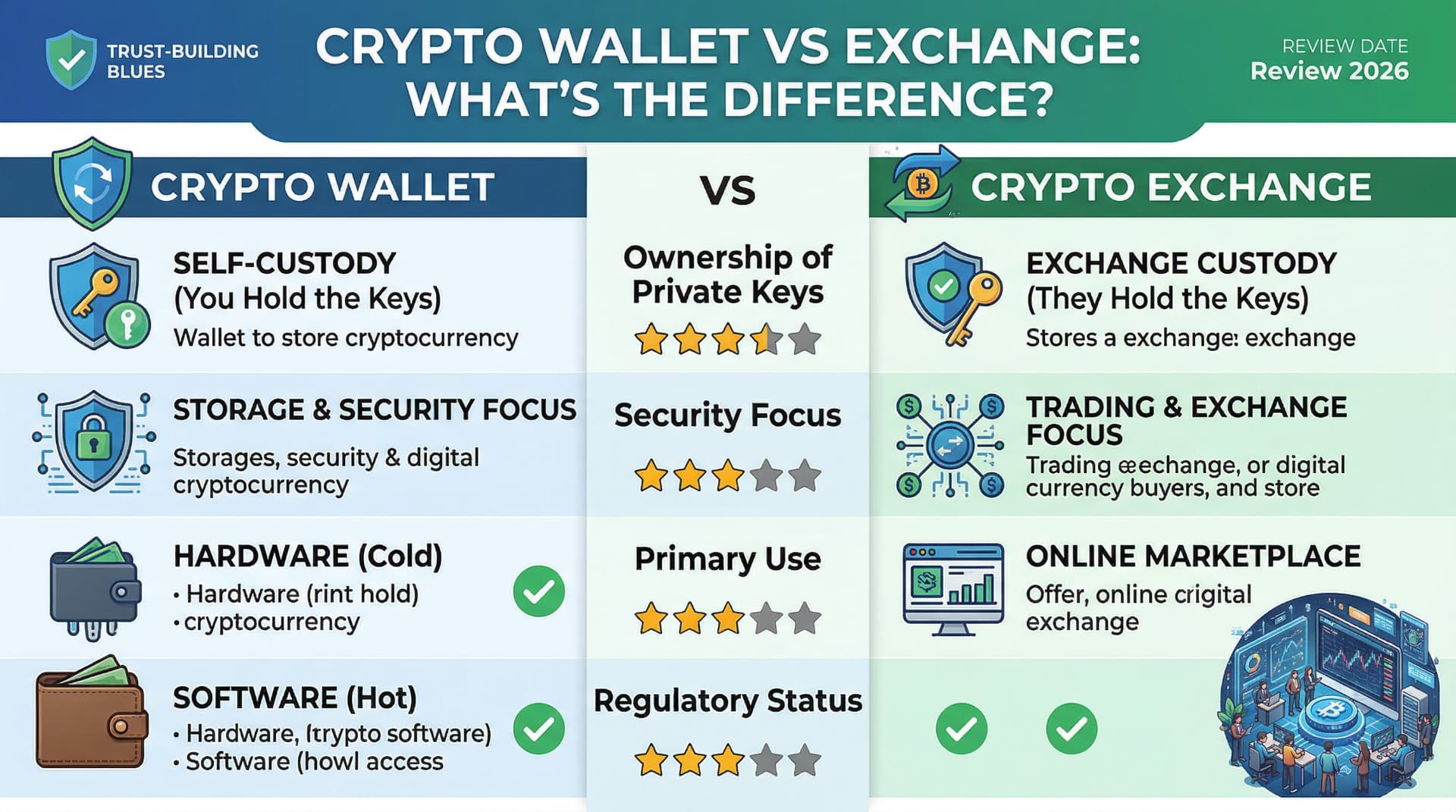
The Short Answer
A crypto exchange is where you buy and sell crypto (like a store), while a wallet is where you securely store it (like a safe). For long-term holdings, always move crypto from the exchange to your own wallet.
best crypto wallets vs Exchange: What's the Difference? (2026 Guide)
By DadAlt Investments | Category: Crypto | Last Updated: March 2026
One of the most common sources of confusion for new crypto investors is the difference between a crypto exchange and a crypto wallet — and why it matters enormously which one holds your coins. Most beginners buy Bitcoin or Ethereum on Coinbase or Kraken and assume their crypto is safely "in their account." Technically, it is. Practically, they're trusting a third party with an asset the third party could lose, freeze, or go bankrupt with. A crypto wallet, by contrast, gives you direct ownership of your private keys — the cryptographic proof that your coins are yours — with no middleman between you and your money. Understanding the difference between an exchange and a wallet isn't just a technical detail; it's the foundational security decision every crypto owner needs to make. This guide explains both tools in plain English, covers the hot vs. cold wallet distinction, and gives you a practical framework for deciding when to use each one.
The Core Analogy: Bank vs. Personal Safe
The fastest way to understand the exchange vs. wallet distinction is with a simple analogy:
-
A crypto exchange is like a bank. You deposit money, the bank holds it, and you access it through an account. The bank controls the vault. If the bank fails, gets hacked, or freezes your account, you may not be able to get your money out.
-
A crypto wallet is like a personal safe. You hold the only key. No one else can open it. If you lose the key (your seed phrase), no locksmith can help you — the crypto is gone. But no bank failure, exchange hack, or regulatory freeze can touch it.
This analogy maps directly to how crypto actually works:
| Crypto Exchange | Crypto Wallet | |
|---|---|---|
| Who holds the private keys | The exchange | You |
| Account access | Username + password | Seed phrase (12–24 words) |
| Can freeze your account | Yes | No |
| Can go bankrupt | Yes | No |
| Password recovery available | Yes | No — seed phrase only |
| Used for | Buying, selling, trading | Storing and moving crypto |
The hard lesson from FTX (2022): When FTX collapsed, over $8 billion in customer funds were frozen or lost. Every single person who lost money was someone who left their crypto on the exchange. The people who held hardware wallets or software wallets with their own private keys lost nothing — because their crypto wasn't on FTX's books to begin with.1
What Is a Crypto Exchange?
A crypto exchange is an online platform where you can buy, sell, and trade cryptocurrency — similar in concept to a stock brokerages. You create an account with a username and password, verify your identity (KYC), and fund your account with U.S. dollars via bank transfer or debit card. From there you can buy Bitcoin, Ethereum, and hundreds of other coins.
When you hold crypto on an exchange, the exchange holds your private keys on your behalf. You have a balance in an account — but the actual how blockchain impacts small business ownership belongs to the exchange's pooled wallet addresses. You own a claim on the crypto, not the crypto itself. This is called a custodial arrangement, because the exchange acts as your custodian.2
What exchanges are good at:
- Buying and selling crypto with U.S. dollars — exchanges are the on-ramp and off-ramp between fiat currency and crypto. You generally need an exchange to convert dollars to Bitcoin or to convert Bitcoin back to dollars.
- Active trading — real-time order books, limit orders, price charts, and high liquidity make exchanges the right tool for frequent trading.
- Earning yield — many exchanges offer crypto staking, lending programs, or savings features.
- Convenience — account recovery, customer support, and a familiar username/password login make exchanges far easier for beginners than self-custody wallets.
Major U.S. crypto exchanges:
- Coinbase — largest U.S. exchange, beginner-friendly, available in all 50 states
- Kraken — strongest security record (zero major hacks in 13+ years), 500+ coins
- Gemini — NYDFS trust company charter since 2015, strong compliance credentials
- Robinhood — crypto alongside stocks, zero commission
Related: crypto exchanges | Coinbase vs Kraken vs Gemini: Which Is Safest?
What exchanges cannot guarantee:
- Your funds in a bankruptcy. Crypto held on exchanges is not FDIC insured (only your USD cash balance may be). When Celsius filed for bankruptcy in 2022, crypto assets on the platform were classified as assets of the estate — not customer property.1
- Uninterrupted access. Exchanges can freeze withdrawals, as Celsius and FTX did, with no warning to users.
- Protection from their own insolvency. An exchange's institutional insurance covers the platform against hacks — not its obligation to individual users if the company itself fails.
What Is a Crypto Wallet?
A crypto wallet is a tool that stores, sends, and receives cryptocurrency — but it doesn't actually "hold" your coins the way a bank holds cash. Your coins always exist on the blockchain. What a wallet stores is your private key: the cryptographic number that proves you own a specific blockchain address and authorizes you to move the coins at that address.3
Because you hold the private key — not an exchange — no third party can freeze your wallet, go bankrupt with your funds, or restrict your access. This is called non-custodial ownership: you are your own custodian.
The tradeoff is responsibility. There is no password reset for a non-custodial wallet. Lose your seed phrase and your crypto is gone — permanently and irreversibly. There is no "forgot my password" link, no customer support ticket that can help you.
How a private key and seed phrase relate:
- A private key is a 256-bit cryptographic number — essentially a very long, random password — that controls a single blockchain address.
- A seed phrase (12 or 24 random words in a specific order) is a human-readable master backup that can regenerate all your private keys. One seed phrase backs up your entire wallet, including every coin on every blockchain you've used with that wallet.
- Whoever has your seed phrase has full, immediate control over all the crypto in that wallet — with no recourse for you.
Hot Wallet vs. Cold Wallet Explained
Once you understand the custodial vs. non-custodial distinction, the next important split is hot vs. cold — which refers to whether the wallet is connected to the internet.
Hot Wallets — Convenience with Some Risk
A hot wallet is a non-custodial wallet that runs on an internet-connected device: a smartphone app, a desktop application, or a browser extension. Because it's online, it's always accessible and easy to use — but it's also theoretically reachable by malware, phishing attacks, or browser exploits.
Common hot wallets:
- MetaMask — the most widely used hot wallet for Ethereum and EVM-compatible chains (Arbitrum, Polygon, Base, Optimism). Available as a browser extension and mobile app. Excellent for DeFi and NFTs. As of March 2026, MetaMask now also supports Bitcoin, Solana, and TRON in the same wallet interface.4
- Coinbase Wallet — a separate, non-custodial app from the Coinbase exchange (you do not need a Coinbase account to use it). Beginner-friendly with a strong onboarding flow. Over 15 million total installs globally. Supports Ethereum, Bitcoin, Solana, and all major EVM chains.5
- Trust Wallet — mobile-first, multi-chain wallet supporting 100+ blockchains. Best for users who want broad asset coverage from their phone without manual network configuration.6
- Phantom — purpose-built for Solana and Solana-based NFTs, with expanding multi-chain support.
Hot wallets are free, easy to set up (no KYC, no account required), and appropriate for small amounts you actively use. The general rule: treat a hot wallet like a regular wallet in your back pocket — only put in what you'd be comfortable losing if it were stolen.
Cold Wallets — Maximum Security
A cold wallet is a non-custodial wallet that keeps your private keys completely offline. The most common form is a hardware wallet — a small physical device (about the size of a USB drive) that signs transactions internally without ever exposing your private key to the internet. Even if the computer it's connected to is infected with malware, the private key never leaves the device.7
Common cold wallets:
- Ledger Nano X — supports 5,500+ coins, Bluetooth connectivity for mobile, ~$149
- Trezor Safe 3 — open-source firmware, EAL6+ secure element chip, 7,000+ coins, ~$79
- Trezor Model T — 100% open-source, color touchscreen, Shamir Backup, ~$219
- Coldcard Mk4 — Bitcoin only, air-gapped signing, maximum security for advanced users, ~$158
Related: Best Hardware Wallets for Long-Term Crypto Storage — our full comparison and review.
Cold wallets are the right choice for any amount you intend to hold long-term and don't need to trade frequently.
Hot vs. Cold: The Practical Summary
| Hot Wallet | Cold Wallet | |
|---|---|---|
| Internet connected | Yes | No |
| Best for | Daily use, DeFi, active amounts | Long-term savings, large holdings |
| Setup cost | Free | $60–$220 |
| Examples | MetaMask, Trust Wallet, Coinbase Wallet | Ledger Nano X, Trezor Safe 3 |
| Risk | Malware, phishing | Physical loss, seed phrase loss |
| KYC required | No | No |
Best practice: Use a hot wallet for the small amounts you're actively trading or using in DeFi. Use a cold wallet for your long-term holdings — the crypto equivalent of keeping your savings in a fireproof safe rather than your back pocket.
When to Use an Exchange vs. a Wallet
Here's the practical decision framework:
Use an exchange when:
- You're buying crypto for the first time with U.S. dollars
- You're actively trading between multiple coins
- You want to convert crypto back to dollars and transfer to your bank
- You're earning yield through staking or lending programs
- Your total crypto holdings are small enough that exchange risk is acceptable (generally under $500)
Use a wallet when:
- You've bought crypto and plan to hold it for weeks, months, or years
- Your total holdings exceed $500–$1,000 (a hardware wallet becomes worth the cost)
- You want to use DeFi protocols, NFT marketplaces, or other blockchain applications
- You've decided you want true ownership — not a claim on a third party's balance sheet
The practical rule: Keep only what you're actively trading on an exchange. Move everything else to a wallet — ideally a hardware wallet for any amount over $1,000. For a step-by-step guide, see How to Move Crypto Off an Exchange to a Wallet.
Think of it this way: your exchange account is like your checking account (for active use). Your hardware wallet is like a savings account or a home safe (for what you're actually keeping).
Private Keys and Seed Phrases Explained Simply
These two terms come up constantly in crypto and are worth fully understanding:
Private Key
A private key is a 256-bit number — a string of 64 hexadecimal characters — that mathematically proves you own a specific address on a blockchain and authorizes you to move funds from it. It looks something like:
3a4f2d8b... [64 characters]
You never need to see or manage your private key directly. Your wallet handles it for you. What you do need to safeguard is the seed phrase that generates it.
Seed Phrase
A seed phrase (also called a recovery phrase, mnemonic phrase, or backup phrase) is a set of 12 or 24 ordinary English words — in a specific, ordered sequence — that can regenerate all of your private keys. It might look like:
legal winner thank year wave sausage worth useful legal winner thank yellow
The seed phrase is everything. Anyone who has those words, in that order, has full control of every wallet address and every coin associated with it — immediately and irrevocably. There is no higher level of access. No PIN, no 2FA, no customer support can protect you if your seed phrase falls into the wrong hands.
The four seed phrase rules:
- Write it on paper with a ballpoint pen, immediately after setup. Number each word. Store it privately.
- Never store it digitally. Not in Notes, not in a password manager, not in an email draft, not in Google Drive, not as a phone photo. Any digital copy can be stolen by malware.
- Never share it with anyone, for any reason. Legitimate support staff from Ledger, Trezor, MetaMask, or any exchange will never ask for your seed phrase. Ever.
- Store a second physical copy in a separate, secure location. A safe at home plus a safe deposit box, for example. If your house burns down and your only copy of the seed phrase was in it, the crypto is gone.
FAQ
Can I have a Coinbase account AND a hardware wallet at the same time?
Yes — and for most serious crypto holders, this is the right setup. You use Coinbase (or Kraken, Gemini, etc.) to buy crypto with dollars. Once you've bought it, you transfer your long-term holdings to your hardware wallet for safe keeping. When you eventually want to sell, you send the crypto back to the exchange and convert it to dollars. The exchange and the wallet serve different functions and work together seamlessly.8
Is MetaMask a wallet or an exchange?
MetaMask is a non-custodial hot wallet — not an exchange. It stores your private keys on your device (browser extension or mobile app), and only you have access. MetaMask does include a built-in swap feature (which routes trades through decentralized exchanges like Uniswap), but MetaMask itself does not hold custody of your funds at any point. You can use MetaMask completely independently of any centralized exchange.4
The distinction matters because MetaMask cannot freeze your account, cannot go bankrupt with your funds, and cannot be subpoenaed to seize your assets. The tradeoff: MetaMask cannot help you recover a lost seed phrase, and there is no password reset.
What actually happens to my crypto if my exchange goes bankrupt?
In most cases: you may lose access to your funds for months or permanently. When FTX filed for bankruptcy in 2022, customer withdrawals were frozen immediately. When Celsius filed for bankruptcy, a court ruled that crypto deposited in Celsius's Earn program was an unsecured creditor claim — not customer property. Customers received pennies on the dollar years later, after a lengthy legal process.1
Unlike a bank, your exchange balance is not FDIC insured (only USD cash balances may have FDIC pass-through insurance, depending on the exchange). Crypto held on an exchange in a trading account has no federal deposit insurance. The safest protection against exchange bankruptcy is to not hold more on an exchange than you're actively trading.
Do I need a wallet to buy crypto for the first time?
No. The simplest path to buying your first Bitcoin or Ethereum is to open an account on a regulated U.S. exchange (Coinbase, Kraken, or Gemini), complete KYC verification, link a bank account, and buy. Your crypto sits in the exchange's custodial account — convenient, but with the risks described above.
Once you've made your first purchase and understand the basics, the next step is to set up a personal wallet (starting with a free hot wallet like Coinbase Wallet or MetaMask, and eventually a hardware wallet for larger holdings) and transfer your long-term holdings off the exchange. You don't need a wallet to start — but you should plan to get one.
Putting It All Together: The Recommended Setup
For most U.S. crypto investors, the right structure is a layered approach:
-
Exchange account (Coinbase, Kraken, or Gemini) — for buying, selling, and converting to/from dollars. Keep only what you're actively trading here.
-
Hot wallet (Coinbase Wallet, MetaMask, or Trust Wallet) — for small amounts you use regularly, DeFi access, NFT purchases, or anything you want to move quickly. Free to set up, non-custodial.
-
Hardware wallet (Trezor Safe 3 or Ledger Nano X) — for long-term savings. Any holding over $1,000 should be here. Your keys, your coins, fully offline.
The exchange is the door into crypto. The wallet — especially the hardware wallet — is where you actually live.
Sources and References
Disclaimer: This article is for informational purposes only and does not constitute financial or investment advice. Cryptocurrency is highly volatile and speculative. Never invest more than you can afford to lose. DadAlt Investments may earn affiliate commissions from some links in this article at no cost to you.
Recommended Reading
- How to Move Crypto Off an Exchange to a Wallet
- 5 Crypto Wallets Every Dad Should Know
- Best Crypto Exchanges for Beginners
Footnotes
-
Gemini Cryptopedia. "Crypto Wallets: Custodial vs. Non-Custodial Wallets." Gemini. https://www.gemini.com/cryptopedia/crypto-wallets-custodial-vs-noncustodial ↩ ↩2 ↩3
-
Ledger Academy. "What Are the Different Types of Crypto Wallets?" Ledger. July 2025. https://www.ledger.com/academy/topics/crypto/types-of-crypto-wallets ↩
-
MoonPay. "Custodial vs Non-Custodial Wallets: What's the Difference?" https://www.moonpay.com/learn/blockchain/custodial-vs-non-custodial-wallets ↩
-
CryptoSlate. "MetaMask Wallet Review 2026: Security, Fees, Chains and Best Use Cases." Updated March 13, 2026. https://cryptoslate.com/crypto-wallets/metamask-review/ ↩ ↩2
-
CoinGecko. "Top 7 Hot Wallets in 2026." March 2026. https://www.coingecko.com/learn/top-hot-software-wallets-crypto ↩
-
Koinly. "MetaMask vs. Trust Wallet: Which Is Best In 2026?" January 2026. https://koinly.io/blog/metamask-vs-trustwallet/ ↩
-
BitGo. "Custodial vs. Non-Custodial Wallets: Where is Your Crypto Held?" https://www.bitgo.com/resources/blog/custodial-vs-non-custodial-wallet/ ↩
-
ChainUP. "Custodial vs Non-Custodial Wallets: Your 2026 Crypto Wallet Guide." March 2026. https://www.chainup.com/blog/comprehensive-guide-custodial-vs-non-custodial-hot-wallets/ ↩
Frequently Asked Questions
Is it safe to leave crypto on an exchange?
For short-term trading, exchanges are reasonably safe. For long-term holdings, it's risky — exchanges can be hacked, freeze withdrawals, or go bankrupt (like FTX). Self-custody in a wallet is significantly safer.
What happens if a crypto exchange gets hacked?
You could lose some or all of your holdings. While major exchanges carry insurance, coverage is often limited. This is exactly why experienced investors move significant holdings to personal hardware wallets.
Do I need a wallet if I only have a little crypto?
If you hold under $500, exchange storage is reasonable with proper security (strong password, 2FA). Once your holdings grow beyond that, a hardware wallet is a smart $70–$150 insurance policy.

About the Author
Jared DeValk
Founder, DadAlt Investments
Father, alternative investment researcher, and founder of DadAlt Investments. 14+ years turning hard lessons into honest guidance for dads building real wealth.