
Coinbase vs Kraken vs Gemini: Which Is Safest?
Safety comparison of the top U.S. crypto exchanges.
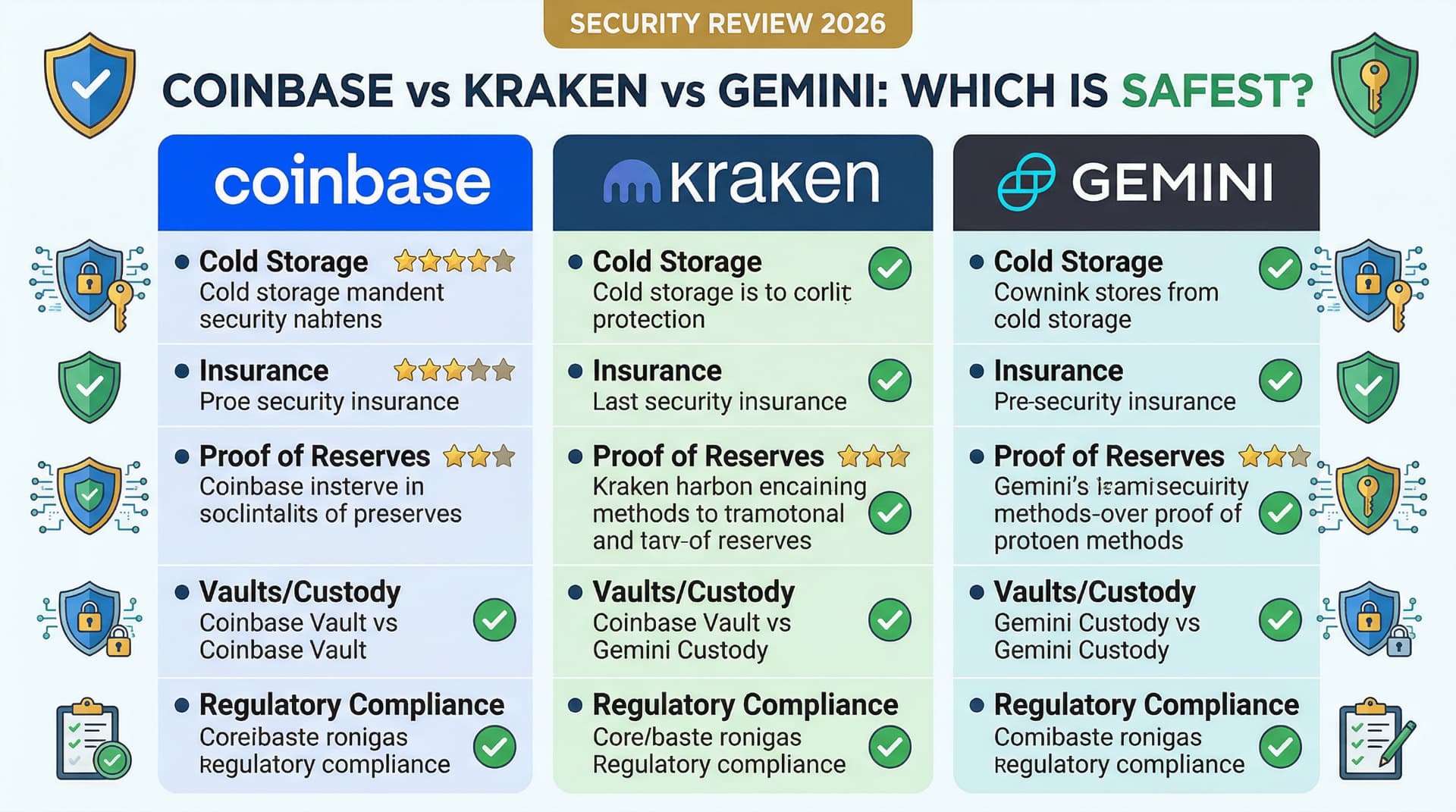
The Short Answer
Gemini is technically the safest due to SOC 2 compliance and full insurance coverage, but Coinbase and Kraken are both highly secure — all three are excellent choices for U.S. dads entering crypto.
Coinbase vs Kraken vs Gemini: Which Is Safest? (2026 Guide)
By DadAlt Investments | Category: Crypto & Digital Assets | Last Updated: March 2026
Summary
If you are buying cryptocurrency in the United States in 2026 and safety is your top concern, the conversation starts — and largely ends — with three platforms: Coinbase, Kraken, and Gemini. All three are registered with FinCEN, regulated under U.S. law, compliant with state Money Service Business (MSB) licensing requirements, and among the most financially transparent best crypto exchanges for beginnerss operating anywhere in the world. None of them is FTX. None of them is Celsius. None of them evaporated with your money. That distinction matters more than it should have to, given the history of offshore and unregulated exchanges that wiped out billions in customer funds between 2022 and 2023. This guide breaks down exactly what makes each platform safe, what each one does better than the others, how their fees actually compare, and which one to choose based on your specific priorities — so you can make a confident decision and stop leaving your crypto on a sketchy exchange.
Why These Three? The Case for Regulated U.S. Exchanges
Before comparing the three platforms in detail, it is worth establishing why the regulatory framework matters — and why the FTX, Celsius, and Voyager collapses are the clearest argument for using only compliant U.S. exchanges.
What happened with offshore and unregulated exchanges:
- FTX (2022): Approximately $8 billion in customer funds lost after the exchange used customer deposits for proprietary trading; founder convicted of fraud
- Celsius (2022): $4.7 billion in customer funds frozen and largely lost after using customer deposits in high-risk DeFi strategies
- Voyager (2022): Customer assets locked for months; eventual recovery was partial and delayed
In every case, the exchange operated without meaningful regulatory oversight, lacked audited proof of reserves, and had no legal obligation to segregate customer funds from company funds.
What all three regulated U.S. exchanges share:
- FinCEN registration as Money Service Businesses — legally required to maintain AML (Anti-Money Laundering) programs, file Suspicious Activity Reports, and comply with Bank Secrecy Act requirements 1
- State MSB licenses in the states where they operate
- FDIC pass-through insurance on U.S. dollar cash balances — your USD deposits are held in custodial accounts at FDIC-insured banks, with pass-through coverage up to $250,000 per depositor 2
- Verifiable corporate structures — all three are audited, have publicly available financials or regular attestations, and operate under U.S. jurisdiction with legal accountability
- Segregated customer funds — customer assets are not commingled with company operating funds
Critical clarification on FDIC insurance: The $250,000 FDIC protection applies only to U.S. dollar cash balances held at partner banks — not to cryptocurrency. Your Bitcoin, Ethereum, or other crypto holdings are not FDIC-insured at any exchange. This is true industry-wide and is not specific to these three platforms.
Quick Comparison Table: Coinbase vs Kraken vs Gemini (2026)
| Feature | Coinbase | Kraken | Gemini |
|---|---|---|---|
| Founded | 2012 | 2011 | 2014 |
| Publicly Traded | ✅ NASDAQ: COIN | ❌ Private | ✅ NASDAQ: GEMI (Sept 2025) |
| No. of Cryptocurrencies | 250+ | 500+ | 70–80 |
| Regulatory Status | FinCEN MSB; state licenses | FinCEN MSB; Wyoming SPDI bank charter | NYDFS Trust Company; BitLicense; MiCA (EU) |
| Security Certifications | SOC 1 & 2 Type 2 | ISO/IEC 27001:2022; SOC 1 & 2 Type 2 | SOC 1 & 2 Type 2; ISO 27001 |
| Proof of Reserves | ✅ Published | ✅ Quarterly, verified by independent accountant | ✅ Full-reserve model disclosed |
| FDIC USD Insurance | ✅ Pass-through up to $250K | ✅ (via partner banks) | ✅ Pass-through up to $250K |
| Crypto Insurance | Crime policy (~$255M platform-level) | No disclosed crypto-specific insurance fund | Hot wallet insurance (~$125–200M) |
| Staking Available | ✅ Yes | ✅ Yes (on-chain, returned to U.S. users) | ✅ Yes (ETH, SOL, limited assets) |
| Basic App Fees | 1.49% – 3.99% | 0.9% – 1.5% (instant buy) | 0.5% – 1.49% |
| Advanced/Pro Fees | 0.00–0.60% (maker/taker) | 0.16% maker / 0.26% taker (entry) | 0.20% maker / 0.40% taker (entry) |
| Available in All 50 States | ❌ (not Hawaii) | ❌ (not NY, WA, ME for some products) | ✅ All 50 states |
| Mobile App Rating (iOS) | 4.7★ | 4.7★ | 4.4★ |
| 24/7 Customer Support | ✅ Phone and chat | ✅ Live chat and email | ❌ Email only |
Sources: Coinbase.com, Kraken.com, Gemini.com, CoinBureau, CryptoSlate (March 2026) 12345
Coinbase — Most User-Friendly and Largest U.S. Exchange
Coinbase was founded in 2012 and became the first major U.S. crypto exchange to go public when it listed on NASDAQ in 2021 under ticker COIN. As of 2026, it is the largest U.S.-based cryptocurrency exchange by trading volume and custodied assets, managing approximately $404 billion in assets as of year-end 2024 — including nearly 12% of all Bitcoin globally. 1
Why Coinbase Stands Out for Beginners
Coinbase was designed from day one to remove friction from crypto investing. The main Coinbase app features a one-tap Buy/Sell interface, a clean educational section that teaches users about each asset before they buy, and a verification process that walks first-timers through KYC in minutes. For someone who has never owned crypto and wants to buy their first $100 of Bitcoin, Coinbase is the most approachable starting point available.
Key Coinbase features in 2026:
- 250+ cryptocurrencies — largest selection of the three platforms
- NASDAQ-listed (COIN) — as a public company, Coinbase files quarterly earnings reports, is subject to SEC oversight, and operates with financial transparency that private exchanges are not required to provide
- Coinbase One subscription — a flat monthly fee that eliminates trading commissions (for eligible users)
- Coinbase Advanced Trade — the professional trading interface built into the same account, with significantly lower fees than the basic app (see Fees section below)
- Coinbase Wallet — a self-custody crypto option that lets you move crypto off the exchange and into your own wallet when you are ready for full control of your private keys
- Staking on 8+ assets — including ETH, SOL, ADA, and others where permitted by state regulations
Coinbase Security Architecture
Coinbase's approach to security relies on a layered structure: 2
- Cold storage: The vast majority of customer crypto (reported as ~98%) is stored in air-gapped cold wallets, physically secured with 24/7 monitoring
- SOC 1 and SOC 2 Type 2 certifications — audited controls for financial reporting integrity and data security
- FDIC pass-through insurance on USD cash balances: up to $250,000 per depositor through partner banks 2
- Crime insurance policy (~$255 million) covering platform-wide breaches including internal theft and cybersecurity incidents — this does not cover individual account compromises 2
- 2FA, biometric login, YubiKey support, and withdrawal allowlisting — multiple layers of user-facing account security
Important Coinbase security note: In 2025, Coinbase disclosed a data breach that affected fewer than 1% of users, caused by a bribed contractor who leaked personal information. No crypto funds were stolen in this incident, but it reinforced that all exchanges, including regulated U.S. ones, face ongoing human-factor risks. 1
Coinbase Limitations
- Higher fees on the basic app. The standard Coinbase interface charges 1.49% for bank transfers and up to 3.99% for debit card purchases. Most users who do not know about Advanced Trade pay far more than they need to.
- Not available in Hawaii for standard accounts (some products available, but full exchange access is restricted).
- $100 ACAT transfer-out fee to move your account to another platform.
- Limited research tools compared to Kraken Pro.
Best for: First-time crypto buyers who want the simplest possible onboarding experience, widest coin selection, and the reassurance of using the most recognizable, publicly traded U.S. crypto company.
Kraken — Best Security Record in the Industry
Kraken was founded in 2011 and publicly launched in 2013, making it one of the oldest continuously operating cryptocurrency exchanges in the world. It serves over 15 million users across 190+ countries and offers 500+ cryptocurrencies. 3
Money.com named Kraken the best crypto exchange overall for March 2026, describing it as "arguably the safest digital platform for trading your crypto, with high marks across all the security assessment platforms we looked at." The specific reason cited — and it is the most important sentence in any safety comparison — is this: Kraken has never experienced a security breach that resulted in customer fund losses in its entire 13+ year history of operation. 6
That track record is extraordinary in an industry where major hacks have devastated exchanges like Binance ($570 million, 2022), Bitfinex ($72 million, 2016), and Mt. Gox ($450 million, 2014). Kraken's flawless record across 13 years at significant scale is the single strongest data point in any security comparison.
Kraken's Security Architecture
Kraken's security framework is the most comprehensively documented of the three exchanges: 34
- ISO/IEC 27001:2022 certification — the international standard for Information Security Management Systems (ISMS); certifies that Kraken's security processes, risk management, and controls meet the highest global benchmark
- SOC 1 Type 2 and SOC 2 Type 2 attestations — published twice annually; audited controls covering security, availability, and confidentiality
- Proof of Reserves 2.0 — quarterly, independently audited by an independent accounting firm; the September 2025 report showed a 114.9% Bitcoin reserve ratio, meaning Kraken held 14.9% more BTC than customer balances required. Users can cryptographically verify their own individual balance inclusion via a Merkle tree structure. 3
- 95%+ of assets in air-gapped cold storage — physically secured in cages with 24/7 armed guard surveillance, alarm systems, and video monitoring
- Global Settings Lock — a configurable feature that requires a waiting period before account settings (including password or 2FA) can be changed, preventing unauthorized account takeovers
- Wyoming SPDI banking charter (2020) — Kraken became the first crypto company to receive a state banking charter, subjecting it to bank-level capital and custody requirements
The June 2024 bug bounty incident: A security researcher (CertiK) exploited a newly discovered vulnerability and withdrew approximately $3 million from Kraken's corporate treasury — not customer accounts. Kraken patched the vulnerability within 47 minutes and no customer funds were at risk. The researcher initially declined to return the funds; the matter was referred to law enforcement and resolved. This incident, while notable, actually demonstrates the effectiveness of Kraken's rapid response — and importantly, customer funds were never in jeopardy. 4
Kraken Pro: Lowest Fees of the Three Platforms
Kraken Pro — accessible through the same account as the main Kraken interface — has the most competitive fee structure of the three exchanges for active traders: 3
- Maker fees: 0.16% at entry tier, scaling down to 0.00% at higher volumes
- Taker fees: 0.26% at entry tier, scaling down to 0.10% at higher volumes
- Staking: Available for on-chain staking (returned to U.S. users after a regulatory pause); Kraken charges approximately 15–30% of crypto staking as a commission (rates vary by asset and region)
Kraken state availability note: Kraken is not available in New York, Washington state, or Maine for certain products due to state licensing restrictions. New York residents seeking a regulated option should consider Coinbase or Gemini, both of which are licensed there.
Best for: Investors for whom security is the absolute top priority — particularly those who want the strongest provable track record (13+ years, zero customer fund losses), the best Proof of Reserves program, and ISO 27001 certification. Also the best choice for active traders who want the lowest maker/taker fees of the three platforms.
Gemini — Best for Compliance-First Investors
Gemini was founded in 2014 by Cameron and Tyler Winklevoss and operates as a New York State-chartered trust company — not a standard Money Transmitter. This regulatory distinction is significant: as a trust company under the New York Department of Financial Services (NYDFS), Gemini is legally a fiduciary, meaning it is required by law to act in clients' interests, maintain high capital reserves, and meet compliance standards comparable to traditional banks. 5
In September 2025, Gemini's parent company listed on NASDAQ under the ticker GEMI, joining Coinbase as a publicly traded U.S. crypto company with mandatory financial disclosure obligations.
Gemini's Regulatory and Security Credentials
Gemini's compliance framework is the most extensively documented of the three: 5
- New York State Trust Company — the highest-level U.S. state financial regulatory structure available to a crypto exchange; a full banking charter under New York law
- NYDFS BitLicense — obtained in 2015, making Gemini the first crypto exchange to receive this license; one of the strictest crypto licensing regimes globally
- MiCA license (EU) — Markets in Crypto-Assets regulation compliance; regulated in the European Union
- SOC 1 Type 2 and SOC 2 Type 2 certifications — first crypto exchange to achieve both; verified that its security and financial controls meet institutional-grade audit standards
- ISO 27001 — certified information security management system
- Full-reserve model — Gemini publicly discloses that customer assets are backed 1:1; it was the first major exchange to adopt this policy publicly
- Hot wallet insurance (~$125–200M) covering exchange-level theft and employee misconduct for online-held assets 5
- Cold storage: 95%+ of customer assets held offline, geographically distributed
Gemini's Coin Selection and Interface
Gemini supports approximately 70–80 cryptocurrencies — the smallest selection of the three platforms. This is deliberate: Gemini applies a rigorous internal compliance and legal review to every asset before listing it, in line with its NYDFS oversight requirements. The result is a smaller but heavily vetted selection.
Gemini interface:
- Standard interface — clean, organized, designed for simplicity
- ActiveTrader — the professional trading interface accessible within the same account, with lower fees (0.20% maker / 0.40% taker at entry)
- Gemini Dollar (GUSD) — a USD-pegged stablecoin issued by Gemini itself, backed 1:1 by USD held in FDIC-insured accounts; useful for moving between cash and crypto without leaving the platform
- Gemini Staking — available for ETH and SOL with no minimum; Gemini deducts approximately 15–30% of rewards as a service fee depending on the asset 5
- Available in all 50 U.S. states — unlike Coinbase (not Hawaii) and Kraken (limited in NY, WA, ME), Gemini operates in every U.S. state
Gemini's 2022 data breach note: In 2022, Gemini disclosed a third-party data breach that exposed email addresses and partial phone numbers for approximately 5.7 million users. No crypto funds or financial data were compromised. The information was later used in phishing campaigns against Gemini users. This reinforced the importance of enabling hardware key authentication (YubiKey support) rather than relying on email-based 2FA.
Gemini Limitations
- Smaller coin selection — 70–80 assets vs. Coinbase's 250+ and Kraken's 500+
- Higher base fees than Kraken Pro (0.20% maker vs. 0.16%); lower than basic Coinbase
- Email-only customer support — no phone or live chat; support tickets typically resolved in one business day
- Limited liquidity compared to Coinbase — $118 million daily volume vs. Coinbase's $1+ billion; relevant for large orders but not for typical retail purchases
Best for: U.S. investors who specifically value the deepest regulatory compliance track record — NYDFS trust company status, BitLicense since 2015, full fiduciary obligations, and first-to-SOC-certify status. Also the best option for investors in all 50 states (including those excluded from Kraken) who want institutional-grade oversight.
Security Deep-Dive: Which Is Actually Safest?
This is the question the article title promises to answer, and the honest answer is: all three are among the safest crypto exchanges operating anywhere in the world. The distinguishing factors depend on which dimension of safety matters most to you.
Dimension 1: Hacking Track Record
| Exchange | Customer Fund Losses from Hacks | Notable Security Incidents |
|---|---|---|
| Kraken | ✅ Zero in 13+ years | June 2024: $3M from corporate treasury (not customer funds); patched in 47 minutes |
| Gemini | ✅ Zero crypto losses | 2022: Email/phone data breach via third party; no funds at risk |
| Coinbase | ✅ Zero platform-wide crypto losses | 2021: 6,000 users affected by SMS 2FA vulnerability; 2025: personal data breach (<1% of users) |
Winner on hacking record: Kraken. Thirteen-plus years, zero customer fund losses, independent proof of reserves. This is the industry benchmark.
Dimension 2: Regulatory Depth
| Exchange | Strongest Regulatory Credential |
|---|---|
| Gemini | NYDFS Trust Company (fiduciary obligations) + BitLicense since 2015 + MiCA (EU) |
| Coinbase | Publicly traded on NASDAQ; SEC oversight; SOC 2 Type 2; state MSB licenses |
| Kraken | Wyoming SPDI banking charter (2020); ISO/IEC 27001:2022; FinCEN MSB; EU MiCA |
Winner on regulatory depth: Gemini. Operating as a full trust company with fiduciary obligations under New York banking law is the most rigorous regulatory status available to a U.S. crypto exchange.
Dimension 3: Transparency and Auditability
| Exchange | Proof of Reserves | Audit Frequency | Public Financial Disclosure |
|---|---|---|---|
| Kraken | ✅ Quarterly, Merkle tree, independently audited; users verify own balance | Quarterly | No (private company) |
| Gemini | ✅ Full-reserve model; periodic attestations | Periodic | Yes (NASDAQ: GEMI since Sept 2025) |
| Coinbase | ✅ Periodic attestations | Periodic | Yes (NASDAQ: COIN) |
Winner on transparency: Kraken for crypto-specific Proof of Reserves (quarterly, user-verifiable); Coinbase and Gemini for financial transparency via mandatory public company disclosures.
Overall Verdict
- Safest by hacking record: Kraken
- Safest by regulatory depth: Gemini
- Safest by financial transparency: Coinbase and Gemini (both public companies)
- For a first-time U.S. investor who wants one word: All three are safe. Pick based on your other priorities — beginner-friendliness (Coinbase), lowest fees (Kraken Pro), or strictest compliance (Gemini).
Fees Comparison: What You Actually Pay
This is where most comparisons fail readers: they compare the basic/instant buy fees, which are the most expensive way to use any of these platforms. Every serious crypto investor should be using the advanced or pro version of each interface.
Always Use Advanced Trade / Pro / ActiveTrader
The default simple buy interface at each platform builds in significant spreads and fees. Switching to the professional interface costs nothing extra and dramatically reduces your cost per trade:
| Platform | Basic/Instant Buy Fee | Advanced Fee (Maker) | Advanced Fee (Taker) | How to Access |
|---|---|---|---|---|
| Coinbase | 1.49% – 3.99% | 0.00% – 0.40% | 0.05% – 0.60% | "Advanced Trade" in the same app |
| Kraken | 0.9% – 1.5% | 0.00% – 0.16% | 0.10% – 0.26% | "Kraken Pro" in the same account |
| Gemini | 0.50% – 1.49% | 0.02% – 0.20% | 0.06% – 0.40% | "ActiveTrader" in the same account |
Sources: Coinbase.com, Kraken.com, Gemini.com (March 2026) — fee schedules are volume-tiered; rates listed are for entry-level volume 135
The practical comparison: For a $500 BTC purchase, the difference between using the basic app and the pro interface at each platform can be $5–$15 per trade. That compounds significantly over years of investing.
Kraken Pro wins on maker/taker fees at equivalent volume tiers. Gemini ActiveTrader is competitive. Coinbase Advanced Trade has the widest fee range depending on volume but can be competitive at moderate volume.
Which Should You Choose?
Choose Coinbase if:
- You are buying crypto for the first time and want the smoothest possible onboarding
- You want the widest selection of cryptocurrencies (250+)
- You want a single platform that also offers a self-custody wallet (Coinbase Wallet) when you are ready for that step
- You want 24/7 phone and chat support — Kraken offers live chat/email 24/7, Gemini offers email only
- The financial transparency of a publicly traded U.S. company (NASDAQ: COIN) matters to you
Choose Kraken if:
- Security is your absolute top priority — 13+ years, zero customer fund losses, the industry's strongest hacking track record
- You want the lowest advanced trading fees of the three platforms (Kraken Pro maker fees from 0.16%, scaling to 0.00%)
- You want the most rigorous and user-verifiable Proof of Reserves (quarterly, Merkle tree, independently audited)
- You want the widest cryptocurrency selection (500+) and access to margin/futures trading
- You are an active or intermediate trader who wants professional tools and deep liquidity
Choose Gemini if:
- Regulatory compliance is your top priority — NYDFS trust company with fiduciary obligations is the deepest regulatory status available to a U.S. crypto exchange
- You are in New York, Washington state, or Maine (where Kraken has access restrictions)
- You want institutional-grade custody — Gemini Custody serves hedge funds and Bitcoin passive income strategies custodians; VanEck's Solana ETF uses Gemini as its custodian
- You want a clean, organized interface without the complexity of Kraken's advanced tools
- The full-reserve model and SOC 1/2 Type 2 first-mover certification matters to you
When to Consider All Three
Many experienced crypto investors hold accounts at two or all three platforms. There is no regulatory restriction on this, and it provides practical advantages: access to coins unavailable on one platform, diversification of custodial risk, and flexibility to use whichever fee structure is best for a given trade.
When to Move Beyond All Three
The safest way to hold crypto long-term is not on any exchange — it is in self-custody. If you are holding more than $1,000 in cryptocurrency that you do not intend to sell or trade in the near term, moving it to a crypto wallets (Ledger Nano X or Trezor Safe 3) eliminates custodial risk entirely. You are then protected not just against exchange hacks but against exchange insolvency, regulatory freezes, and account access issues.
See also: Best Hardware Wallets for Long-Term Crypto Storage — a full comparison of Ledger, Trezor, and Coldcard with setup guidance.
Frequently Asked Questions
Is my crypto insured on these exchanges?
Your U.S. dollar cash is covered by FDIC pass-through insurance up to $250,000 per depositor through custodial accounts at partner banks — at all three exchanges. Your cryptocurrency is not FDIC-insured anywhere. Coinbase carries a ~$255M crime policy covering platform-wide breaches (not individual account compromises). Gemini maintains approximately $125–200M in hot wallet insurance. Kraken does not disclose a specific crypto insurance fund but maintains ISO 27001 certification and quarterly-audited Proof of Reserves. No amount of insurance replaces self-custody for significant long-term holdings. 245
Should I keep crypto on an exchange or move it to a wallet?
For crypto you are actively trading or plan to sell soon, keeping it on a regulated exchange like these three is reasonable and convenient. For crypto you are holding long-term as an investment — particularly amounts above $1,000 to $5,000 — the standard recommendation among security professionals is to move it to a hardware wallet for self-custody. "Not your keys, not your coins" is not a cliché; it is a description of the legal reality of exchange-held crypto in most jurisdictions.
Can I stake on all three exchanges?
Yes, all three offer staking, with some variation:
- Coinbase: Staking on 8+ assets (ETH, SOL, ADA, and others where permitted); staking rewards vary by asset; availability subject to state regulations
- Kraken: On-chain staking returned to U.S. users after a 2023 regulatory pause; available for major Proof-of-Stake assets; commission approximately 15–30% of rewards depending on asset
- Gemini: Staking for ETH and SOL; no minimum; approximately 15–30% service fee deducted from rewards 5
For tax purposes, staking rewards are taxable as ordinary income in the U.S. in the year received, regardless of which platform you use.
Which exchange has the best overall fee structure?
For active traders using pro interfaces: Kraken Pro has the lowest entry-tier maker fees (0.16%) of the three and the best volume-based discounts. For infrequent buyers who prioritize simplicity: Gemini's instant buy fees (0.50%–1.49%) are slightly lower than Coinbase's standard rates. The universal recommendation: always use the advanced interface — Coinbase Advanced Trade, Kraken Pro, or Gemini ActiveTrader — regardless of which platform you choose. The difference between basic and advanced fees on a single transaction can offset months of price appreciation.
Sources and References
Disclosure: This article is for informational purposes only and does not constitute financial, tax, or investment advice. DadAlt Investments may receive compensation through affiliate relationships with the exchanges mentioned. Cryptocurrency is not FDIC-insured. All investments in cryptocurrency carry significant risk of loss including total loss of principal. Exchange fees, coin availability, and regulatory status are subject to change. Always verify current features and terms directly with the exchange before opening an account. FDIC coverage applies only to USD cash balances held at partner banks — not to cryptocurrency.
Recommended Reading
- Best Crypto Exchanges for Beginners
- How to Buy Bitcoin Safely Without Getting Scammed
- 5 Crypto Wallets Every Dad Should Know
Footnotes
-
InvestingHaven. 10 Best Crypto Exchange or Apps in 2026. March 2026 — Coinbase: $404B AUM year-end 2024; 108M+ users; 12% of all Bitcoin; 9 of 11 U.S. spot Bitcoin ETFs; 2025 data breach affected less than 1% of users; NASDAQ: COIN; FinCEN MSB registration. [https://investinghaven.com/crypto-how blockchain impacts small business/coins/best-crypto-exchange/](https://investinghaven.com/crypto-blockchain/coins/best-crypto-exchange/) ↩ ↩2 ↩3 ↩4 ↩5
-
Coinbase. Insurance. Coinbase.com — FDIC pass-through coverage up to $250,000 on USD cash balances in custodial accounts; crime insurance policy covers platform-wide breaches of digital currencies; crime policy does not cover individual account compromise; crypto not FDIC-insured. https://www.coinbase.com/legal/insurance ↩ ↩2 ↩3 ↩4 ↩5 ↩6
-
CoinBureau. Kraken Review 2026: Security, Fees, Staking, & Pro. Updated January 6, 2026 — ISO/IEC 27001:2022 certification; SOC 1 & 2 Type 2 (twice annual); Proof of Reserves 2.0 with quarterly audits by independent accountant; 114.9% BTC reserve ratio (Sept 2025); 500+ assets; 15M users; FinCEN MSB; Wyoming SPDI banking charter; Kraken Pro fees 0.16% maker / 0.26% taker entry tier. https://coinbureau.com/review/kraken ↩ ↩2 ↩3 ↩4 ↩5 ↩6
-
The Investors Centre. Is Kraken Safe? Security & Risk Analysis (2026). December 2026 — 13+ years without customer fund losses; quarterly Proof of Reserves verified by independent accountant; ISO/IEC 27001 certification; co-founded Blockchain Security Standards Council with Coinbase and Anchorage Digital; June 2024 CertiK incident: $3M from corporate treasury (not customer funds), patched in 47 minutes. https://theinvestorscentre.com/best-crypto-exchange/kraken-review/is-kraken-safe/ ↩ ↩2 ↩3 ↩4
-
CryptoSlate. Gemini Exchange Review. Updated January 29, 2026 — NYDFS-regulated New York trust company (fiduciary); SOC 1 & 2 Type 2; ISO 27001; BitLicense since 2015; MiCA license EU; full-reserve model; hot wallet insurance ~$125M; NASDAQ: GEMI (September 2025); VanEck Solana ETF custodian; staking for ETH and SOL; 70–80 cryptocurrencies; available all 50 U.S. states; email support only. https://cryptoslate.com/crypto-exchanges/gemini-exchange-review/ ↩ ↩2 ↩3 ↩4 ↩5 ↩6 ↩7 ↩8
-
Money.com. 6 Best Crypto Exchanges of March 2026. March 2026 — Kraken named best crypto exchange overall for March 2026; described as "arguably the safest digital platform for trading your crypto"; cited for never suffering a large-scale hack since launching in 2011; Kraken Pro noted for some of the lowest spot trading fees and highly customizable dashboard. https://money.com/best-crypto-exchanges/ ↩
Frequently Asked Questions
Has Coinbase ever been hacked?
Coinbase itself has never been breached, though some individual accounts have been compromised through phishing and SIM-swapping. Enable 2FA with an authenticator app (not SMS) for maximum security.
Which exchange has the best customer support?
Kraken consistently ranks highest for customer support among U.S. exchanges, offering 24/7 live chat. Coinbase has improved but still relies heavily on email support. Gemini falls somewhere in between.
Should I use one exchange or multiple?
One exchange is sufficient for most beginners. Pick the one that feels most comfortable. As your portfolio grows, some investors split holdings across exchanges to reduce single-platform risk.

About the Author
Jared DeValk
Founder, DadAlt Investments
Father, alternative investment researcher, and founder of DadAlt Investments. 14+ years turning hard lessons into honest guidance for dads building real wealth.