
Best Investing Apps for Busy Dads (2026 Guide)
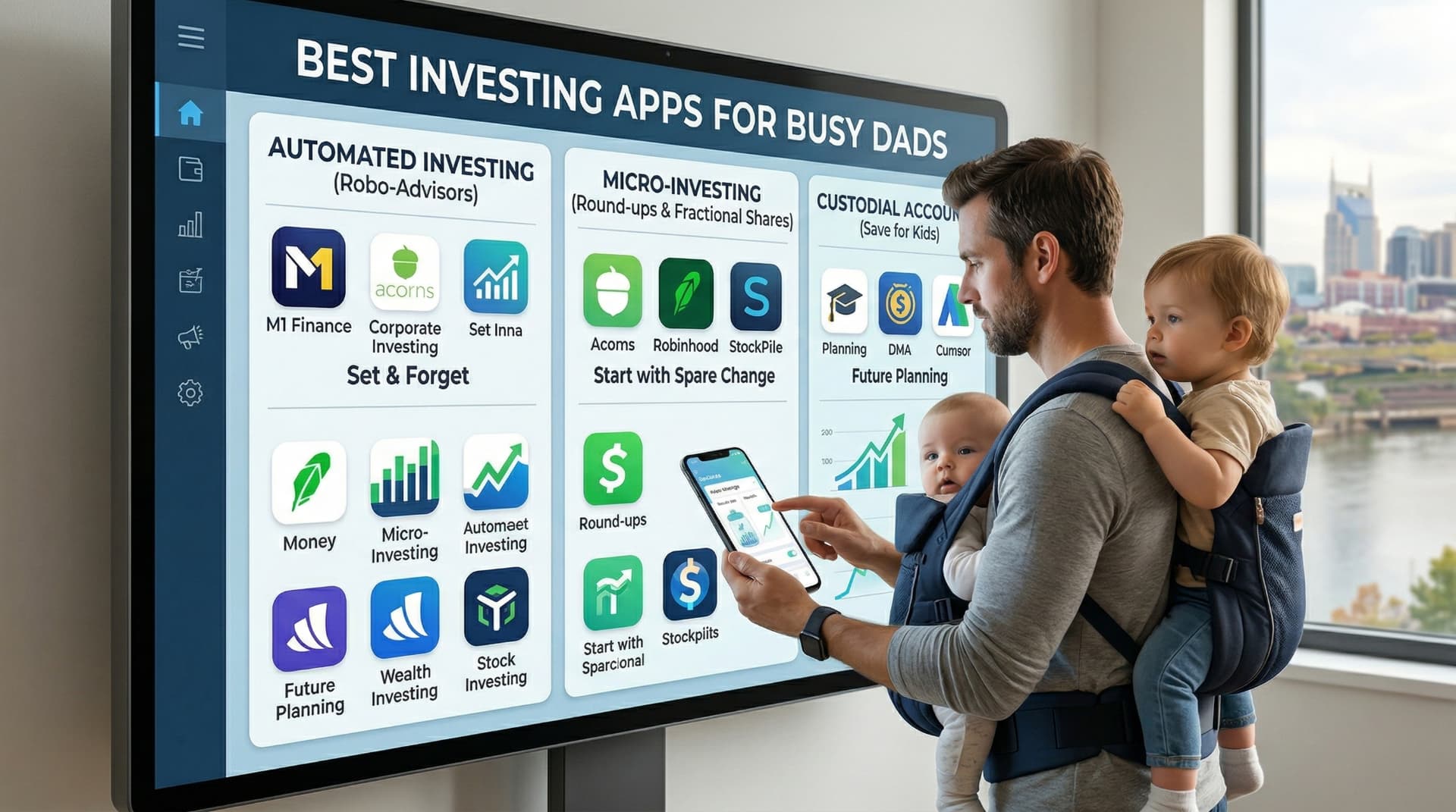
Five investing apps designed for dads who want autopilot wealth building.
The Short Answer
The best investing apps for busy dads are M1 Finance (best for autopilot portfolios), Fidelity (best all-around), Acorns (best for micro-investing), Betterment (best robo-advisor), and Schwab (best for retirement) — all designed for set-it-and-forget-it wealth building.
Best Investing Apps for Busy Dads (2026 Guide)
By DadAlt Investments | Category: Stocks & How to Open a Brokerage Accounts | Last Updated: March 2026
Between work, school pickups, homework help, youth sports, and the thousand other things that fill a dad's schedule, sitting down to research individual stocks or monitor a portfolio daily is simply not realistic — and it should not have to be. The good news: the five best investing apps for busy dads in 2026 are built specifically to work in five to ten minutes of setup, then run largely on autopilot. Fidelity is the best all-in-one platform for dads who want every account — brokerage, IRA, 401(k) rollover, HSA, even a 529 for the kids — under one roof at zero cost. Schwab combines serious investing tools with a full checking account and free robo-advisor. M1 Finance automates index fund investing down to the level where you set a portfolio once and it manages itself. Acorns turns the spare change from your everyday spending into an investment habit with zero manual effort. And Betterment manages a professionally structured portfolio entirely on your behalf, automatically rebalancing and harvesting tax losses while you coach soccer. This guide covers exactly what each app does, what it costs, what it automates, and which one fits your specific situation as a dad building wealth for your family.
What Dads Need From an Investing App That Others Don't
Most investing app reviews are written for single 25-year-olds with unlimited time and high risk tolerance. The criteria that matter for dads are different:
1. It has to work in 5–10 minutes An app that requires 30 minutes of research to use properly will get opened once and forgotten. The apps on this list can be set up in a Sunday afternoon and then run on autopilot from there. If checking the app takes longer than a typical bathroom break, it is the wrong app.
2. Automation first Contributions, dividend reinvestment, rebalancing, and recurring purchases should all be configurable once and then happen automatically. The best investing habit for a busy dad is one that does not require remembering to invest on payday — the money moves before it can be spent.
3. The family financial picture in one place Ideally, one app shows your retirement account, your kids' future college fund, your emergency fund, and your taxable investments in a single dashboard. Managing four separate apps for four separate accounts adds friction and creates gaps.
4. Brief, jargon-free educational content Financial media is noisy, alarmist, and designed to generate clicks rather than help you make good decisions. The best investing apps for dads offer short, plain-English explanations of what you own and why — without requiring a finance degree to understand.
Quick Comparison: Best Investing Apps for Busy Dads (2026)
| App | Account Types | Minimum | Commissions | Automation Features | Mobile Rating | Best For |
|---|---|---|---|---|---|---|
| Fidelity | Brokerage, IRA, Roth IRA, 401k rollover, HSA, 529, custodial | $0 | $0 | Automatic investments, DRIP, recurring buys | ⭐⭐⭐⭐⭐ | All-in-one; permanent financial home |
| Charles Schwab | Brokerage, IRA, Roth IRA, 401k rollover, checking, robo-advisor | $0 ($5K for robo) | $0 | Intelligent Portfolios auto-rebalancing | ⭐⭐⭐⭐⭐ | Banking + investing + robo-advisor |
| M1 Finance | Brokerage, IRA, Roth IRA, SEP IRA, custodial | $0 ($100 recommended) | $0 | Pie auto-rebalancing, dividend reinvestment | ⭐⭐⭐⭐ | Set-and-forget index fund automation |
| Acorns | Brokerage, IRA (Traditional/Roth/SEP), checking, custodial | $0 | $0 trades | Round-ups, recurring deposits, auto-invest | ⭐⭐⭐⭐ | Starting from zero; habit building |
| Betterment | Brokerage, IRA (Traditional/Roth/SEP), 401(k) | $0 | $0 trades | Daily rebalancing, tax-loss harvesting, DRIP | ⭐⭐⭐⭐⭐ | Fully automated professional portfolio |
#1 Fidelity — Best All-In-One for Long-Term Investors
Fidelity is the best single financial platform available to U.S. investors in 2026, and it earns the top spot for busy dads specifically because it eliminates the need for multiple apps. You can hold your 401(k) rollover, Roth IRA, HSA, 529 college savings plan, taxable brokerage, and even a high-yield checking account all at Fidelity — visible on one dashboard — with zero account minimums, zero commissions, and zero ongoing maintenance fees.1
Zero-Cost Investing: FZROX and FZILX
Fidelity's most underappreciated feature for long-term investors is the ZERO expense ratio fund suite — index mutual funds that cost literally nothing to own:
- FZROX (Fidelity ZERO Total Market Index Fund) — 0.00% expense ratio; tracks the entire U.S. stock market
- FZILX (Fidelity ZERO International Index Fund) — 0.00% expense ratio; international diversification
For comparison, even Vanguard's legendary index funds charge 0.03%–0.07%. On a $100,000 portfolio, those fees cost $30–$70/year. FZROX and FZILX cost $0. These funds are available only to Fidelity account holders — you cannot buy them anywhere else — and they represent the lowest possible cost for a diversified long-term portfolio.1
Automatic Investment Scheduler
Fidelity's automatic investment feature is exactly what a busy dad needs: you set the fund, the dollar amount, and the frequency (weekly, biweekly, or monthly), and every purchase happens on payday without further thought. There is no minimum recurring amount — you can automate $50/month or $5,000/month with equal ease. Combined with DRIP (dividend reinvestment) enabled on all holdings, dividends compound automatically without requiring any manual reinvestment.
The Full Account Suite for Families
No other app on this list matches Fidelity's breadth of account types relevant to a dad building wealth for his family:
- Roth IRA and Traditional IRA — with automatic annual contribution scheduling
- 401(k) rollover — Fidelity helps transfer old 401(k) accounts from previous employers directly
- HSA (Health Savings Account) — invest your HSA balance in index funds for long-term tax-free medical savings; the "triple tax advantage" account that most investors underutilize
- 529 College Savings Plan — invest for college on a tax-advantaged basis; Fidelity manages one of the largest 529 plans in the country
- UGMA/UTMA custodial accounts — invest on behalf of your children; assets transfer when they reach adulthood
- Fidelity Youth Account — specifically for teens ages 13–17 to invest real money with parental oversight, building financial literacy while you monitor their activity
All of these accounts are visible on a single Fidelity dashboard, giving you a complete family financial picture in one place.2
Mobile App: 5-Star Rated and Genuinely Useful
Fidelity's mobile app consistently earns top ratings (4.8/5 on the App Store) and is designed for both the occasional check-in and the more engaged investor. For busy dads, the most useful features are:
- Portfolio summary dashboard — one screen showing all accounts and total net worth
- Quick trade — buy your recurring ETF purchase in three taps
- Notifications — configurable security and large-balance-change alerts (everything else can be turned off)
- Educational content — Fidelity's Learning Center covers retirement planning, kids and money, and market basics in short, jargon-free articles and videos
What Fidelity Is Best For
Dads who want a permanent financial home for every account type their family will ever need, at zero ongoing cost, with the best automation tools and the lowest-cost index funds available anywhere.
Limitation: Fidelity's platform is comprehensive enough that new investors can feel overwhelmed initially by the number of options. Start with one account (Roth IRA), one fund (FZROX), and one automation setting (monthly recurring purchase). Add complexity only when you are ready.
#2 Charles Schwab — Best for Education and All-in-One Banking
Schwab is the right choice for dads who want their checking account and investment accounts at the same institution — genuinely integrated, not just visually combined. Schwab's checking account comes with unlimited ATM fee reimbursements worldwide, which is a meaningfully useful banking benefit, and its Intelligent Portfolios service is the most powerful free robo-advisor available from a traditional brokerage.3
Schwab Intelligent Portfolios: Free Robo-Advisor at $5,000
Schwab Intelligent Portfolios is a full robo-advisor — it builds a diversified portfolio of ETFs, automatically rebalances to maintain your target allocation, and manages the account on your behalf — at $0 management fee. The minimum to open is $5,000, and the only costs are the underlying ETF expense ratios (which are minimal for Schwab's own funds).
For the investor who hits the $5,000 minimum and just wants their investments to manage themselves, Intelligent Portfolios is hard to beat. It handles:
- Portfolio construction across 20+ asset classes
- Automatic rebalancing when allocations drift
- Tax-loss harvesting on accounts of $50,000 or more
- Dividend reinvestment automatically
Compare this to Betterment's 0.25% annual fee on the same service, and on a $50,000 account Schwab saves you $125/year.3
Banking Integration: ATM Reimbursements and Seamless Transfers
Schwab's checking account is genuinely one of the best checking accounts available for travelers and anyone who uses ATMs regularly:
- Unlimited ATM fee reimbursements at any ATM worldwide — Schwab reimburses third-party ATM fees at the end of each billing period
- No foreign transaction fees
- Instant transfers between your Schwab checking account and your investment accounts
- FDIC-insured cash balances
For a dad who travels for work or wants the simplicity of one financial institution handling banking and investing together, this integration is Schwab's defining advantage.
Schwab's Educational Resources
Schwab provides some of the best free investing education available at any brokerage:
- Schwab Learning Center: organized courses from introductory ("what is a stock?") to advanced tax strategies
- Live webinars and on-demand video library
- Market commentary and research from Schwab's analysts and 14 third-party providers (Morningstar, Moody's, etc.)
- Branch access: approximately 400 physical Schwab locations nationwide for in-person support when complex questions arise
What Schwab Is Best For
Dads who want banking and investing combined in one institution — especially those who want a free robo-advisor to handle portfolio management automatically, or who value the ability to walk into a physical branch.
Limitation: Schwab's full-featured desktop platform (particularly thinkorswim) is significantly more complex than the average dad needs. Stick to the standard Schwab mobile app and Intelligent Portfolios to keep things simple.
#3 M1 Finance — Best for Automation and "Set It and Forget It"
M1 Finance occupies a unique position among investing apps: it is the only platform that combines total portfolio customization (you choose every holding and every target percentage) with complete automation of the execution (M1 handles all buying, rebalancing, and dividend reinvestment). The result is a portfolio that runs entirely on autopilot once configured — not a generic robo-advisor portfolio, but your specific allocation executed without ongoing manual intervention.4
How M1 Pies Work: Your Portfolio on Autopilot
The core concept at M1 is the "Pie" — a portfolio you build by selecting stocks or ETFs and assigning each a target percentage. Once your Pie is set:
- Every new deposit automatically buys the holdings furthest below their target percentage
- Dividends are automatically reinvested to rebalance toward your targets
- There are no commissions on any trade
- There is no management fee on the basic tier
For a busy dad who wants to build a specific two-fund or three-fund portfolio (for example: 70% VTI + 20% VXUS + 10% BND) and then never think about rebalancing again, M1 is the ideal vehicle.
A Practical Example: The Three-Fund Portfolio on Autopilot
Consider a dad who sets up this Pie on M1 Finance:
- 70% VTI (Vanguard Total Stock Market ETF, 0.03% expense ratio)
- 20% VXUS (Vanguard Total International Stock ETF, 0.07% expense ratio)
- 10% BND (Vanguard Total Bond Market ETF, 0.03% expense ratio)
He sets up automatic bi-weekly deposits of $300 on payday. From that point forward, every deposit automatically buys the underweight fund. When VTI runs up and becomes 75% of the portfolio, M1 directs new deposits to VXUS and BND automatically until the allocation returns to target. He never places a manual trade. The portfolio self-corrects with every deposit.
M1 Finance Fees
- Basic tier: $0 commissions, $0 management fee for accounts with $10,000+ in assets; $3/month fee for accounts below $10,000
- M1 Premium ($3/month): Adds an afternoon trading window (standard is morning only), lower margin rates (5.90% vs. standard), and a high-yield cash account
- IRA fee: $3/month, waived at $10,000+ in total M1 assets
- Account transfer (ACAT outbound): $100 — factor this in if you may consolidate elsewhere later
M1 Finance Is Best For
Dads who already know what they want to own (typically index ETFs like VTI, VOO, SCHD, or a diversified blend) and want the execution to happen automatically without any manual trades, commission costs, or rebalancing decisions.
Limitation: M1 uses scheduled trading windows (typically one in the morning for standard accounts) — it is not designed for investors who want to trade at a specific price during the day. This is perfectly fine for long-term index fund investors and irrelevant for anyone buying and holding for decades. Also note: M1 Finance has faced some customer service criticism for response times when issues arise.4
#4 Acorns — Best for Micro-Investing and Getting Started
Acorns is the right answer for one specific situation: a dad who currently has nothing invested and has tried and failed to start a consistent investing habit through willpower alone. Acorns's core innovation is psychological rather than financial — it removes the decision entirely by automatically rounding up every purchase on your linked debit or credit card to the nearest dollar and investing the difference. If you spend $3.75 on a coffee, $0.25 gets invested. If you spend $47.60 on groceries, $0.40 gets invested. You never see the money, you never decide to invest it, and it accumulates.5
How Round-Ups Work
After linking a debit or credit card:
- Acorns monitors your purchases in real time
- Each purchase is rounded up to the nearest dollar
- Acorns accumulates the round-up amounts until they total $5
- The $5 is swept from your checking account and invested in your Acorns portfolio automatically
The result: most users invest $30–$80/month through round-ups without thinking about it. Combined with a manual recurring deposit (Acorns makes this easy to set up), the total monthly investment grows quickly.
Acorns Plans and Pricing (2026)
| Plan | Monthly Cost | What's Included |
|---|---|---|
| Bronze | $3/month | Taxable investment account + IRA + metal debit card + round-ups |
| Silver | $6/month | Bronze + Acorns Early (custodial investment account for kids) + GoHenry-style kids' finance |
| Gold | $12/month | Silver + ability to buy individual stocks + 3% IRA match in year one |
For a family with kids, the Silver plan at $6/month is the practical choice — it includes the round-up investing for the parent, an IRA for retirement savings, and the Acorns Early custodial investment account for the kids. The Gold plan's 3% IRA match is a genuine benefit in year one, though it applies only during the first year and at the maximum IRA contribution of $7,500, the match is $225 — worth factoring against the $144/year in additional cost.
Acorns' Portfolio Structure
Acorns builds each user's portfolio from a small selection of diversified, low-cost ETFs — you do not pick individual stocks or funds. You select a risk level (conservative to aggressive) and Acorns builds a portfolio accordingly. Holdings include ETFs from Vanguard, iShares, and Goldman Sachs across U.S. stocks, international stocks, bonds, and real estate.
For a dad just starting out, this approach is ideal — the simplicity removes decision fatigue and ensures you are holding a diversified, professionally constructed portfolio from day one.
Found Money
Acorns' Found Money feature works like cash-back investing: partner brands (including major retailers) direct a percentage of your qualifying purchases into your Acorns account. This is bonus money on top of normal investing — no cash-back card required.
What Acorns Is Best For
Dads who currently have nothing invested and need the lowest-friction possible entry point. Acorns is also excellent as a secondary account alongside Fidelity or M1 — use it to turn everyday spending into a supplemental investment habit while your primary account handles the serious long-term saving.
Limitation: The monthly fee structure is proportionally expensive for very small accounts. On a $500 account, $3/month is 7.2% annually — far more than the investment can earn. Acorns works best once your balance exceeds $3,000–$5,000, at which point the fee becomes a reasonable 0.7%–1.2% annually. For small starting balances, Fidelity's zero-fee structure with fractional shares is more cost-efficient, though it requires more initiative to set up recurring investments manually.5
#5 Betterment — Best Robo-Advisor for Hands-Off Portfolio Management
Betterment is the original robo-advisor — launched in 2008, it pioneered the concept of automated, algorithm-managed investing for retail investors — and in 2026 it remains the most feature-complete hands-off investing option available. You answer a few questions about your goals and timeline, Betterment builds a diversified ETF portfolio, and from that point forward it manages the account entirely: daily rebalancing, automatic dividend reinvestment, tax-loss harvesting, and goal-specific portfolio allocation. Your only job is to fund it.6
How Betterment Works
The setup process takes approximately 10 minutes:
- Create an account (no minimum balance required)
- Define your financial goals — retirement, emergency fund, college savings, major purchase, etc.
- For each goal, answer questions about your timeline and risk tolerance
- Betterment builds a customized portfolio of low-cost ETFs for each goal
- Set up a recurring deposit
- Done — Betterment manages everything from here
Each goal gets its own separate portfolio with an allocation appropriate for that timeline. A retirement goal with a 25-year horizon gets a growth-oriented equity allocation. An emergency fund goal with a 1-year horizon gets a conservative, liquid allocation. These are managed separately and automatically.
Tax-Loss Harvesting: A Premium Feature at a Standard Price
Tax-loss harvesting is one of the most valuable tools in taxable investment accounts — it systematically identifies investments trading at a loss and sells them to generate tax deductions that offset your capital gains, then immediately reinvests in a correlated security to maintain your exposure. In 2026, Betterment reports that nearly 70% of users who enable tax-loss harvesting have their entire advisory fee covered by the estimated tax savings the feature generates.6
At traditional brokerages and wealth managers, tax-loss harvesting is typically reserved for accounts with $100,000 or more. Betterment provides it to every account regardless of size, included in the standard 0.25% annual fee.
Betterment's Fee Structure
Betterment has a simple two-tier structure:
Digital Plan (standard):
- $5/month flat fee for accounts that don't meet the deposit or balance threshold
- 0.25% annually for accounts with $20,000+ in balance OR with $250+/month in recurring deposits
- No trade fees, no transfer fees, no rebalancing fees
Premium Plan:
- 0.65% annually ($0.25 Digital base + $0.40 Premium surcharge)
- Minimum $100,000 in eligible investments
- Adds unlimited phone access to Certified Financial Planners (CFPs)
For most dads, the Digital Plan at 0.25% is the right tier. On a $50,000 portfolio, that is $125/year — less than $11/month — for complete automated portfolio management including tax-loss harvesting and daily rebalancing.6
Goals-Based Investing: Built for Family Financial Planning
Betterment's goals framework is particularly well-suited for dads managing multiple financial objectives simultaneously. You can create separate goals for:
- Retirement (25+ year horizon)
- Emergency fund (0–2 year horizon)
- Kids' college (10–18 year horizon)
- Major purchase like a home down payment (3–7 year horizon)
- Family vacation (1–2 year horizon)
Each goal gets its own appropriately allocated portfolio, its own progress tracker, and its own funding schedule. The dashboard shows you how each goal is tracking against its target date — giving you the "family financial picture" in one view that the outline calls out as a core requirement for dads.
What Betterment Is Best For
Dads who want fully automated, professionally structured investing with no stock picking, no rebalancing decisions, and no ongoing portfolio management — just define your goals, fund them, and let the algorithm work.
Limitation: At 0.25% annually, Betterment is more expensive than managing a portfolio yourself at Fidelity or M1 Finance. On a $200,000 portfolio, 0.25% is $500/year — whereas Fidelity's FZROX at 0.00% is $0/year. The fee is the cost of genuine automation and tax-loss harvesting. Whether it is worth it depends on how much you value not having to think about your investments at all. Also note: Betterment does not offer mutual funds, cryptocurrency, or individual stock selection in its standard plan.6
How to Pick the Right App for Your Situation
Not every app is right for every dad. Here is the practical decision framework:
Just starting out with less than $500 to invest: Start with Acorns (round-ups build the habit automatically) or Fidelity (fractional shares from $1, no fees). Acorns if you need the habit built in; Fidelity if you are self-motivated enough to set up a recurring investment.
Want full automation with index funds — no stock picking, no rebalancing: Use M1 Finance if you want to choose your specific ETFs and have them managed automatically. Use Betterment if you want someone else to choose the ETFs, manage the allocation, and handle tax-loss harvesting without any input from you.
Want one app for everything — bank account, IRA, brokerage, and kids' accounts: Fidelity is the clear choice for total financial consolidation: checking, savings, Roth IRA, HSA, 529, custodial account, and taxable brokerage all in one. Schwab is the right choice if a fully integrated checking account with unlimited ATM reimbursements is a priority alongside investing.
Already have a 401(k) at work and want to add an IRA: Open a Roth IRA at Fidelity (zero cost, FZROX at 0.00%) or Schwab (access to Intelligent Portfolios free robo-advisor once you hit $5,000). Both allow you to set up automatic monthly contributions linked to your paycheck schedule.
Managing multiple financial goals simultaneously (retirement + college + emergency fund): Betterment's goals-based system was built specifically for this scenario — each goal gets its own separately managed portfolio, timeline, and progress tracker on one dashboard.
FAQ
How Much Do I Need to Start Investing with an App?
Less than you think:
- Fidelity: $0 to open; fractional shares from $1
- Schwab: $0 to open; Stock Slices fractional shares from $5; Intelligent Portfolios requires $5,000
- M1 Finance: $0 to open; $100 recommended to begin auto-investing
- Acorns: $0 to open; starts investing when round-ups accumulate to $5
- Betterment: $0 to open; minimum first deposit of $10
The practical minimum to start a meaningful investing habit is approximately $50/month — a recurring automatic deposit that builds toward a Roth IRA contribution over time. Starting with $50/month at age 30 and increasing it gradually will build a meaningful retirement portfolio. The apps on this list make that $50 work without requiring any additional attention.2
Is a Robo-Advisor Better Than Picking Index Funds Myself?
For a busy dad, a robo-advisor (Betterment or Schwab Intelligent Portfolios) is often the better practical choice — not because the algorithm is smarter than a low-cost index fund, but because it removes the behavioral risk of making emotional decisions.
Studies consistently show that self-directed investors underperform the very funds they hold because they sell during downturns and buy after runups. A robo-advisor manages the portfolio automatically, preventing impulsive rebalancing during market volatility.
If you are confident you will leave a self-managed index fund portfolio alone for 20–30 years regardless of what the market does, Fidelity's FZROX at 0.00% will outperform Betterment's equivalent portfolio net of the 0.25% annual fee. If you are honest that you might react to volatility, the robo-advisor's automation is worth the fee as behavioral insurance.
Are Investing Apps Safe and SIPC-Insured?
Yes. All five apps reviewed here are regulated by the SEC and FINRA, and your investments are protected by SIPC (Securities Investor Protection Corporation) insurance up to $500,000 per account (including up to $250,000 in uninvested cash) if the brokerage fails. This protection covers broker failure — it does not protect against normal market losses.3
For context: Fidelity, Schwab, Betterment, M1 Finance, and Acorns are all established, regulated entities with billions of dollars in client assets. The realistic risk to your money is market volatility, not platform failure. As an additional layer of security:
- Cash balances at Schwab and Fidelity are FDIC-insured through bank sweep programs
- Betterment Cash Reserve is FDIC-insured up to $2 million through partner banks
- All platforms use two-factor authentication and bank-level encryption
Can I Use Multiple Investing Apps at the Same Time?
Yes — and for many dads, a combination approach makes practical sense:
The efficient two-app setup:
- Fidelity or Schwab for your Roth IRA and any long-term holdings (zero cost, full account suite)
- Acorns as a supplemental habit-building account (round-ups from everyday spending)
The maximum automation setup:
- Betterment for a fully automated taxable account with tax-loss harvesting
- Fidelity for the Roth IRA (no management fee on tax-advantaged account saves the 0.25%)
Note that Roth IRA contribution limits ($7,500 under 50 in 2026; $8,600 age 50+) apply per person across all accounts — you cannot split the limit across two separate Roth IRAs to double-contribute. If you have IRAs at multiple platforms, the combined contributions cannot exceed the annual limit.
There is no regulatory reason to limit yourself to one investment app. The practical consideration is simplicity — more apps means more to track. Start with one, build the habit, and add a second only when it serves a specific purpose the first does not.
Sources and References
Disclaimer: This article is for informational and educational purposes only and does not constitute financial, tax, or investment advice. App features, fees, and account details are subject to change — verify current information directly with each platform before opening an account. IRA contribution limits cited are for the 2026 tax year. Investing involves risk including potential loss of principal. DadAlt Investments may earn affiliate commissions from some links in this article at no cost to you.
Recommended Reading
- How to Open a Brokerage Account
- Fidelity vs Vanguard vs Schwab: Which Is Best?
- Best Passive Income Investments for Beginners
Footnotes
-
Bankrate. "Best Investment Apps In March 2026: A Complete Guide." March 2026. https://www.bankrate.com/investing/best-investment-apps/ — Fidelity: $0 commissions on U.S. stocks and ETFs, $0 minimum, fractional shares. Full account suite: taxable brokerage, IRAs, HSAs, custodial accounts, and robo-advisor (Fidelity Go). Manage entire financial life on one platform — banking, investing, and retirement. SIPC coverage up to $500,000 plus Fidelity's Customer Protection Guarantee. Youth account for teens 13–17 with parental oversight and educational content. ↩ ↩2
-
The Motley Fool. "6 Best Investment Apps for Beginners of 2026." January 23, 2026. https://www.fool.com/money/buying-stocks/best-investment-apps-for-beginners/ — Fidelity rated 5/5: strong reputation, beginner-friendly, low fees, wide range of investment options, in-person support, educational tools. $0 commission trades, SIPC insured. Schwab: $0 commissions, no minimums, Intelligent Portfolios ($5,000 minimum, $0 management fee), 24/7 customer support. Starting with $50/month recurring investment builds initial portfolio over time. ↩ ↩2
-
Savings Grove. "12 Best Investment Apps for Beginners & Pros (2026 Comparison)." December 26, 2025. https://savingsgrove.com/blogs/guides/investment-apps-comparison — Schwab: $0 commissions, $0 minimum, excellent customer service and research tools; Intelligent Portfolios $5,000 minimum, $0 management fee. SIPC protection up to $500,000. Schwab unlimited ATM reimbursements worldwide via checking account. ~400 physical branch locations. Acorns: $3/month Bronze, $5/month for family accounts with kids' features; round-ups to nearest dollar automatically invested; cashback rewards from partner retailers invest into portfolio. ↩ ↩2 ↩3
-
M1 Finance (via TradingCosts). "Navigating the Future of Investment: Best Investment Apps 2026." March 2026. https://www.tradingcosts.com/best-investment-apps-2026/ — M1 Finance Pie investing: target allocations for stocks and ETFs; M1 automatically invests new deposits and rebalances; $0 commissions, $0 management fee on basic tier; $3/month Premium adds afternoon trading window, lower margin (5.90%), high-yield cash; M1 Borrow portfolio line of credit; $3/month IRA fee waived at $10,000+; $100 ACAT outbound transfer fee. Limited trading windows (one per day standard); not for day traders. ↩ ↩2
-
Bankrate. "Best Investment Apps In March 2026." https://www.bankrate.com/investing/best-investment-apps/ — Acorns: rounds up debit/credit card purchases to nearest dollar, invests the difference; Bronze $3/month (taxable account, IRA, metal debit card); Silver $6/month adds kids' features; Gold $12/month adds individual stocks and 3% first-year IRA match; FDIC insured via Lincoln Savings Bank and NBKC Bank; portfolio built on diversified low-cost ETFs chosen by risk level; Found Money cashback from partner brands invested automatically. ↩ ↩2
-
NerdWallet. "Betterment Review 2026: A Top-Tier Robo-Advisor Worth Considering." January 22, 2026. https://www.nerdwallet.com/investing/reviews/betterment — Betterment Digital: $5/month flat or 0.25% annually (with $20,000+ balance or $250+/month deposits); $0 minimum; fractional shares; daily automatic rebalancing; tax-loss harvesting (70% of users cover taxable advisory fee through estimated tax savings); goals-based investing with separate portfolios per goal; Traditional, Roth, SEP IRAs; cash management (checking + high-yield Cash Reserve 3.25% APY); SIPC member up to $500,000; 4.8/5 App Store rating. Premium: 0.65% annually, $100,000 minimum, unlimited CFP access. ↩ ↩2 ↩3 ↩4
Frequently Asked Questions
What's the best set-it-and-forget-it investing app?
M1 Finance lets you build a custom portfolio 'pie' and automatically invests every deposit according to your target allocation. Once set up, it runs on autopilot — perfect for dads who don't want to actively manage investments.
Is Acorns worth it for investing?
Acorns is great for starting the investing habit by rounding up purchases. But at $3–$5/month, the fee is high relative to small balances. Once you've built the habit, graduate to a zero-fee platform like Fidelity.
Can I manage my family's investments from one app?
Fidelity and Schwab both allow you to manage multiple accounts (yours, spouse's, kids' custodial accounts, IRAs) from a single login. This makes family portfolio management much simpler.

About the Author
Jared DeValk
Founder, DadAlt Investments
Father, alternative investment researcher, and founder of DadAlt Investments. 14+ years turning hard lessons into honest guidance for dads building real wealth.