
Best Brokerages for Dividend Investors
Find the right brokerage for dividend investing.
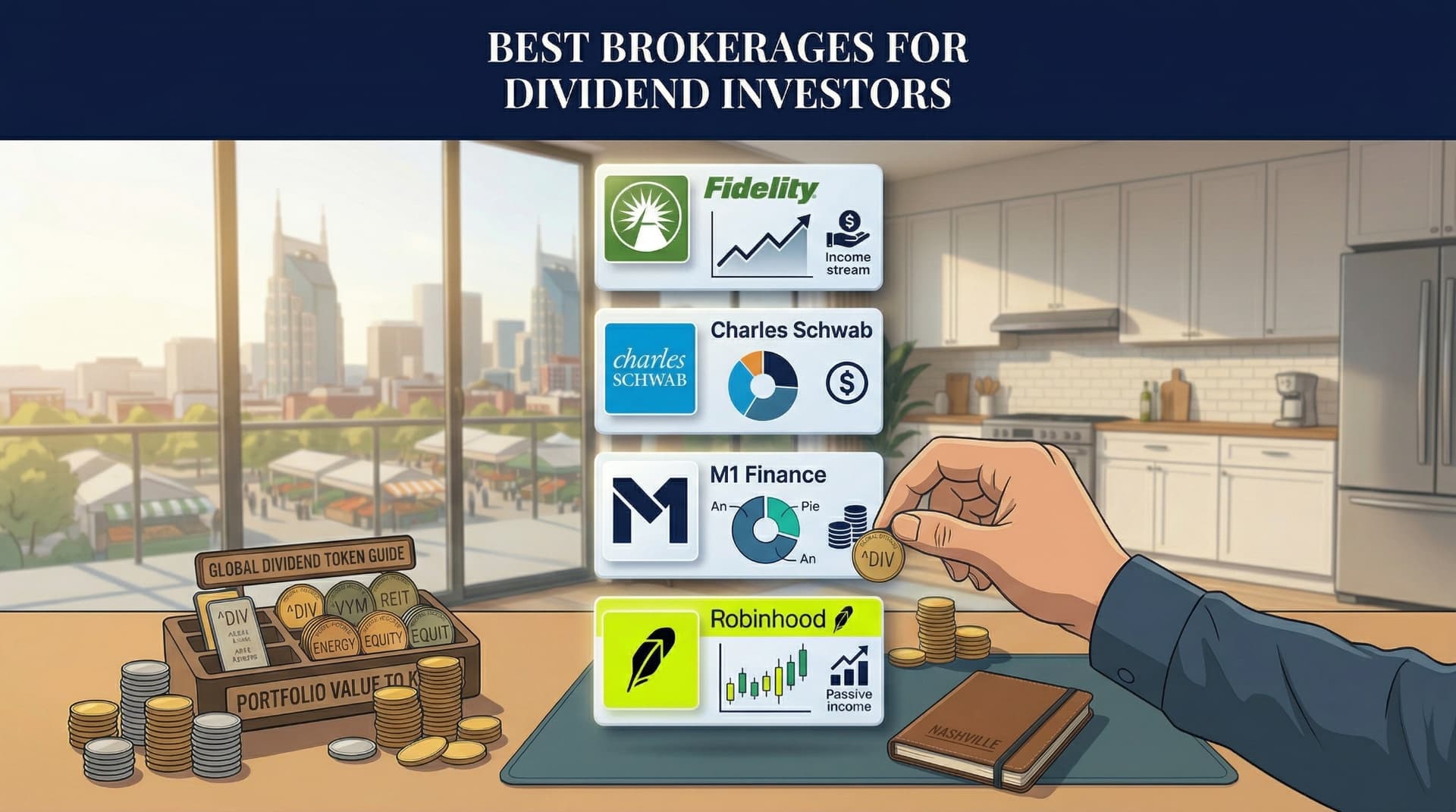
The Short Answer
The best brokerages for dividend investing are Fidelity (best DRIP and screening), M1 Finance (best for automated dividend portfolios), and Schwab (best research) — all support automatic dividend reinvestment at no extra cost.
Best Brokerages for Dividend Investors (2026 Guide)
By DadAlt Investments | Category: Stocks & Brokerages | Last Updated: March 2026
Summary
Not every brokerage is built the same for dividend investors. The features that matter most — fractional dividend reinvestment, clean 1099-DIV tax reporting, access to the best dividend ETFs, and solid IRA support — vary significantly from one platform to the next. This guide ranks and reviews the four best brokerages for dividend investors in 2026: Fidelity, Vanguard, and Schwab for overall quality and lowest cost, Charles Schwab for desktop research and screening tools, M1 Finance for fully automated portfolio-level reinvestment, and Robinhood for its industry-leading IRA contribution match. Whether you are building a SCHD-and-VYM dividend growth portfolio, stacking JEPI income in a Roth IRA providers, or just starting your first dividend account, the right brokerage makes compounding easier and more efficient.
What Dividend Investors Need That Other Investors Don't
A casual platforms for index funds investor can go to almost any major brokerage and do just fine. A dividend investor has a more specific set of requirements. Getting these right is the difference between an account that compounds on autopilot and one that constantly demands your attention.
Here is what actually matters for dividend investing:
-
Fractional DRIP — not just whole-share reinvestment. A traditional DRIP (Dividend Reinvestment Plan) that only buys whole shares will often leave cash sitting uninvested after each dividend payment. If your quarterly SCHD dividend is $47 and one share costs $28, a whole-share DRIP buys one share and leaves $19 in cash. A fractional DRIP puts the full $47 back to work. Over decades, that difference compounds meaningfully.
-
Clear 1099-DIV reporting that separates qualified from ordinary dividends. This matters more than most beginners realize. Qualified dividends (most dividends from U.S. stocks and many ETFs) are taxed at the preferential long-term capital gains rate — 0%, 15%, or 20% depending on income. Ordinary dividends (common from covered call ETFs like JEPI, and from REITs like VNQ) are taxed as regular income. A brokerage that muddies these in its tax forms costs you hours at tax time and increases the risk of errors.
-
Access to the best dividend ETFs. All major brokerages offer SCHD, VYM, VIG, JEPI, JEPQ, and VNQ commission-free. But some restrict certain ETF categories from DRIP enrollment or fractional purchase — a subtle limitation that still matters.
-
IRA support for tax-sheltered dividend income. Holding JEPI, JEPQ, or VNQ in a taxable brokerage account generates ordinary income taxed every year. Holding those same funds inside a Roth IRA means that income grows and is withdrawn tax-free. The best dividend brokerages support Roth IRAs, Traditional IRAs, and SEP IRAs with full DRIP and fractional share functionality.
-
Low or zero-commission reinvestment. Every major online brokerage now offers $0-commission DRIP reinvestment, but it is worth confirming before opening an account — some platforms still charge for certain reinvestment transactions or mutual fund purchases.
Quick Comparison: Best Brokerages for Dividend Investors (2026)
| Feature | Fidelity | Charles Schwab | M1 Finance | Robinhood |
|---|---|---|---|---|
| DRIP Available | ✅ Yes | ✅ Yes | ✅ Yes (Auto-Invest) | ✅ Yes |
| Fractional DRIP | ✅ All eligible securities | ✅ All eligible securities | ✅ Yes — into portfolio | ✅ From $1 |
| IRA Types | Roth, Traditional, SEP, Rollover | Roth, Traditional, SEP, Rollover | Roth, Traditional, SEP, Rollover | Roth, Traditional |
| IRA Contribution Match | ❌ No | ❌ No | ❌ No | ✅ 1–3% (Gold: $5/mo) |
| Dividend Screener | ✅ Basic | ✅ Advanced (thinkorswim) | ❌ No | ❌ No |
| 1099-DIV Quality | ⭐⭐⭐⭐⭐ Best in class | ⭐⭐⭐⭐ Strong | ⭐⭐⭐ Good | ⭐⭐⭐ Basic |
| Expense Ratio Funds | FZROX 0.00% | SWTSX 0.03% | ETFs only | ETFs only |
| Mutual Funds | ✅ 10,000+ | ✅ Extensive | ❌ No | ❌ No |
| Fractional Shares Min. | $1 — 7,000+ securities | $5 — S&P 500 stocks only | $1 — all holdings | $1 — stocks & ETFs |
| Account Minimum | $0 | $0 | $0 | $0 |
| Best For | Best overall; lowest cost | Research & desktop tools | Automated reinvestment | IRA match + simplicity |
Sources: Fidelity.com, Schwab.com, M1.com, Robinhood.com (March 2026) 1234
#1 Fidelity — Best Overall for Dividend Investors
Fidelity earns the top spot for dividend investors on every meaningful criterion: the broadest fractional DRIP program, the best 1099-DIV tax reporting in the industry, access to ZERO expense ratio funds with dividend components, and 24/7 customer support.
DRIP and Fractional Reinvestment
Fidelity's DRIP program covers all eligible stocks, ETFs, closed-end funds, and mutual funds, and it reinvests dividends into fractional shares automatically — meaning every dollar of dividend income goes back to work without delay. 1 With over 7,000 securities eligible for fractional shares from as little as $1, Fidelity's fractional DRIP program is the widest available among major U.S. brokerages.
To enable DRIP at Fidelity: go to Accounts → Account Features → Dividends and Capital Gains → Update, then select "Reinvest" for each eligible position.
Tax Reporting Quality
Fidelity's 1099-DIV is widely considered the most detailed and clearly organized of any major brokerage, with:
- Clean separation of qualified vs. ordinary dividends
- Itemized breakdown of Section 199A dividends (important for REIT investors)
- Capital gains distributions reported separately from dividend income
- Integrated tax tools that let you model your tax liability before year-end
For dividend investors managing a mix of SCHD (mostly qualified dividends), VNQ (ordinary income), and JEPI (ELN income classified as ordinary), clean reporting at the brokerage level saves significant time and reduces errors.
ZERO Expense Ratio Funds With Dividend Exposure
Fidelity offers the only 0.00% expense ratio index funds available to retail investors, four of which include dividend-paying components: 5
| Fund | Type | Expense Ratio | Dividend Component |
|---|---|---|---|
| FZROX | Total U.S. Market | 0.00% | Yes — includes all dividend payers |
| FZILX | International Index | 0.00% | Yes — international dividend payers |
| FNILX | S&P 500 Index | 0.00% | Yes — 500 largest U.S. dividend payers |
| FZIPX | Extended Market | 0.00% | Yes — small/mid cap dividend exposure |
One important caveat: these ZERO funds are proprietary to Fidelity and cannot be transferred in-kind to another brokerage. If you ever move accounts, they must be liquidated first. For most long-term investors this is not a material concern, but it is worth knowing.
IRA Support
Fidelity supports Roth IRA, Traditional IRA, SEP IRA, SIMPLE IRA, and Rollover IRA accounts, all with full DRIP and fractional share functionality. IRAs at Fidelity carry $0 account fees and no minimum balance requirement.
Best for: Investors who want the broadest fractional DRIP, the cleanest tax reporting, access to zero-cost index funds, or who hold both dividend ETFs and individual dividend stocks.
#2 Charles Schwab — Best for Desktop Dividend Research and Screening
Schwab is NerdWallet's pick for best online broker for IRA investors in 2026, and it earns its second-place ranking here on the strength of its research tools, dividend screener, and thinkorswim platform. 6
DRIP and Fractional Reinvestment
Schwab's DRIP program covers stocks, ETFs, closed-end funds, and mutual funds, with fractional share reinvestment available on all eligible positions. 2 To enroll, go to Accounts → Positions on Schwab.com and select "Yes" in the Reinvest column for each position. Schwab's DRIP setup is straightforward once you know where to find it, though new users sometimes find the account navigation less intuitive than Fidelity's.
One limitation: Schwab's Stock Slices fractional share program — which allows fractional purchases of S&P 500 stocks from $5 — is limited to S&P 500 components. For dividend stocks outside the S&P 500, or for ETFs, fractional shares are available in standard account reinvestment but the Stock Slices interface does not apply.
Dividend Screener via thinkorswim and Stock Hacker
This is where Schwab genuinely stands apart. The thinkorswim platform — acquired from TD Ameritrade in 2020 — includes a Stock Hacker scanning tool that lets dividend investors filter the entire market by: 7
- Dividend yield (e.g., all stocks with yield between 3% and 6%)
- Dividend growth rate (e.g., 5+ consecutive years of dividend increases)
- Payout ratio (e.g., payout ratio below 60% for sustainability screening)
- Ex-dividend date (to identify upcoming dividend capture opportunities)
- Custom fundamental criteria combined with technical filters
Schwab's built-in screener on the main website also allows filtering by dividend yield, frequency (monthly vs. quarterly), and industry sector — accessible without downloading the full thinkorswim desktop app.
This level of screening depth is not available at Fidelity, M1 Finance, or Robinhood.
Tax Reporting
Schwab's 1099-DIV reporting is strong — qualified vs. ordinary dividends are clearly separated, and cost basis tracking is accurate and detailed. Schwab does note that dividend income in DRIP accounts is still a taxable event in non-retirement accounts, even though dividends are reinvested rather than received as cash. 2
400+ Branch Locations
For investors who want occasional in-person support — especially when setting up a complex dividend portfolio, reviewing tax forms, or rolling over a 401(k) — Schwab's 400+ branch locations are a significant practical advantage.
Best for: Dividend investors who want the best research and screening tools, including thinkorswim's Stock Hacker for filtering dividend stocks by yield, growth rate, and payout ratio. Also ideal for investors who want branch access.
#3 M1 Finance — Best for Automated Dividend Portfolios
M1 Finance is the most distinctive platform on this list. It is not a traditional brokerage — it occupies a middle ground between a self-directed brokerage and a robo-advisor. You choose your investments; M1 automates the buying, rebalancing, and dividend reinvestment.
For a dividend investor who wants to build a set-and-forget SCHD + VYM + VNQ (or any custom combination) portfolio with zero ongoing maintenance, M1 Finance is unmatched.
How M1's Dividend Reinvestment Works
M1's reinvestment system works differently from a traditional DRIP and, for many investors, works better. 89
When you build a portfolio at M1 — called a "Pie" — you assign target percentages to each holding. For example:
- 40% SCHD
- 30% VYM
- 20% VIG
- 10% JEPI
When dividends are paid into your account, M1 does not simply buy more of the security that paid the dividend. Instead, it routes the dividend cash to whichever holdings in your Pie are most underweight relative to their target allocation. This is portfolio-level dynamic rebalancing — the dividend itself becomes the rebalancing event.
The effect is powerful: your portfolio stays close to your target allocation automatically, without you ever having to sell an overweight position or manually direct cash. This is a fundamentally better form of rebalancing than selling winners — it avoids triggering taxable events in taxable accounts.
M1 also now supports traditional DRIP — you can choose to have dividends from a specific holding reinvested back into that same holding, rather than going into the broader Pie. 9
Dividend reinvestment settings at M1:
- Invest (default) — Dividends are added to your cash balance and reinvested into underweight Pie positions when balance reaches $25
- M1 DRIP — Dividends from each security are reinvested back into that same security (traditional DRIP style)
- Earn — Dividends are swept to M1's high-yield cash account, currently earning 3.10% APY 10
Dividend Dashboard
M1 has significantly upgraded its dividend tracking tools in recent years. The dedicated dividend dashboard shows: 8
- Upcoming dividends with ex-dividend and pay dates
- Estimated annual dividend income
- Dividend yield and yield on cost
- Month-by-month projected dividend income chart
- Confirmed vs. estimated payment status
For investors tracking income from a multi-ETF dividend portfolio, this is the best dividend income visualization tool available among the platforms on this list.
Limitations
M1 Finance has meaningful limitations that disqualify it as the top pick:
- No real-time trading. M1 executes trades in one or two daily batch windows (morning and afternoon). You cannot place a market order immediately during the trading day. For long-term dividend ETF investors this rarely matters, but it is a real constraint.
- $100 ACAT transfer-out fee. Moving your account to another brokerage costs $100. Compare this to $0 at Fidelity.
- No mutual funds. Dividend mutual funds are not available.
- Limited fundamental research. There are no built-in screeners for evaluating individual dividend stocks by payout ratio, yield, or dividend history.
- IRA maintenance fee. Retirement accounts carry a $3/month fee, waived if you maintain $10,000 or more in total M1 assets. 11
Best for: Dividend investors who want a fully automated, set-and-forget portfolio with intelligent dividend reinvestment and automatic rebalancing — particularly for an ETF-only dividend strategy like SCHD + VYM + VIG + JEPI.
#4 Robinhood — Best for IRA Match + Simple Dividend Investing
Robinhood rounds out this list not for the depth of its dividend tools, but for one feature that no other brokerage offers at the same level: an IRA contribution match that puts free money directly into your retirement account.
IRA Contribution Match — How It Works in 2026
Robinhood's IRA match program is the only one of its kind among major retail brokerages: 412
- Without Robinhood Gold: 1% match on all annual IRA contributions
- With Robinhood Gold ($5/month): 3% match on all annual IRA contributions, up to the contribution limit
For a dividend investor maxing out a Roth IRA in 2026 at $7,500:
- 1% match = $75 free
- 3% match (Gold) = $225 free
The match is deposited into your Robinhood IRA and is available to invest immediately. To keep the full Gold match, you must maintain a Robinhood Gold subscription for at least 12 months and keep the matched funds in the IRA for at least 5 years. 12
Additionally, through April 30, 2026, Robinhood Gold subscribers earn a 2% match on IRA transfers and 401(k) rollovers (in addition to the standard 3% on annual contributions). This is a limited-time promotion. 4
Why this matters for dividend investors: A Roth IRA is the ideal account for holding high-income dividend ETFs like JEPI (8%+ yield, ordinary income), JEPQ, and VNQ (REIT income, ordinary income). These funds generate income that is taxed as ordinary income in a taxable account every single year. Inside a Roth IRA, that income compounds tax-free and is withdrawn tax-free in retirement. Getting a 3% bonus on every Roth IRA contribution — on top of that tax benefit — is a meaningful long-term advantage.
DRIP and Fractional Shares
Robinhood offers DRIP on eligible stocks and ETFs with fractional share reinvestment from $1. To enable it, go to Account (person icon) → Investing → Dividend Reinvestment and toggle on the positions you want enrolled.
Robinhood's fractional share program covers stocks and ETFs from $1, accessible during normal trading hours (9:30 AM – 4:00 PM ET). Fractional orders are not available during extended hours trading.
Limitations
Robinhood has real limitations for serious dividend investors:
- No mutual funds. This is a hard cap on its usefulness for dividend investors who want funds like Fidelity's mutual fund lineup.
- No dividend screener. There are no tools to filter stocks or ETFs by dividend yield, payout ratio, or growth rate.
- Limited research. Fundamental data is basic compared to Fidelity or Schwab.
- $100 ACAT transfer-out fee. One of the highest transfer-out fees in the industry. 6
- Roth and Traditional IRA only. No SEP IRA or SIMPLE IRA support.
Best for: Dividend investors who primarily want a Roth IRA for high-income ETFs (JEPI, JEPQ, VNQ) and want to capture the 1–3% IRA contribution match. Also suitable as a secondary account to complement a primary account at Fidelity or Schwab.
What to Look for in a Dividend Brokerage
Before choosing a platform, run through these four questions:
1. What is the DRIP quality? Does the brokerage reinvest dividends into fractional shares automatically, or only whole shares? A whole-share DRIP leaves residual cash uninvested — not ideal for compounding. Fidelity, Schwab, M1, and Robinhood all offer fractional dividend reinvestment.
2. How clear is the tax reporting? For dividend investors, the 1099-DIV is the most important tax document you will receive annually. You need it to clearly separate qualified dividends (taxed at 0/15/20%) from ordinary dividends (taxed as income) and from Section 199A REIT distributions. Fidelity leads on this. If you hold SCHD, JEPI, and VNQ in the same account, clean reporting matters.
3. Can you hold the best dividend ETFs in an IRA? All four brokerages on this list support SCHD, VYM, VIG, JEPI, JEPQ, and VNQ in both taxable accounts and IRAs. However, if you want mutual fund dividend income strategies (e.g., Fidelity Equity Dividend Income Fund, FDGFX), only Fidelity and Schwab support mutual funds.
4. Are there screening tools to evaluate individual dividend stocks? If you want to complement ETFs with individual dividend stocks — Realty Income (O), Johnson & Johnson (JNJ), Coca-Cola (KO) — you need a screener to evaluate yield, payout ratio, and dividend history. Only Schwab (via thinkorswim and Stock Hacker) offers serious screening tools for this purpose among the four platforms reviewed here.
Best Dividend ETFs Available at All Four Brokerages
All four brokerages on this list offer commission-free access to every major dividend ETF. Here is a quick reference guide organized by strategy:
Dividend Growth — Tax-Efficient in Taxable Accounts
These ETFs pay mostly qualified dividends and are appropriate for taxable brokerage accounts or Roth IRAs.
| ETF | Strategy | Yield (approx.) | Expense Ratio | Dividend Frequency |
|---|---|---|---|---|
| SCHD | Dow Jones Dividend 100 — quality screen | ~3.5–4.0% | 0.06% | Quarterly |
| VYM | FTSE High Dividend Yield Index — 500+ stocks | ~2.4–3.0% | 0.06% | Quarterly |
| VIG | 10+ years consecutive dividend growth | ~1.6–1.8% | 0.05% | Quarterly |
Sources: 24/7 Wall St. (December 2025), DividendPro.io (March 2026) 1314
SCHD is widely regarded as the best all-around dividend ETF for 2026 — a yield of approximately 3.5–4.0%, a 0.06% expense ratio, and 10+ consecutive years of dividend payments required for inclusion. 14 VYM offers broader diversification (500+ stocks vs. SCHD's 100) with a similar expense ratio and slightly lower yield. VIG prioritizes dividend growth rate over current yield — lower payout today, faster-growing income over time.
High-Income / Covered Call — Best in Tax-Advantaged Accounts
These ETFs generate high current income through options strategies (equity-linked notes or covered calls), but the income is classified as ordinary income, not qualified dividends. They are most efficient inside a Roth IRA or Traditional IRA where that ordinary income is either sheltered or deferred.
| ETF | Strategy | Yield (approx.) | Expense Ratio | Dividend Frequency |
|---|---|---|---|---|
| JEPI | S&P 500 + covered call ELNs | ~8% | 0.35% | Monthly |
| JEPQ | Nasdaq 100 + covered call ELNs | ~9–10% | 0.35% | Monthly |
Source: 24/7 Wall St. (December 2025) 13
JEPI and JEPQ both pay monthly, making them popular for investors building an income calendar. The trade-off is capped upside in strong bull markets — the covered call strategy limits participation in large price gains. In a Roth IRA, that 8%+ monthly yield compounds completely tax-free.
REIT Income — Best in Tax-Advantaged Accounts
REIT dividends are classified as ordinary income (they are required to distribute 90%+ of taxable income as dividends). Like JEPI/JEPQ, they belong in tax-advantaged accounts for maximum efficiency.
| ETF | Strategy | Yield (approx.) | Expense Ratio | Dividend Frequency |
|---|---|---|---|---|
| VNQ | Vanguard Real Estate ETF — diversified U.S. REITs | ~3.5–4.5% | 0.13% | Quarterly |
Holding VNQ in a taxable brokerage account creates ordinary income tax liability every quarter. Holding it in a Roth IRA eliminates that entirely.
See also: passive income strategies with ETFs in 2026](/article/passive-income-with-etfs) — a full breakdown of building a dividend ETF income calendar with SCHD, JEPI, and VNQ.
The Tax Efficiency Decision: Which Dividend ETFs Go Where
This single decision — which accounts hold which dividend ETFs — can be worth thousands of dollars per year in saved taxes over a lifetime of dividend investing. Here is the framework:
Put in a Roth IRA (or Traditional IRA):
- JEPI and JEPQ (ordinary income — sheltered from annual tax drag)
- VNQ and other REIT ETFs (ordinary income — sheltered from annual tax drag)
- Any high-yield covered call ETF
Put in a Taxable Brokerage Account:
- SCHD (mostly qualified dividends — taxed at 0/15/20%, not ordinary income rates)
- VYM (mostly qualified dividends)
- VIG (mostly qualified dividends, lower yield, very tax-efficient)
- VTI / VOO (broad market — includes dividend-payers, mostly qualified)
The dividend growth ETFs (SCHD, VYM, VIG) are relatively tax-efficient in taxable accounts because their dividends are largely qualified. The high-income ETFs (JEPI, JEPQ, VNQ) generate ordinary income that is taxed every year in a taxable account — a drag that compounds negatively over time.
Frequently Asked Questions
Which brokerage has the best DRIP program for dividend investors?
Fidelity has the broadest and most seamless DRIP program — covering 7,000+ securities with fractional reinvestment on all eligible positions from $1. M1 Finance has the most intelligent DRIP system for ETF portfolios, routing dividend cash to underweight positions automatically. For most dividend investors, Fidelity is the default choice; M1 is the better fit if you want complete hands-off automation.
Can I hold dividend ETFs and individual dividend stocks in a Roth IRA?
Yes, at all four brokerages on this list. SCHD, VYM, VIG, JEPI, JEPQ, VNQ, and individual dividend stocks like Coca-Cola, Realty Income, and Johnson & Johnson can all be held in a Roth IRA at Fidelity, Schwab, M1, and Robinhood. Note that M1 does not charge commissions on Roth IRA trades, but applies a $3/month maintenance fee waived above $10,000 in total M1 assets. 11
What is the best brokerage for monthly dividend income?
Robinhood or Fidelity, depending on your goals. JEPI and JEPQ both pay monthly at approximately 8–10% yield and are available commission-free at all major platforms. If your goal is building a monthly income calendar — staggering quarterly payers (SCHD, VYM) with monthly payers (JEPI, JEPQ) — any of the four brokerages work. Robinhood is the simplest platform for this; Fidelity has the cleanest tax reporting for mixed-income portfolios.
How do I track dividend income across multiple accounts?
M1 Finance has the best built-in dividend income dashboard among these four platforms — it shows projected monthly income, upcoming pay dates, yield on cost, and historical payments. For investors with accounts across multiple brokerages, third-party tools like Dividend.com, Simply Safe Dividends, or DividendPro are worth exploring for consolidated tracking.
Sources and References
Disclosure: This article is for informational purposes only and does not constitute financial or tax advice. DadAlt Investments may receive compensation through affiliate relationships with the brokerages and platforms mentioned. Dividend yields, expense ratios, and platform features are subject to change. Always verify current rates and features directly with the brokerage before opening an account. Consult a qualified tax advisor regarding dividend tax treatment in your specific situation.
Recommended Reading
- How to Build a Dividend Portfolio as a Beginner Dad
- Top Stock Brokerages for New Investors
- Fidelity vs Vanguard vs Schwab: Which Is Best?
Footnotes
-
Fidelity. Dividends and Capital Gains. Fidelity.com — Fractional DRIP availability, 7,000+ securities from $1, DRIP setup instructions, IRA account types. https://www.fidelity.com/learning-center/smart-money/how-to-open-a-brokerage-account ↩ ↩2
-
Charles Schwab. Dividend Reinvestment Plan (DRIP) — Stocks Dividend Reinvestment Plan. Schwab.com — DRIP enrollment steps, fractional reinvestment availability, tax implications of DRIP in taxable accounts. https://www.schwab.com/stocks/dividend-reinvestment-plan ↩ ↩2 ↩3
-
M1 Finance. Dividend Investing — Put Your Dividends to Work. M1.com — DRIP options (Invest, M1 DRIP, Earn), dividend dashboard features, 3.10% APY on Earn account. https://m1.com/invest/dividend-investing/ ↩
-
Robinhood. Robinhood Gold IRA companies Transfer Bonus. Robinhood.com — 3% Gold IRA contribution match, 2% transfer bonus through April 30, 2026, match retention requirements. https://robinhood.com/us/en/support/articles/ira-gold-match-2026/ ↩ ↩2 ↩3
-
Fidelity. ZERO expense ratio index funds. Fidelity.com — FZROX, FZILX, FNILX, FZIPX at 0.00% expense ratio, dividend reinvestment availability, portability caveat. https://www.fidelity.com/mutual-funds/fidelity-funds/zero-expense-ratio-index-funds ↩
-
NerdWallet. Best Brokers for Dividend Investing: 2026 Top Picks. Updated February 17, 2026 — NerdWallet names Schwab best IRA broker 2026; Robinhood $100 ACAT transfer fee noted. https://www.nerdwallet.com/investing/best/drip-brokers-for-dividend-investing ↩ ↩2
-
Charles Schwab. thinkorswim Desktop — Stock Hacker Scan Tab. Schwab.com — Stock Hacker tool, 400+ technical studies, fundamental filters including dividend yield and growth rate. https://www.schwab.com/trading/thinkorswim/desktop; https://www.schwab.com/learn/story/how-to-use-thinkorswim-scan-tab ↩
-
RetireBeforeDad.com. M1 Finance Review 2026: A Top Broker for Long-Term Investors. Updated January 26, 2026 — M1 dividend dashboard features, Auto-Invest mechanics, dividend pie strategy, $12 billion in client assets. https://www.retirebeforedad.com/m1-finance-review/ ↩ ↩2
-
M1 Finance Help Center. Dividend Handling. M1.com — Three dividend handling modes: Invest, M1 DRIP, Earn; $1 minimum for reinvestment; traditional DRIP into same security now available. https://help.m1.com/en/articles/9437743-dividend-handling ↩ ↩2
-
M1 Finance. Dividend Investing — Earn Account. M1.com — Dividends swept to high-yield cash account earning 3.10% APY (taxable accounts only; not available in IRAs). https://m1.com/invest/dividend-investing/ ↩
-
TraderHQ.com. M1 Finance Review 2026: Automated Investing Worth It? Updated February 7, 2026 — IRA $3/month maintenance fee, waived above $10,000; account types; $100 ACAT fee. https://traderhq.com/m1-finance-review-automated-investing-robo-advisor/ ↩ ↩2
-
Robinhood. IRA Match FAQ. Robinhood.com — 2026 IRA contribution limits: $7,500 under 50 / $8,600 age 50+; 1% match without Gold; 3% with Gold ($5/month); 5-year asset retention requirement; 12-month Gold subscription requirement. https://robinhood.com/us/en/support/articles/ira-match-faq/ ↩ ↩2
-
24/7 Wall St. 3 Dividend ETFs Better Than SCHD. December 22, 2025 — VIG yield 1.57%, expense ratio 0.05%, 5-year return 76.50%; VYM yield 2.39%, 5-year return 89.08%; JEPI yield 8.21%, monthly payments. https://247wallst.com/investing/2025/12/22/3-dividend-etfs-better-than-schd/ ↩ ↩2
-
DividendPro.io. Best Dividend ETFs for Passive Income in 2026: SCHD vs VYM vs NOBL & More. March 2026 — SCHD ~3.5% yield, 0.06% expense ratio, described as best all-around dividend ETF for 2026. https://www.dividendpro.io/blog/best-dividend-etfs-passive-income-2026 ↩ ↩2
Frequently Asked Questions
Which brokerage has the best dividend reinvestment plan?
Fidelity offers fractional-share DRIP on all stocks and ETFs, meaning every cent of your dividend gets reinvested. M1 Finance automates this across your entire portfolio with its 'pie' system.
Do I pay taxes on reinvested dividends?
Yes — reinvested dividends are still taxable income in taxable accounts. In a Roth IRA, dividends grow tax-free. This is why holding dividend stocks in tax-advantaged accounts is often the smarter move.
How do I screen for good dividend stocks?
Look for Dividend Aristocrats (25+ years of increases), payout ratios below 60%, and yields between 2–5%. All three brokerages offer free stock screeners to filter by these criteria.

About the Author
Jared DeValk
Founder, DadAlt Investments
Father, alternative investment researcher, and founder of DadAlt Investments. 14+ years turning hard lessons into honest guidance for dads building real wealth.